Septic system care comes down to four habits: pump the tank every 3 to 5 years, have it inspected regularly, keep anything but human waste and toilet paper out of it, and protect the drainfield. Do those, and a septic system can quietly serve a home for decades. Skip them, and you risk sewage backups, a failed drainfield and a repair bill that the EPA puts at $3,000 to $7,000 or more (EPA SepticSmart homeowner guide).
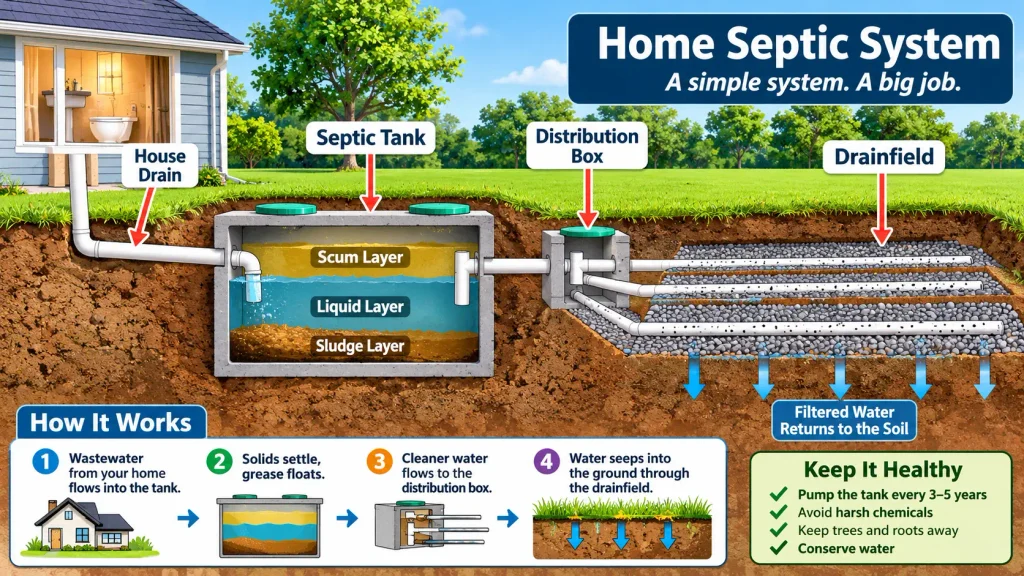
This guide covers everything a homeowner needs to know: how the system works, when to pump, what is safe to flush and pour, how to protect the drainfield, the warning signs of trouble, and the rules that apply to septic systems. Each section links to a detailed guide when you need more.
Septic System Care Checklist
| Task | How often | More detail |
|---|---|---|
| Have the system inspected by a septic professional | Every 1 to 3 years (yearly for systems with pumps or other mechanical parts) | Pumping and inspection |
| Pump the septic tank | Every 3 to 5 years for most homes | How to empty a septic tank |
| Flush only human waste and toilet paper | Always | What not to flush |
| Fix leaking toilets and faucets | As soon as you notice | Fix a running toilet |
| Spread laundry loads through the week | Every week | Saving water (below) |
| Keep cars, sheds and trees off the drainfield | Always | Roots in the drainfield |
| Keep a record of pumping and repairs | After every service | Records (below) |
How a Septic System Works
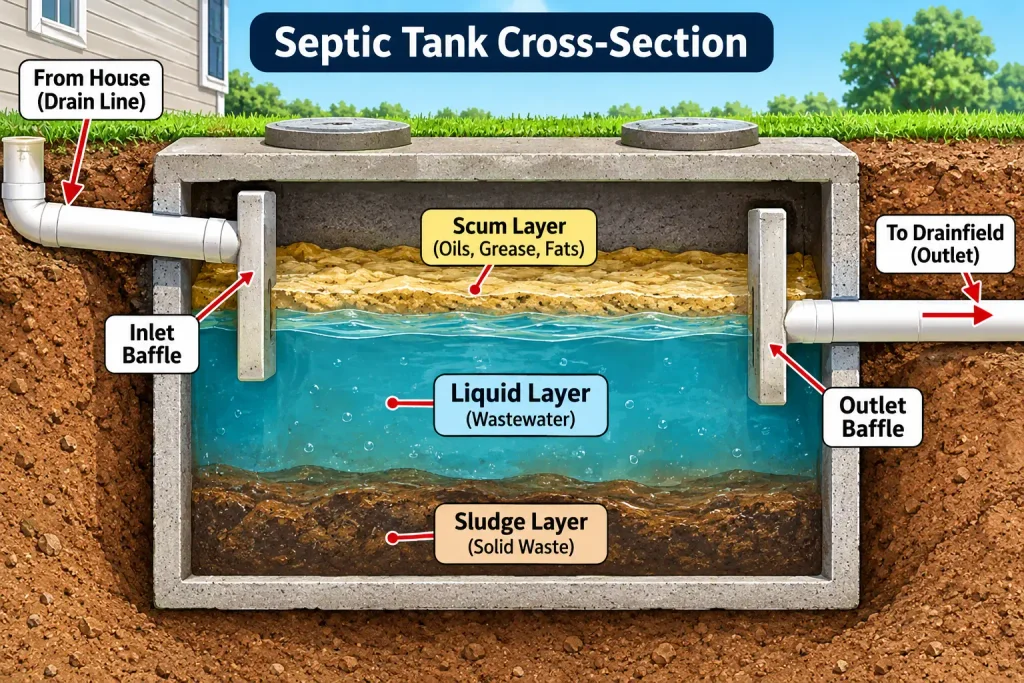
All the wastewater from your home leaves through one main drain pipe and flows into the septic tank, a buried watertight container usually made of concrete, fiberglass or polyethylene (EPA SepticSmart homeowner guide). Inside the tank, the waste separates into three layers:
- Scum on top: grease, oils and anything lighter than water.
- Liquid in the middle, called effluent.
- Sludge on the bottom: solids that sink and are slowly broken down by bacteria.
Baffles or tees at the inlet and outlet keep the scum and sludge in the tank while the liquid flows out to the drainfield, a network of perforated pipes laid in gravel trenches under your lawn. The liquid seeps into the soil, which naturally removes harmful bacteria, viruses and nutrients. If the drainfield gets overloaded with water or clogged with solids, it floods, and sewage can come up to the surface or back up into the house.
That is why almost every rule of septic care is about two things: keeping solids from building up in the tank, and keeping too much water or solid material from reaching the drainfield.
Common Types of Septic Systems
Most homes have a conventional system, but poor soil, a high water table or a small lot often call for something different. Knowing your type matters, because systems with pumps, blowers or timers need more frequent inspection. The main types, as described by the EPA (EPA):
| Type | How it works | Where it is used |
|---|---|---|
| Conventional | Tank feeds a gravel or stone trench drainfield where soil microbes finish treatment | Most single-family homes with suitable soil |
| Chamber | Connected plastic chambers replace the gravel in the drainfield | Areas with high groundwater or little gravel; easier to install |
| Mound | Effluent is pumped into a raised sand mound before it reaches the native soil | Shallow soil, high groundwater or shallow bedrock |
| Aerobic treatment unit (ATU) | Air is pumped into the tank to boost the bacteria that treat the wastewater | Small lots, poor soils, or homes near lakes and streams |
| Drip distribution | Timed doses of effluent flow through drip lines in the topsoil | Sites where a mound would otherwise be needed; requires power |
| Recirculating sand filter | Effluent is pumped through a sand filter for extra treatment | High water tables or sites near water; costs more |
If your system has an alarm, a pump or a blower, test the alarm and have the parts checked yearly. Your county health department can usually tell you which type was permitted for your property.
Pumping and Inspection
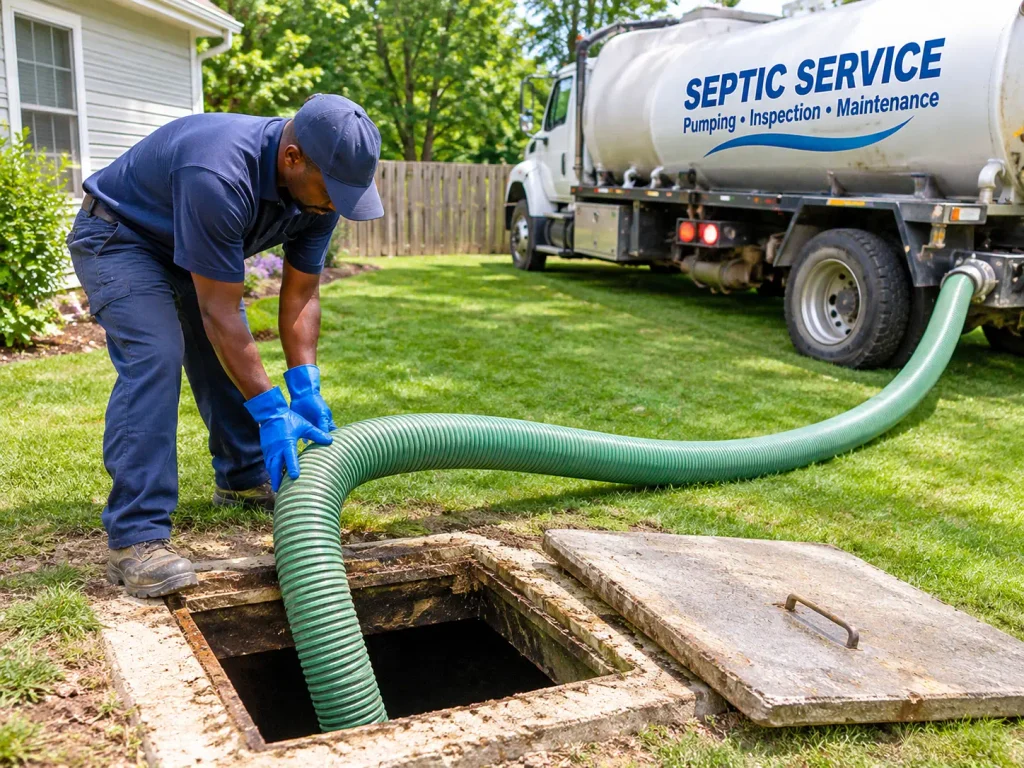
The EPA recommends that a typical household septic system be inspected every 1 to 3 years and pumped every 3 to 5 years (EPA). Systems with electrical floats, pumps or other mechanical parts should be inspected about once a year. Your exact schedule depends on:
- The number of people in the home
- How much wastewater you produce
- How much solid material goes in (garbage disposals add a lot)
- The size of your tank
During an inspection, the technician measures the scum and sludge layers. The EPA’s guide says to pump when the bottom of the scum layer is within 6 inches of the bottom of the outlet, or the top of the sludge layer is within 12 inches of the outlet (EPA SepticSmart homeowner guide).
Pumping is not a DIY job: it takes a vacuum truck, and the waste has to go to a licensed disposal site. A standard 1,000-gallon tank typically costs $300 to $600 to pump. Our guide to emptying a septic tank covers costs, what happens during the visit and how to find a good service. If your drains are already backing up, skip ahead to what to do when your septic tank is full.
Septic additives do not replace pumping
Store shelves are full of products that promise to “break down” waste and reduce pumping. The EPA says additives can be ineffective or even harm the system, and that periodic pumping is the only true way to keep a septic system working properly (EPA). There are a few situations where a bacterial treatment may help; our review of whether septic tank treatments work explains them.
What Goes Down the Drain
The EPA’s rule is simple: do not flush anything besides human waste and toilet paper (EPA SepticSmart homeowner guide). Everything else either does not break down or kills the bacteria the tank depends on.
Never flush
- “Flushable” wipes, baby wipes and paper towels
- Feminine hygiene products and condoms
- Dental floss and cotton swabs
- Diapers and cat litter
- Coffee grounds and cigarette butts
- Medications
- Household chemicals, paint and solvents
See the full list, and why each one causes trouble, in what not to flush if you have a septic tank.
Toilet paper
All toilet paper eventually breaks down, but some breaks down far faster than others. Thinner, single-ply and “septic-safe” papers are the safest bet. Our guide to the best toilet paper for septic systems compares brands and shows a simple jar test you can do at home.
Grease, oil and food
Never pour cooking oil or grease down the drain. It floats into the scum layer and can clog the outlet and the drainfield. Use your garbage disposal sparingly or not at all: the EPA notes that frequent disposal use significantly increases the buildup of sludge and scum (EPA SepticSmart homeowner guide). Scrape plates into the trash or compost instead.
Cleaning products and bleach
Normal household cleaning is fine. Problems come from large amounts at once. A 1987 University of Arkansas study found that it took roughly 1.85 gallons of liquid bleach in a 1,000-gallon tank to kill the bacteria, and even then they recovered within about 30 hours. Our guide to whether bleach is safe for septic tanks covers safe amounts and products to avoid, such as bleach tablets that sit in the toilet tank.
Drain cleaners
Skip chemical drain openers. The EPA suggests boiling water or a drain snake instead (EPA SepticSmart homeowner guide). Our guide to unclogging a drain without chemicals covers five safe methods.
Save Water to Protect the Drainfield
Every gallon that goes down the drain has to be treated by the drainfield. The EPA estimates that a typical home uses nearly 70 gallons of water per person per day indoors, and that a single leaking toilet can waste as much as 200 gallons a day (EPA SepticSmart homeowner guide). Too much water in a short time stirs up solids in the tank and can push them into the drainfield.
- Fix leaks fast. A running toilet or a dripping faucet sends a constant trickle into the tank.
- Spread out laundry. Doing every load on one day floods the system. Run one or two loads a day instead, and use a high-efficiency washer if you can.
- Use efficient fixtures. Older toilets use 3.5 to 5 gallons per flush; newer high-efficiency models use 1.6 gallons or less.
- Keep extra water out. Never drain a hot tub or pool into the septic system. Large amounts of water stir the solids in the tank and can push them into the drainfield.
Protect the Drainfield
The drainfield is the most expensive part of the system to replace, and the easiest to damage without realizing it. The EPA’s advice (EPA SepticSmart homeowner guide):
- Never park or drive on it. The weight crushes pipes and compacts the soil so water cannot soak in.
- Do not build on it. No sheds, patios, pools or play sets.
- Plant trees and shrubs well away from it. Roots seek out the water and nutrients in the pipes. If roots are already a problem, see how to kill roots in a septic tank and drainfield.
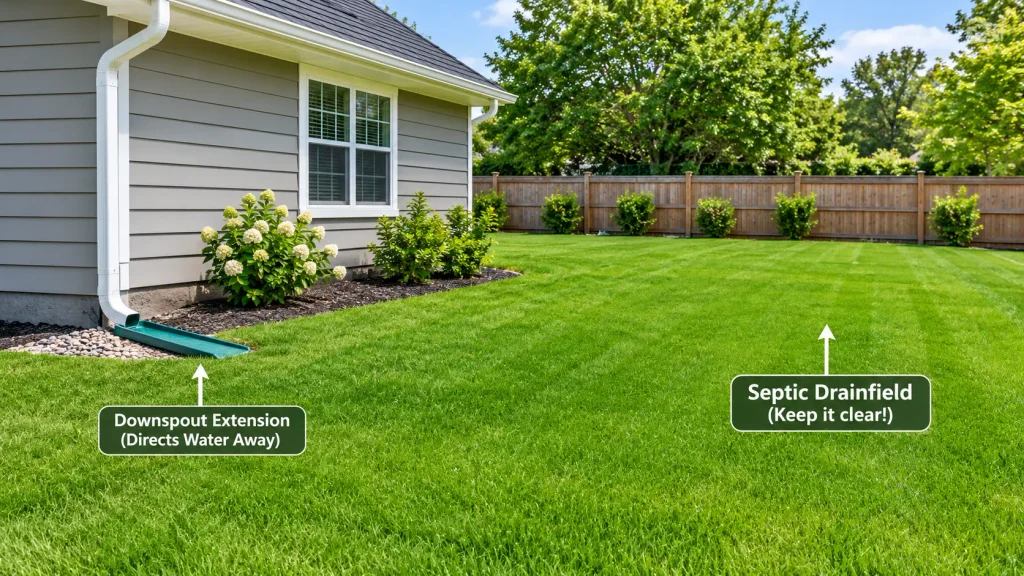
- Divert water. Keep roof drains, sump pumps and other rainwater drainage pointed away from the drainfield.
- Plant only grass over the drainfield. It holds the soil in place and uses some of the moisture.
Water Softeners and Septic Systems
The EPA notes that water softeners and purification systems can send hundreds of gallons of water to a septic tank (EPA SepticSmart homeowner guide). If you have hard water and a septic system, choose a softener with efficient demand-initiated or metered regeneration, which uses less water than one that regenerates on a timer. Our guide to the best water softeners notes which models do this.
Warning Signs of Septic Trouble
The EPA lists these signs of a failing system (EPA SepticSmart homeowner guide):
- Wastewater backing up into household drains
- Bright green, spongy grass over the drainfield, even in dry weather
- Pooling water or muddy soil around the tank, drainfield or in the basement
- A strong sewage odor around the tank or drainfield
Slow drains throughout the house and gurgling pipes are also early signs. A bad smell is not always the first symptom, so do not wait for one.
What to do
- Cut water use right away: no laundry, dishwasher or long showers.
- Follow our septic tank is full checklist and call a septic service.
- If several drains back up but the tank was pumped recently, the problem may be a blocked line between the house and the tank; see the signs of a main sewer line clog.
- Keep people and pets away from any sewage on the ground, and do not try to open the tank yourself: septic tanks contain toxic gases.
How Long Does a Septic System Last?
It depends mostly on the tank material and how well it is maintained. Concrete tanks commonly last 25 to 40 years, fiberglass 30 to 40, plastic 20 to 30, and older steel tanks 15 to 20. The drainfield’s life depends on soil, use and care. Regular pumping is the single biggest factor in how long both last. Our guide to how long a septic tank lasts covers each material and the signs that replacement is near.
Septic Rules, Permits and Selling a Home
Septic systems are regulated by your state and usually enforced by your county health department. Installing, replacing or enlarging a system almost always requires a permit and an inspection, and some areas require regular inspections or pumping records. Cesspools and “straight pipes” that discharge untreated sewage are illegal in most places, and a failing system that is reported usually comes with a deadline to fix it.
Fines and enforcement vary widely by state. Our state-by-state guide to illegal septic system penalties lists the rules and typical fines where you live.
If you are buying or selling a home with a septic system, expect a septic inspection to be part of the deal; many buyers and lenders ask for one. Having up-to-date pumping and inspection records makes the sale smoother.
Septic Care Through the Year
- Spring: after the thaw, walk the drainfield and look for wet spots, sewage smells or unusually green patches. Clean gutters and check that downspouts drain away from it.
- Summer: guests and outdoor living mean more water use. Space out laundry, and do not let anyone drive or park on the drainfield for parties.
- Fall: a good time to schedule pumping before the ground freezes, when lids are easier to dig up.
- Winter: snow insulates the system, so do not plow or pack it down over the tank and drainfield. Fix leaking fixtures, because a slow trickle can freeze in exposed pipes. Keep vehicles off frozen ground over the system.
Septic Safety
- Never go into a septic tank or lean into the opening. Tanks contain gases such as hydrogen sulfide and methane that can overcome a person in seconds.
- Keep lids secure. A loose or cracked lid is a serious fall hazard for children and pets. Replace damaged lids right away.
- No flames or sparks near an open tank, because the gases can be flammable.
- Stay away from surfacing sewage and keep children and pets off wet areas over the drainfield until the problem is fixed.
Keep a Septic Record
Keep one folder or note with:
- A simple sketch showing where the tank lid and drainfield are
- The tank size and material, if you know them
- Every pumping and inspection: date, company, and what they found
- Any repairs, and the permit number for the system if you have it
It saves time for the next technician, helps you stick to the schedule, and is exactly what a buyer’s inspector will ask for.
Moving Into a Home With a Septic System?
- Ask the seller for pumping and inspection records, the permit, and a site plan showing the tank and drainfield.
- Have the system inspected and the tank pumped as part of the purchase if it has not been done recently.
- Find and mark the tank lid and drainfield, so nobody plants trees or builds over them.
- Learn your system type and whether it has an alarm, pump or filter that needs regular attention.
- Set a reminder for the next pumping, and keep this guide and our what not to flush list handy for everyone in the house.
Septic Myths That Cost Homeowners Money
- “If I use an additive, I never need to pump.” The EPA is clear that pumping, not additives, is what keeps a tank working (EPA). Solids that bacteria cannot digest build up no matter what you add.
- “If it does not smell, it is fine.” A foul odor is not always the first sign of trouble, according to the EPA. Slow drains, gurgling and soggy spots in the yard often come first.
- “Flushable wipes are safe.” They do not break down the way toilet paper does, and they are one of the most common causes of clogged septic lines. See what not to flush.
- “Any bleach will kill my septic tank.” Normal cleaning and laundry use is fine; it takes gallons at once to harm the bacteria. Our bleach and septic guide has the numbers.
- “A septic system lasts forever.” Tanks and drainfields wear out, and neglect shortens their life dramatically. Planning for eventual replacement, and maintaining the system to push that date back, is part of owning one.
- “Pumping is only needed when there is a problem.” By the time drains back up, solids may already have reached the drainfield, which is the expensive part to fix. Pump on a schedule, not in an emergency.
Frequently Asked Questions
How do I find my septic tank?
Check your property records or ask your county health department, which often has the permit and a site plan. You can also follow the main drain pipe where it leaves the house; the tank is usually 10 to 25 feet away in that direction. A septic service can locate it with a probe or a camera if needed.
Can I use a garbage disposal with a septic system?
You can, but sparingly. Food waste adds solids that make the tank fill faster, so homes that use a disposal heavily usually need more frequent pumping.
Do I need to add yeast or bacteria to my septic tank?
No. Human waste supplies all the bacteria a healthy tank needs. The EPA says additives can be ineffective or even harmful (EPA).
What does a new septic system cost?
The EPA’s homeowner guide puts repair or replacement at $3,000 to $7,000 (EPA SepticSmart homeowner guide), but that guide dates from 2015, and complex systems or poor soils can cost far more today. Routine maintenance is the cheapest way to avoid that bill.
Can I use water normally right after the tank is pumped?
Yes. The tank refills with normal use over the following days, and the bacteria re-establish themselves from household waste. There is no need to add anything to “restart” it.
Can heavy rain affect my septic system?
Yes. A saturated drainfield cannot absorb more water, so drains may slow down during long wet spells. Cut back on water use until the ground dries out, and make sure gutters and sump pumps are not draining toward the drainfield.
Your Septic Care Plan in Three Steps
- Find out when the tank was last pumped. If it has been more than 3 years, or you do not know, book an inspection and pumping.
- Set the house rules. Only human waste and toilet paper in the toilet; no grease down the sink; laundry spread through the week.
- Walk the drainfield. Move anything parked on it, redirect downspouts, and note any trees close to the lines.
That is most of what keeps a septic system working for decades.
About HomePlumbing101
HomePlumbing101 turns manufacturer manuals, product specifications and public guidance from sources like the U.S. EPA and Department of Energy into plain, step-by-step help for homeowners. Every guide flags the jobs that need a licensed plumber. We are an information site only and do not offer plumbing or HVAC services. More about how we write our guides.