Bleach is one of the most common household cleaning products. If you have a septic system, you have probably wondered whether using it puts your tank at risk.
The answer is not a simple yes or no. It depends on how much bleach enters the system, how often, and in what form. Getting this wrong in either direction causes problems — either you unnecessarily avoid a useful cleaning product, or you damage the bacterial ecosystem your tank depends on.
This guide gives you a clear, specific answer for every common bleach use scenario in the home.
Is Bleach Safe for Septic Tanks? The Quick Answer
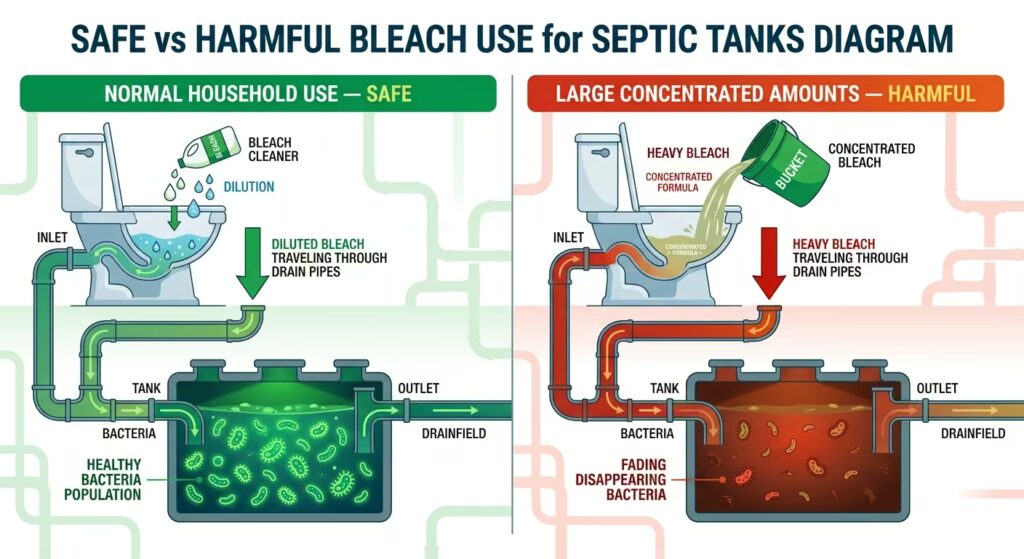
Normal household bleach use is safe for a septic system. Cleaning your toilet bowl, wiping down surfaces, doing laundry with bleach, and running a bleach-based dishwasher tablet are all fine in the quantities typical of a household.
What is not safe is large, concentrated amounts of bleach entering the system at once — pouring a full bottle down a drain, leaving a bleach soak in a drain for hours, or running multiple heavy bleach tasks back-to-back on the same day.
The key factor is dilution. By the time normal cleaning bleach travels through your household pipes and reaches the tank, it is diluted enough to have minimal impact on the bacterial population inside.
How Bleach Affects Your Septic Tank
A septic tank functions because of billions of naturally occurring bacteria that break down organic waste. These microorganisms are the engine of the entire system.
Bleach — sodium hypochlorite — is an antimicrobial agent. At sufficiently high concentrations, it kills bacteria. That is what makes it an effective disinfectant in the home and potentially harmful to a septic system.
The question is always about concentration. A small amount of bleach diluted through ten gallons of water used for toilet cleaning reaches the tank as a trace concentration, not enough to meaningfully affect a population of billions of bacteria. A full litre of bleach poured directly down a drain is a matter entirely different.

Bleach Uses That Are Safe With a Septic System
The following uses produce bleach concentrations that are well within what a healthy septic system can handle without disruption.
| Bleach Use | Safe for Septic? | Why |
| Toilet bowl cleaner (normal dose) | Yes | Highly diluted by the time it reaches the tank |
| Laundry (standard dose per load) | Yes | Further diluted through the wash cycle and rinse water |
| The kitchen surface spray was wiped down | Yes | Residual amounts rinsed away are negligible |
| Dishwasher with a chlorine-based tablet | Yes | Diluted through full wash and rinse cycles |
| Mould treatment on grout or tiles (rinsed) | Yes, in moderation | Rinse thoroughly before water enters the drain |
| Bleach tablet in toilet cistern (continuous) | Use with caution | Releases chlorine with every flush — cumulative effect over time |
Bleach Uses That Can Harm Your Septic System
These scenarios introduce bleach at concentrations that can meaningfully disrupt the bacterial population in your tank.
Pouring large amounts directly down a drain
Pouring half a litre or more of undiluted bleach directly down a sink drain or toilet sends a concentrated slug of antimicrobial agent straight into the tank with minimal dilution along the way.
This is the most common way bleach causes real damage to a septic system. It typically happens when homeowners try to deodorise drains, clear clogs, or disinfect pipes.
For drain odours, use a baking-soda-and-white-vinegar flush instead. For clogs, use a drain snake or a plunger. Both are effective and carry no risk to the septic system.
| RELATED: How to Unclog a Drain Without Chemicals |
|---|
| Bleach and chemical drain cleaners are not the answer for blocked drains when you have a septic system. Read our guide on five safe, effective methods that work without harming your tank. |
Multiple heavy bleach tasks on the same day
Running several high-bleach tasks back-to-back on the same day — heavy laundry, toilet cleaning, kitchen scrubbing, and a drain treatment — delivers repeated doses into the system within a short window.
Each dose may be acceptable individually. When combined on the same day, they can result in a cumulative concentration that stresses the bacterial population.
Spread bleach-heavy cleaning tasks across the week rather than concentrating them on one day. This gives the system time to handle each load without cumulative impact.
Continuous-release bleach toilet tablets
Bleach tablets that sit in the toilet cistern and release chlorine with every flush send a low but constant dose of bleach into the septic system throughout every day.
A single flush of toilet bowl cleaner is diluted before it reaches the tank. A continuous-release tablet sends dozens of doses per day without dilution from a full bowl of water.
Over months and years, this steady drip of chlorine can measurably reduce the bacterial population in the tank and slow waste breakdown. Replace cistern tablets with a bowl-applied cleaner used a few times a week instead.
Bleaching a drain and leaving it to soak
Pouring bleach into a drain and leaving it to sit for an extended period — to clear a clog or disinfect the pipe — sends a concentrated exposure into the system rather than a quick diluted flush.
The longer bleach sits in a drain, the less dilution occurs before it reaches the tank. This is a more harmful exposure than a quick cleaning rinse.
Not All Bleach Products Are Equal
Different bleach-based products have very different concentrations of sodium hypochlorite. Understanding which products are stronger helps you manage your total bleach load more accurately.
| Product Type | Typical Concentration | Septic Risk Level |
| Standard household bleach | 3 to 8% | Low in normal use |
| Toilet bowl cleaner (gel) | 2 to 5% | Low in normal use |
| Laundry bleach (colour-safe) | 1 to 3% | Very low |
| Concentrated bleach (ultra) | 10 to 15% | Moderate — use half the dose |
| Continuous-release cistern tablet | Varies, ongoing dose | Moderate over time — avoid |
| Industrial or commercial bleach | 10 to 20%+ | High — avoid entirely |
If you switch to a concentrated bleach product to save money, reduce the dose proportionally. The same cleaning result requires significantly less product, and your septic system sees a lower total chlorine load.
Septic-Safe Alternatives to Bleach
For homeowners who want to reduce their bleach use around a septic system, these alternatives handle most cleaning tasks effectively without any antimicrobial risk to the tank.
White vinegar
Undiluted white vinegar is an effective descaler, deodoriser, and mild disinfectant. It is safe for all pipe materials and completely harmless to septic bacteria.
It works well for toilet bowl cleaning, drain deodorising, and general surface cleaning. It does not disinfect to the same clinical standard as bleach, but for routine household cleaning, the difference is rarely meaningful.
Baking soda
Baking soda neutralises odours and provides mild abrasive cleaning without any chemical risk to the septic system. When combined with white vinegar, it produces a fizzing reaction that effectively loosens drain buildup.
Hydrogen peroxide
Three percent hydrogen peroxide — the standard pharmacy concentration — is a mild disinfectant that breaks down into water and oxygen. It has no harmful effect on septic bacteria at normal use concentrations.
It is useful for surface disinfection and as an alternative to bleach for light mould treatment. Higher concentration hydrogen peroxide products should be avoided.
Enzyme-based cleaners
Enzyme-based drain and surface cleaners use biological agents rather than chemicals to break down organic matter. They are specifically formulated to be safe for septic systems and actively support the biological environment rather than disrupting it.
| RELATED: Best Septic Tank Treatments — What Actually Works and What to Skip |
|---|
| Enzyme-based products are also available as septic tank treatments. Read our full guide to which types of treatments are worth using and when. |
What to Do If You Have Used Too Much Bleach
If a significant amount of bleach has entered your system — a full bottle poured down a drain, a large-scale disinfection job, or months of continuous-release tablet use — you may want to help the bacterial population recover.
- Stop using bleach-heavy products for at least one to two weeks to allow the surviving bacteria to repopulate naturally.
- Add a bacterial treatment to the system. A high-CFU bacterial product flushed down the toilet introduces fresh bacteria to help restore the population faster.
- Avoid using antibacterial soaps, chemical drain cleaners, or disinfectant products during the recovery period.
- Resume normal water use — the organic waste from daily household use is the food source that supports bacterial growth.
| RELATED: What Not to Flush If You Have a Septic Tank |
|---|
| Bleach is one of many products that affect septic health. Read our complete guide on everything that should and should not go into a septic system. |
Frequently Asked Questions
How much bleach is too much for a septic tank?
There is no universal threshold, but a useful rule of thumb is to keep total bleach use to under three-quarters of a cup per day across all household uses. This is well within what a healthy septic system handles without disruption.
Concentrated bleach products require a smaller volume to reach the same risk level. If you use concentrated bleach, halve the quantity you would use of standard bleach.
Can I use bleach to clean my toilet if I have a septic tank?
Yes. Applying a standard toilet bowl cleaner containing bleach, leaving it for a few minutes, scrubbing, and flushing is safe for a septic system. The bleach is well diluted by the toilet water before it reaches the tank.
What to avoid is using an entire bottle of bleach at once or leaving bleach to soak in the bowl for an extended time.
Is it safe to wash clothes with bleach if I have a septic tank?
Yes, in normal amounts. A standard dose of laundry bleach used in a full wash cycle is further diluted through the wash water and the rinse cycle before it reaches the tank. One or two loads of bleach per week is not a concern.
Where problems arise is when doing many bleach loads in one day or using significantly more than the recommended dose per load.
Do bleach toilet tablets damage septic tanks?
Over time, yes. Continuous-release bleach tablets in the cistern send a low dose of chlorine into the system with every single flush. While each individual flush is harmless, the cumulative daily exposure adds up over months and can measurably reduce the bacterial population.
Switch to a gel or liquid toilet cleaner and apply it two or three times a week instead. You get the same clean toilet with a fraction of the total chlorine exposure.
My plumber said to never use bleach with a septic system. Is that right?
This is an overcorrection that causes unnecessary anxiety. The concern behind the advice is valid — high concentrations of bleach are genuinely harmful to septic bacteria. But the practical reality is that normal household bleach use does not come close to that threshold.
A more accurate version of the advice is: use bleach in normal household amounts, avoid large concentrated doses, and skip the continuous-release cistern tablets. That balance keeps the system healthy without requiring you to change your entire cleaning routine.
How do I know if bleach has damaged my septic tank’s bacteria?
The signs of a disrupted bacterial population are similar to general septic problems: slow drains, odours from the tank or drain field, and reduced solids breakdown, leading to a faster-filling tank.
If you suspect bleach damage, stop using heavy bleach, add a bacterial treatment, and give the system two to four weeks to recover. If symptoms persist after that, have the tank inspected by a professional.
Clean Home, Healthy Tank — You Can Have Both
Bleach and septic systems can coexist without any problem when bleach is used sensibly. Normal toilet cleaning, laundry, and kitchen disinfection are all safe.
The habits to avoid are straightforward: do not pour large amounts directly down drains, do not use continuous-release cistern tablets, and do not stack multiple heavy bleach tasks on the same day.
Follow those three guidelines, and your cleaning routine will have no meaningful impact on the bacterial ecosystem your septic system depends on.