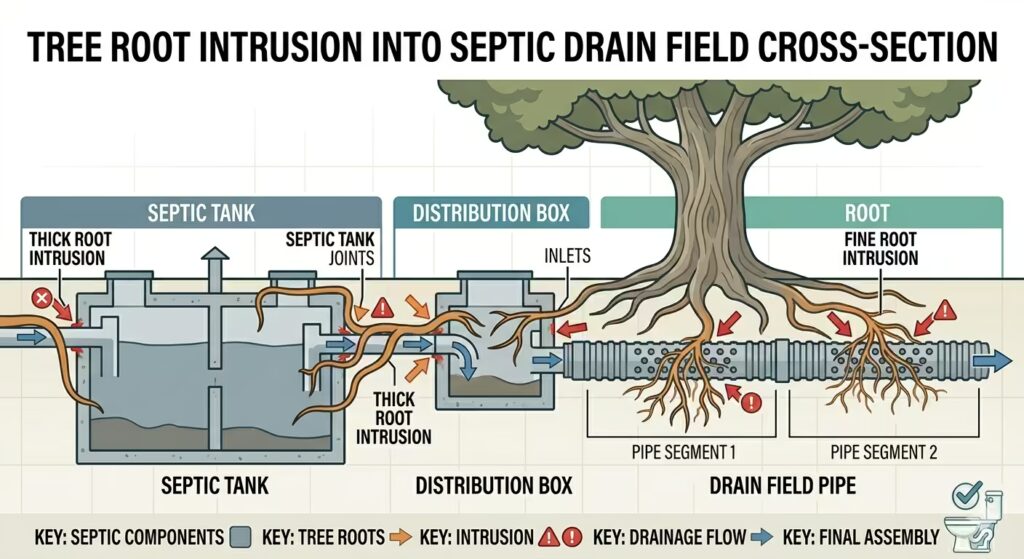
Tree roots and septic systems are a costly combination. Roots are attracted to the warmth, moisture, and nutrients in septic pipes and will find any crack, joint, or opening to enter.
Left unchecked, roots block pipes, damage distribution boxes, and destroy a drain field, which can cost thousands of dollars to replace. Caught early, root intrusion is manageable with the right approach.
This guide covers how to confirm you have a root problem, five proven methods to kill and remove roots, the best products for each situation, and how to protect your system from future intrusion.
Signs You Have Root Intrusion in Your Septic System
Root problems rarely announce themselves dramatically. The signs develop gradually and are easy to mistake for other septic issues. Knowing what to look for helps you catch the problem before it reaches the drain field.
| Symptom | Root Intrusion? | Could Also Be |
| Slow drains throughout the house | Possible | Full tank or main line clog |
| Gurgling sounds from drains and toilets | Possible | Venting issue or partial clog |
| Sewage odor near the drain field | Likely | Full tank or saturated field |
| Unusually lush green grass over the drain field | Likely | Field saturation from overflow |
| Recurring blockages after pumping | Very likely | Damaged outlet baffle |
| Camera inspection confirms roots in pipes | Confirmed | Nothing else |
The only way to definitively confirm root intrusion — rather than just suspect it — is a professional camera inspection of the drain lines. If you are seeing multiple symptoms above and have large trees within 30 feet of your septic system, a camera inspection is worth the cost before committing to treatment.
How Tree Roots Find and Enter Septic Systems
Understanding how roots get in helps you choose the right treatment and protect against future intrusion.
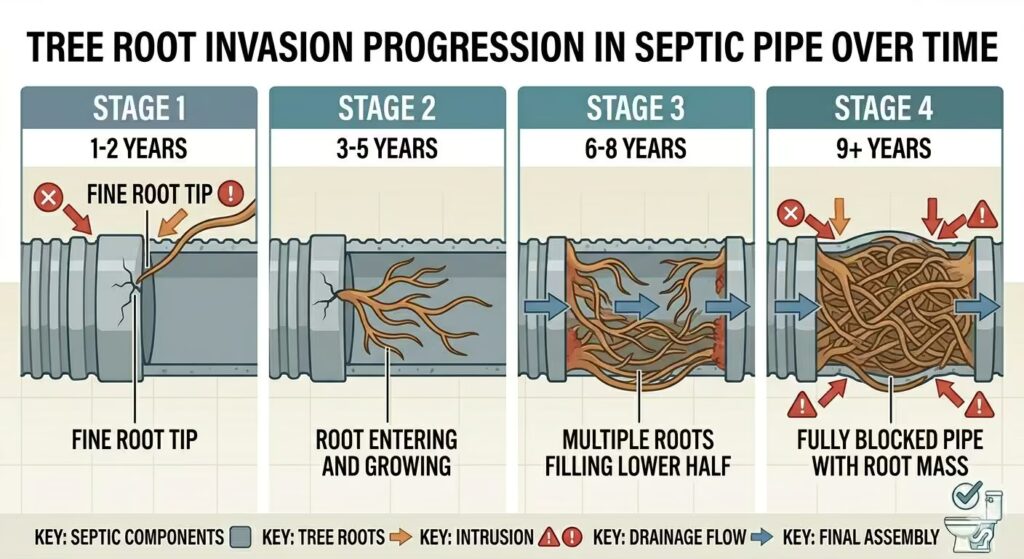
Roots do not force their way through solid pipe. They enter through existing weaknesses — hairline cracks in older concrete pipes, loose joints between pipe sections, and openings in perforated drain-field pipes designed to allow effluent to drain.
Once a tiny root tip enters, it follows the moisture and nutrients inside. Within months, that fine root becomes a mass of roots that can fill a pipe completely. The root also widens the crack as it grows, allowing further intrusion.
Which trees are the biggest risk?
Not all trees pose the same risk to a septic system. The most aggressive root systems belong to trees that naturally seek water.
| Tree Type | Root Aggressiveness | Minimum Safe Distance |
| Willow | Very high | 50 feet or more |
| Poplar / Cottonwood | Very high | 50 feet or more |
| Silver maple | High | 30 to 50 feet |
| Elm | High | 30 to 50 feet |
| Oak | Moderate | 20 to 30 feet |
| Pine / Evergreen | Low to moderate | 10 to 20 feet |
| Ornamental shrubs | Low | 5 to 10 feet |
5 Methods to Kill and Remove Roots From a Septic System
Method 1: Foaming Root Killer — best first-line treatment
Foaming root killers are the most widely recommended chemical treatment for septic root intrusion. Unlike liquid root killers that sink to the bottom of the pipe, foaming formulas expand to fill the entire pipe interior, coating roots on all surfaces, including the top of the pipe where they grow most aggressively.
The active ingredient in most foaming root killers is dichlobenil or metam sodium, herbicides that kill roots on contact without harming the tree above ground. The treatment kills the roots inside the pipe without necessarily killing the entire tree.
- Flush the foaming root killer down the toilet according to the product instructions—usually 1 or 2 packets.
- Avoid using the toilet or any drains for 8 to 12 hours after treatment to allow the foam to remain in contact with the roots.
- Repeat every 6 to 12 months for maintenance to prevent regrowth.
| PRODUCT PICK: RootX Foaming Root Killer for Septic Tanks and Sewer Lines |
|---|
| Why it works: The most widely recommended foaming root killer among septic professionals. Uses dichlobenil to kill roots on contact while the expanding foam reaches every surface inside the pipe. Registered with the EPA and safe for all types of sewer pipe, including PVC, concrete, and cast iron. Does not harm the tree above ground or the bacterial balance of the septic tank. Best for: Moderate root intrusion in drain lines and pipes. Best used as both a treatment and an annual prevention treatment once roots have been identified. |
Method 2: Copper Sulfate — effective but use with caution
Copper sulfate crystals poured into the toilet kill roots by drying out root tissue on contact. It is inexpensive, widely available, and has been used for decades as a root control treatment.
However, copper sulfate comes with important caveats. It is more harmful to the septic system’s bacterial balance than foaming root killers, and it can leach into groundwater in larger quantities. It is also banned for use in septic systems in some states. Check your local regulations before using it.
- Pour half a cup of copper sulfate crystals into the toilet and flush.
- Treat every three to four months to maintain effectiveness.
- Do not use in excessive quantities — more is not more effective and increases the risk to soil and groundwater.
| Check local regulations before using copper sulfate |
|---|
| Several US states have restricted or banned the use of copper sulfate in septic and sewer applications due to groundwater concerns. California, Washington, and several other states have specific restrictions. Check with your county health department before using this treatment. |
Method 3: Mechanical Root Cutting — for confirmed heavy blockages
When roots have grown to the point of blocking or significantly restricting a pipe, chemical treatment alone is not enough to clear the blockage. Mechanical cutting removes the root mass physically before chemical treatment can reach the remaining roots.
A plumber’s auger fitted with a root-cutting attachment — called a root cutter or root saw — is fed into the pipe and rotated to slice through the root mass. This is a job for a licensed plumber with the right equipment. Incorrect use can damage the pipe and worsen the situation.
After mechanical cutting, follow up immediately with a foaming root killer. The chemical treatment kills the remaining root stubs and slows regrowth. Without this follow-up, roots regrow into the pipe within months.
| Mechanical cutting is a clearing method, not a cure |
|---|
| Removing roots from a pipe removes the current blockage. It does not address the source — the tree or shrub above ground — and roots will regrow. Follow up with ongoing chemical treatment every 6 months and consider whether the tree needs to be removed. |
Method 4: Tree Removal — the permanent solution
If a specific tree has been identified as the source of the root intrusion and it is within the high-risk distance zone for your septic system, removing the tree is the only permanent solution.
Treating roots chemically keeps them manageable, but does not stop them from regrowing. As long as the tree is alive, its root system will continue seeking water and will return to the septic pipes whenever treatment lapses.
Tree removal should be done by a licensed arborist. After removal, the root system needs to be treated with a stump killer to prevent new shoot growth, and the area should be monitored for root activity for at least one growing season.
| PRODUCT PICK: Bonide Stump-Out Granules |
|---|
| Why it works: Potassium nitrate granules accelerate the natural decomposition of tree stumps and root systems after removal. Applied to the cut stump surface and into drilled holes in exposed roots, the granules make the wood porous and easy to break apart within 4 to 6 weeks. Does not harm surrounding vegetation when applied as directed. Bonide has been a trusted name in garden chemistry since 1926. Best for: Post-tree-removal treatment to speed up stump and root decomposition after removing a tree near a septic system. Most effective on stumps that have been cut for at least 12 to 18 months. |
Method 5: Root Barriers — preventing future intrusion
A root barrier is a physical or chemical barrier installed between an existing tree and the septic system to prevent root growth from reaching the pipes. It does not kill existing roots but prevents new ones from entering the protected zone.
Physical root barriers are sheets of high-density polyethylene or similar material installed vertically in the soil to a depth of 18 to 24 inches. They redirect roots downward and around the barrier rather than toward the septic field.
Chemical root barriers use a slow-release herbicide embedded in a fabric or panel that is installed in the soil. As roots approach, they contact the herbicide and are discouraged from growing further in that direction.
Root barriers are most effective when installed prophylactically — before root intrusion has begun — or after mechanical clearing, to prevent regrowth while an existing tree remains.
| PRODUCT PICK: DeepRoot 18-Inch Linear Root Barrier |
|---|
| Why it works: A high-density polyethylene root barrier panel that redirects root growth downward and around the protected area. Designed for use by arborists and homeowners to protect underground infrastructure from aggressive root systems. Modular panels connect to create barriers of any length needed. Best for: Protecting septic pipes from trees that cannot be removed. Most effective when installed around the perimeter of the drain field before intrusion occurs or after mechanical clearing. |
Root Treatment Products: Which to Use When
| Product Type | Best For | Treats or Prevents? | Frequency |
| Foaming root killer | Early to moderate intrusion | Both | Every 6 to 12 months |
| Copper sulfate | Mild intrusion, lower cost | Treats | Every 3 to 4 months |
| Mechanical cutting | Severe blockage | Treats only | As needed |
| Tree removal | Recurring intrusion | Permanent | One time |
| Root barrier | Prevention and post-clearing | Prevents | Permanent |
When to Call a Professional
Some root situations are beyond what a homeowner can address alone. Recognizing when to call a licensed septic contractor or plumber prevents a manageable problem from becoming much worse.
- You have confirmed root intrusion through a camera inspection, and the roots are in the main outlet pipe or distribution box — not just the drain field laterals
- Chemical treatment has been applied consistently for two seasons, but symptoms continue
- Sewage is backing up into the house — this indicates a blocked main line, not just a slow field
- The drain field is showing signs of saturation, even after the tank has been recently pumped
- You are seeing roots emerge from clean-out access points — this indicates heavy intrusion
| RELATED: How to Empty a Septic Tank |
|---|
| Root intrusion often goes hand in hand with a tank that has not been pumped in too long. Read our guide on how regular pumping keeps the whole system healthier and reduces root pressure on the drain field. |
Long-Term Protection: Keeping Roots Out for Good
The homeowners who never have serious root problems consistently follow the same set of habits.
- Keep all trees with aggressive root systems — willows, poplars, maples — at least 30 to 50 feet from the septic tank and drain field
- Plant only grass, shallow-rooted annuals, or perennials directly over and adjacent to the drain field
- Apply a foaming root killer annually as a preventive treatment, even when no symptoms are present
- Have the septic system camera-inspected every 5 years to catch early root intrusion before it becomes a blockage
- Keep records of which trees are on the property and their proximity to the septic system
- When planting new trees, check the mature root spread of the species before deciding on placement
| RELATED: How Long Does a Septic Tank Last? |
|---|
| Root intrusion is one of the leading causes of premature septic system failure. Read our guide on the lifespan of different tank types and what shortens or extends how long your system lasts. |
Frequently Asked Questions
Will root killer work if the septic tank is already full?
Not effectively. A tank that is full of sludge has very little liquid movement, which means a foaming root killer cannot travel through the pipes properly and will not make full contact with the root mass.
The right sequence is to pump the tank first, then apply root killer. Pumping removes the sludge, restores normal liquid flow, and allows the root killer foam to expand and reach the roots throughout the pipe network.
If you skip the pump and apply root killer to a full tank, you may get partial root kill near the tank inlet, but the pipes farther into the drain field will not be reached. The roots will keep growing, and the problem will return faster than expected.
How do I deal with bamboo roots near a septic field?
Bamboo is one of the most aggressive root systems for septic systems. Unlike tree roots, bamboo spreads through underground rhizomes that can travel several feet per year and are not deterred by standard root barriers.
If bamboo has already reached the drain field, foaming root killer applied through the toilet will kill the roots inside the pipes. However, as long as the bamboo plant above ground is alive, new rhizomes will replace the killed ones within a season.
The only reliable long-term fix for bamboo near a septic field is complete removal of the bamboo plant, including its root system, combined with an annual foaming root killer treatment to catch any regrowth attempting to re-enter the pipes.
If removal is not possible, a deep physical root barrier of at least 24 inches installed between the bamboo and the drain field can significantly slow intrusion, though bamboo rhizomes can go under shallower barriers over time.
Are there natural alternatives to chemical root killers for septic systems?
Yes, though they are less effective than purpose-formulated foaming root killers for established intrusion. Natural options work best as preventive measures rather than active treatments.
Rock salt, also called sodium chloride, is the most commonly cited natural root deterrent. When poured in large quantities down the toilet, it creates a high-salinity environment around pipe joints, dehydrating and discouraging root growth. It is less harmful to septic bacteria than copper sulfate, but also less effective at killing established roots inside the pipe.
To use rock salt: pour half a kilogram down each toilet monthly and avoid using water for 8 to 10 hours afterward to allow the salt to settle and concentrate in the pipes. This works best as an ongoing preventive measure in homes where roots are a recurring issue.
Baking soda and vinegar, despite their effectiveness for many drain problems, have no meaningful impact on root systems. The fizzing reaction is not strong enough to affect root tissue.
If roots are already causing blockages or symptoms, natural methods will not clear them. Mechanical cutting followed by a foaming root killer is required for active intrusion.
Can you kill or remove roots from a drain field without digging it up?
Yes, in many cases. The approach depends on how deeply the roots have penetrated the drain field laterals.
For roots that have entered the perforated lateral pipes of the drain field, foaming root killer is the first-line treatment. Flushed through the toilet, the foam travels through the distribution box and into the lateral pipes, killing roots on contact throughout the network. This does not require any excavation.
For roots that have physically blocked a lateral pipe to the point of collapse or compression, the pipe itself needs to be exposed and either cleared with a root-cutting auger or replaced. This does require digging, but modern trenchless repair methods mean only a small section may need to be exposed rather than the full drain field.
A camera inspection fed through the clean-out access point before any treatment tells you which situation you are dealing with. If the pipes are still structurally intact, chemical treatment is likely to work. If the pipes are physically damaged or collapsed, excavation and repair are unavoidable.
Once the drain field is treated and roots are killed, applying foaming root killer every 6 to 12 months prevents regrowth from re-establishing inside the lateral pipes.
Will root killer harm my septic system bacteria?
Foaming root killers like RootX are formulated to have minimal impact on the bacterial population in the septic tank. The herbicide is absorbed by root tissue and does not significantly alter the tank’s biological environment at recommended doses.
In large quantities, copper sulfate can disrupt bacterial balance. Use it at the recommended dose and not more frequently than directed.
How long does it take for root killer to work?
Foaming root killers begin killing roots on contact. You may notice an improvement in drainage within a few weeks as the dead roots decompose and flow through the system.
Full clearing of a moderate root blockage typically takes one to three months after treatment. For heavy blockages, mechanical cutting is needed first.
Can I use root killer as a preventive measure?
Yes, and this is actually the most cost-effective use of foaming root killer. An annual treatment applied before symptoms appear keeps roots from establishing in the pipes in the first place.
Once roots have caused a blockage, treatment is more expensive and disruptive. Annual prevention costs a few dollars and 15 minutes.
My neighbor has large trees on their property near my septic field. What can I do?
You cannot control what your neighbor plants. You can install a root barrier along your property line to redirect tree roots away from your drain field.
Talk to a licensed septic contractor or arborist about the best barrier placement based on the specific trees and their mature root spread. In some cases, a conversation about property boundaries with your neighbor is also worth having.
Do roots ever enter the septic tank itself?
Yes, though it is less common than drain field intrusion. Roots enter the tank through cracks in older concrete tanks, through the joint between tank sections, or through the inlet and outlet pipe connections.
Root intrusion into the tank itself requires mechanical removal by a professional during a pump-and-inspect visit. The tank joints then need to be sealed to prevent re-entry.
Is it safe to grow a vegetable garden near the septic drain field?
Growing vegetables directly over a drain field is not recommended for two reasons: root vegetables can physically penetrate drain field pipes, and there is a health risk from vegetables grown in soil that may contain trace pathogens from effluent.
Grass and non-edible ornamental plants with shallow root systems are the safest choice directly over the drain field. Keep vegetable gardens at least 10 feet away.
Catch It Early, Treat It Right, Protect It Long Term
Root intrusion into a septic system is a manageable problem when detected before it reaches the drain field. A foaming root killer applied annually costs a few dollars and keeps pipes clear. Replacing a drain field destroyed by roots costs thousands.
Know which trees are near your system, maintain an annual treatment schedule, and have a professional camera inspection every five years. Those three habits protect your investment far more reliably than any emergency response afterward.