A septic tank is not the same as a municipal sewer. What you flush directly affects how well your system works.
Municipal sewers carry waste to a treatment plant that handles almost anything. Your septic tank is a contained biological system with clear limits.
Flushing the wrong things does not just cause clogs. It kills the bacteria your tank needs, fills up your tank faster, and can destroy your drain field.
Why a Septic Tank Is Different From a Sewer
Your septic tank relies on naturally occurring bacteria to break down waste. These microbes work constantly to digest solids and keep the system balanced.
When you flush items that do not break down, they accumulate as sludge. This forces you to pump the tank more frequently and strains the drain field.
When you flush chemicals that kill bacteria, the biological process slows down or stops. Solids build up faster than they should, and the system backs up.

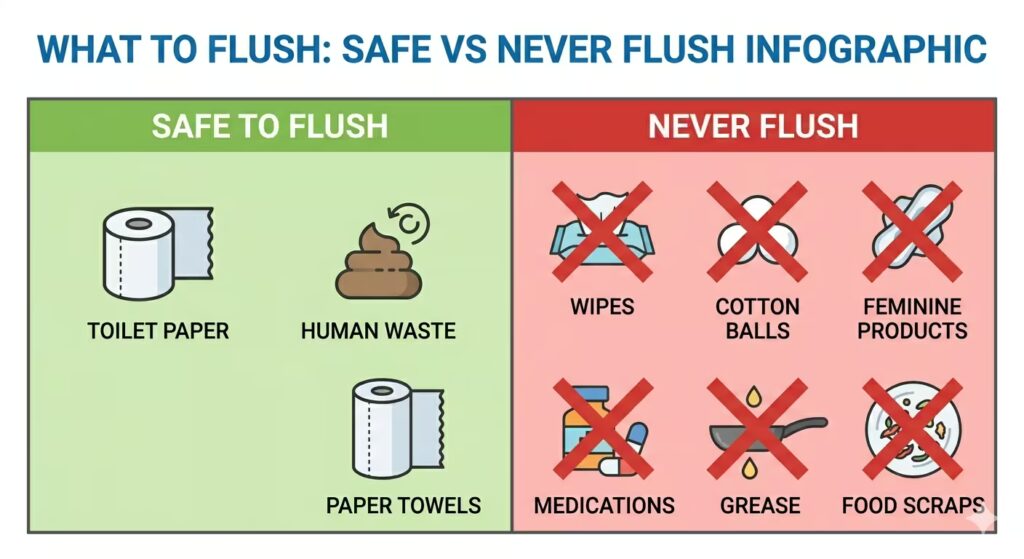
Things You Should Never Flush With a Septic Tank
“Flushable” Wipes
This is the most damaging item going into residential septic tanks today. Despite the label, flushable wipes do not break down in a septic system.
Regular toilet paper dissolves within minutes of contact with water. Wipes retain their structure for months or longer inside your tank.
They accumulate, mat together, and block outlet pipes and drain field lines. No wipe, regardless of its label, is truly safe for a septic system.
Paper Towels and Tissues
Paper towels are made to be strong when wet. That strength is exactly what makes them dangerous in a septic tank.
They do not break down the way toilet paper does. Even one paper towel per day adds up to significant sludge buildup over months.
Facial tissues fall into the same category. They are thicker than toilet paper and break down much more slowly.
Cotton Balls, Cotton Swabs, and Dental Floss
Cotton does not degrade in water. It stays intact inside your tank and tangles around other items to form clumps.
Dental floss is equally problematic. It wraps around pump components and baffle pipes, causing costly mechanical damage.
Feminine Hygiene Products
Tampons and pads are designed to absorb moisture and expand. Inside a septic tank, they absorb liquid and grow significantly.
They do not break down biologically. These products are among the most common causes of septic pump blockages and baffle damage.
Medications
Flushing unused medications seems like a safe disposal method, but it is harmful to your septic system and the environment.
Antibiotics and antiseptic medications kill the bacteria in your tank. Even small amounts over time can disrupt the biological balance your system depends on.
Return unused medications to a pharmacy take-back program or follow your local disposal guidelines.
Grease, Oils, and Fats
Cooking grease poured down the kitchen drain cools and solidifies inside your pipes and tank. It forms a thick layer in the scum zone that is very difficult to break down.
Over time, grease buildup reduces the tank’s effective capacity and coats the outlet baffle. This is one of the fastest ways to shorten the life of a septic system.
Pour cooled grease into a sealed container and throw it in the trash. Never pour it down any drain connected to a septic system.
Food Scraps and Coffee Grounds
Garbage disposals send food solids directly into your septic tank. This significantly increases the rate at which sludge accumulates.
Coffee grounds are particularly damaging. They are fine enough to pass through most filters but accumulate densely at the bottom of the tank.
If you have a septic system, minimize your use of the garbage disposal. Compost food scraps or throw them in the bin instead.
Cat Litter
Even cat litter labeled “flushable” should not go into a septic system. Most varieties are made from clay or silica, which do not biologically break down.
Cat waste can also carry pathogens that the bacterial environment in a septic tank is not designed to neutralize effectively.
Paint, Solvents, and Household Chemicals
Chemical drain cleaners, bleach in large quantities, paint, and solvents all kill the beneficial bacteria in your tank.
A single large pour of chemical drain cleaner can significantly set back your tank’s bacterial population. Use enzyme-based drain cleaners instead.
Never dispose of paint, turpentine, motor oil, or any solvent through a drain connected to your septic system.
| NOTE: Small Amounts of Bleach Are Fine |
|---|
| Using bleach-based cleaners in normal household quantities, such as cleaning a toilet bowl once a week, will not destroy the bacteria in your tank. The concern is large, concentrated amounts poured directly down the drain. |
Cigarette Butts
Cigarette filters are made from cellulose acetate, a plastic-like material that does not biodegrade. They sit in the tank indefinitely.
They also contain concentrated nicotine and chemical residues that are harmful to the system’s bacterial balance.
Quick Reference: Flush It or Bin It?
| Item | What to Do |
| Human waste | Safe to flush |
| Toilet paper (single-ply preferred) | Safe to flush |
| Flushable wipes | Bin it, always |
| Paper towels and tissues | Bin it |
| Cotton balls and swabs | Bin it |
| Dental floss | Bin it |
| Feminine hygiene products | Bin it |
| Medications | Pharmacy take-back |
| Cooking grease | Sealed container, trash |
| Coffee grounds | Compost or trash |
| Cat litter | Trash only |
| Chemical drain cleaners | Use enzyme alternatives |
| Paint and solvents | Hazardous waste disposal |
| Cigarette butts | Bin it |
What About Toilet Paper? Does the Brand Matter?
Yes, it does. Not all toilet paper breaks down at the same speed inside a septic tank.
Thicker, quilted, or multi-ply toilet paper takes longer to dissolve. Single-ply paper is the safest choice for septic systems.
Some brands are specifically designed and tested for septic safety, helping reduce buildup between pump cycles.
| RELATED: Best Toilet Paper for Septic Systems |
|---|
| We tested the most popular brands for septic safety. Find out which ones dissolve quickly and which ones are secretly filling your tank. Read our full guide. |
What Happens When You Flush the Wrong Things?
The effects are not always immediate. That is what makes it easy to ignore until the damage is done.
Short term
Wipes and paper towels begin accumulating in the tank immediately. Bacterial populations begin to decline when harmful chemicals are introduced.
You may notice slow drains or gurgling sounds within weeks of a significant chemical flush.
Medium term
Sludge levels rise faster than normal, meaning your tank fills up before its scheduled pump date.
The drain field starts receiving partially treated waste as the tank’s capacity is compromised.
Long term
A clogged or damaged drain field is the most expensive septic repair. Replacement can cost anywhere from $5,000 to $25,000, depending on your location.
Regular pumping can address a full tank. A destroyed drain field cannot be pumped. It must be dug up and rebuilt.
| RELATED: How to Empty a Septic Tank |
|---|
| Understanding how your tank gets pumped helps you appreciate why keeping it clean matters. Read our full guide to septic tank emptying, including how often to schedule it. |
Simple Habits That Protect Your Septic System
The goal is not to make life complicated. A few consistent habits protect your tank and extend the time between pump cycles.
- Put a small bin next to every toilet for non-flushable items
- Train everyone in the household on the flush-or-bin rule
- Use single-ply or septic-safe toilet paper consistently
- Avoid chemical drain cleaners and use enzyme-based products instead
- Run your dishwasher and washing machine on separate days to avoid overloading the system
- Minimize garbage disposal use and compost food scraps when possible
- Schedule a pump every 3 to 5 years, even if nothing seems wrong
Frequently Asked Questions
Are “septic-safe” wipes actually safe?
No. The term is largely a marketing label. Independent tests consistently show that wipes do not break down in septic conditions.
The only truly safe option is to bin all wipes, regardless of what the packaging says.
Is it okay to use bleach tablets in the toilet tank?
Bleach tablets release a continuous low level of chlorine with every flush. Over time, this can reduce the bacterial population in your septic tank.
It is better to clean the toilet bowl with a small amount of bleach occasionally than to use a continuous-release tablet.
Can I use a garbage disposal with a septic system?
You can, but you should use it sparingly. Garbage disposals roughly double the rate of sludge accumulation in septic tanks.
If you use one regularly, plan to pump your tank more frequently than the standard 3- to 5-year schedule.
What drain cleaner is safe for septic systems?
Enzyme-based and bacterial drain cleaners are the safest option. They work by introducing more of the organisms already in your tank that break down waste.
Avoid any product containing sulfuric acid, sodium hydroxide, or bleach as the primary active ingredient.
The Bottom Line
Your septic tank handles waste well when you give it a fair chance. The single biggest thing you can do is be mindful about what goes into it.
Bin anything that is not human waste or toilet paper. Use septic-safe cleaning products. And schedule regular pumping to keep the system healthy.
The small effort of building these habits saves you from a repair bill that can run into the tens of thousands.