
| IF SEWAGE IS BACKING UP INTO YOUR HOME RIGHT NOW |
|---|
| Stop using all the water immediately. Do not flush toilets, run taps, use the dishwasher, or run the washing machine. Every drop of water you add worsens the situation. Call a licensed septic pumping service as soon as possible — many offer same-day emergency service. Then continue reading this guide. |
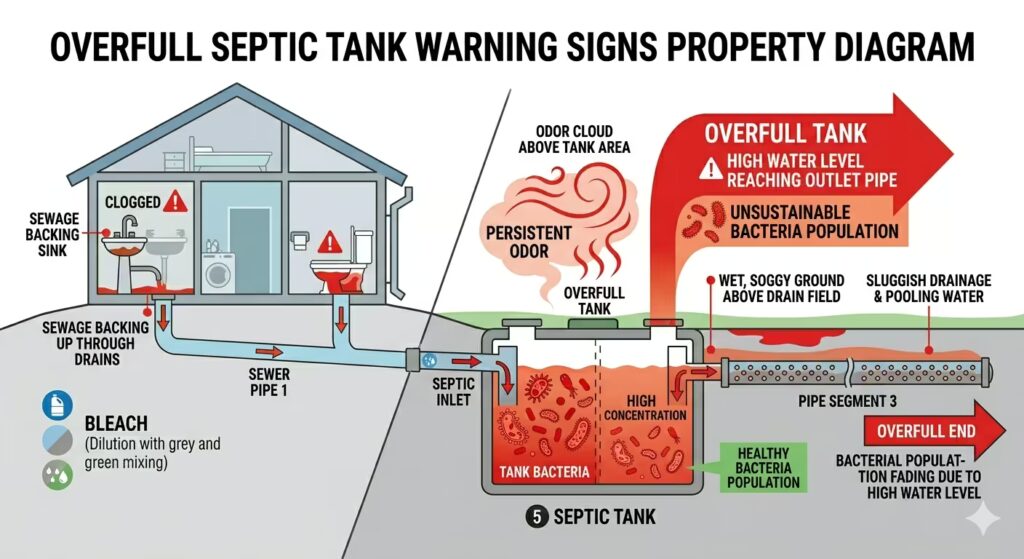
A full septic tank is one of the most stressful home problems a homeowner can face. The signs are unpleasant, the urgency is real, and the cost of getting it wrong is high.
The good news is that a full tank — caught before it fails completely — is fixable. What matters most right now is taking the right steps in the right order.
This guide covers what to do immediately, what to tell the service company, what not to do, and how to make sure this does not happen again.
Is Your Tank Actually Full — or Is Something Else Wrong?
Not every slow drain or bad smell means the tank is full. Before assuming the worst, check whether the signs you are seeing match a full tank specifically.
| Symptom | Full Tank? | Could Also Be |
| All drains slow down at the same time | Very likely | Main sewer line clog |
| Sewage is backing up into the lowest fixtures | Almost certain | Blocked outlet pipe |
| Sewage odor inside the house | Likely | Dry P-trap or vent issue |
| Soggy or wet ground over the drain field | Likely | Drain field failure |
| Strong odor outside near the tank only | Possible | Loose lid or cracked baffle |
| Only one drain is slow | Unlikely | Localised clog in that drain |
The clearest sign of a full tank is multiple fixtures affected simultaneously, particularly when the lowest fixtures in the house — basement toilets, ground-floor drains — back up first.
If only one drain is slow or blocked, the problem is almost certainly a localised clog rather than a full tank. A full tank affects the whole house at once.
What to Do Right Now: Step by Step
Follow these steps in order. Each one matters, and skipping ahead makes the situation harder to manage.

Step 1: Stop all water use in the house immediately
This is the single most important thing you can do. Every toilet flush, tap, shower, dishwasher cycle, and washing machine load adds more water to an already overwhelmed system.
A full tank has no capacity left. Water you add does not go into storage — it pushes sewage backward through the outlet pipe and into your home, or forward into an already saturated drain field.
Tell everyone in the house to stop using water until the tank is pumped. This is not optional.
Step 2: Do not add chemicals, treatments, or additives
When a tank is full, the instinct to pour something down the drain to fix it is understandable. Resist it completely.
Chemical drain cleaners, septic treatments, and enzyme products cannot empty a tank. Adding them to a full system is at best useless and at worst damaging to the bacterial environment the tank needs to recover.
The only thing that empties a septic tank is a pump truck. Do not waste time or money on anything else until that has happened.
Step 3: Keep everyone away from the drain field area
The ground above a saturated drain field is carrying raw or partially treated sewage very close to the surface. This is a genuine health hazard.
Keep children and pets away from the area entirely. Do not walk on the drain field, and do not attempt to dig around the tank or field yourself.
Step 4: Call a licensed septic pumping service
Search for a licensed septic pumping company in your county. Many offer same-day or emergency service for situations exactly like this.
When you call, tell them: the system is backing up into the house, you have stopped all water use, and you need emergency service. Being specific gets you prioritised faster.
| What to have ready when you call |
|---|
| Know the approximate location of your tank on the property. Have your address ready. If you know when the tank was last pumped, mention it. If you have never had it pumped, say so — this affects how long the job will take and what equipment they may need. |
Step 5: Document what you are seeing
Before the technician arrives, take note of exactly which fixtures are affected, when the symptoms started, and whether the drain field looks wet or smells outside.
This information helps the technician assess the situation more quickly and provides a record in case of any dispute about the work done or if insurance is involved.
While You Wait for the Pump Truck
If the service company cannot arrive immediately, here is how to manage the interim period safely.
If you absolutely must use water
Minimise water use as much as possible. If toilet use is unavoidable, use it once and do not flush — flushing sends more water into an already overloaded tank.
Do not use showers, baths, the dishwasher, or the washing machine under any circumstances. These are high-volume water sources that will worsen the backup rapidly.
Dealing with sewage backup inside the house
If sewage has already backed up into a floor drain, toilet, or sink, do not try to clean it up with household cleaners until the tank has been pumped and the flow has stopped.
Raw sewage contains pathogens. If you need to clean up before the technician arrives, wear rubber gloves, use disposable towels, and bag all waste for proper disposal. Avoid skin contact and wash thoroughly afterward.
| IMPORTANT: Sewage is a health hazard |
|---|
| Raw sewage contains harmful bacteria, viruses, and parasites. If sewage has entered your living space, treat it as a biohazard. Keep children, elderly family members, and anyone immunocompromised well away from the affected area until it has been professionally cleaned. |
What to Expect When the Technician Arrives
A septic pumping visit for an emergency full tank follows the same basic process as a scheduled pump, but the technician will also assess the cause and condition of the system.
- The technician locates and opens the tank access lid.
- They assess the liquid level and the condition of the sludge and scum layers.
- The vacuum truck pumps out all the contents of the tank.
- The technician inspects the inlet and outlet baffles, the tank walls, and looks for cracks or structural issues.
- They assess whether the drain field shows signs of failure or saturation.
- They advise you on what caused the backup and what action to take next.
A good technician will give you an honest assessment of whether this was a one-off maintenance issue or a more serious underlying problem.
Ask directly: Is this just a full tank, or is there evidence of damage to the drain field? The answer determines whether a pump-and-maintain approach will work going forward or whether you are looking at a larger repair.
| RELATED: How to Empty a Septic Tank |
|---|
| Read our full guide on what the septic pumping process involves, what questions to ask the technician, and what a service record should include. |
After the Tank Is Pumped: What Comes Next
Once the tank is empty, the immediate crisis is resolved. What you do in the days and weeks after determines whether this happens again.
Resume water use gradually
Do not immediately run the dishwasher, do three loads of laundry, and take long showers on the same day the tank is pumped. The system needs time to re-establish the bacterial environment.
Spread water use across the first 48 hours after pumping. Gradually return to normal usage over the first week.
Add a bacterial treatment
After pumping, the tank is essentially empty of the bacteria it needs to function. A bacterial treatment added in the first few days after pumping helps re-establish the biological activity faster than waiting for natural repopulation.
Use a liquid or dissolvable packet bacterial treatment flushed down the toilet. Avoid heavy water use or bleach for 48 hours after adding it to give the bacteria time to establish.
| RELATED: Best Septic Tank Treatments — What Actually Works and What to Skip |
|---|
| Not all bacterial treatments are equal. Read our updated guide on which types are worth using after pumping and which ones are a waste of money. |
Schedule your next pump date before you forget
The most common reason a tank reaches this point is a missed or overdue pumping schedule. Book the next pump before the service company leaves if they offer future scheduling.
Most households need pumping every 3 to 5 years. If this tank was significantly overdue, consider shortening the interval slightly for the next cycle.
Watch the drain field for the next few weeks
A saturated drain field does not recover instantly. Even after the tank is pumped, the field may remain soggy and slow-draining for days or weeks while the soil dries out and the bacterial environment restores itself.
If the drain field is still wet or smelling after three to four weeks with normal water use, it may have sustained damage that requires professional assessment.
Why Did the Tank Fill Up So Fast?
Understanding the cause prevents a repeat. A septic tank that fills up faster than expected usually has one of these explanations.
The tank was never pumped or severely overdue
This is the most common cause. Many homeowners do not realise septic tanks require regular pumping and go a decade or more without service. A tank that has never been pumped can fill completely with solid sludge, leaving almost no liquid capacity.
The household grew, or water use increased significantly
A tank sized for two people fills faster when four are living in the home. Adding a lodger, having family stay long-term, or significantly increasing daily water use can push a tank to capacity sooner than expected.
Non-biodegradable items were flushed
Wipes, paper towels, feminine hygiene products, and other non-biodegradable items do not break down in the tank. They accumulate as solid waste and fill the tank significantly faster than organic waste alone.
| RELATED: What Not to Flush If You Have a Septic Tank |
|---|
| The items going down your drains have a direct impact on how quickly the tank fills. Read our complete guide on what is safe and what accelerates buildup. |
A component has failed
A broken outlet baffle, a collapsed distribution box, or a failed drain field can cause the tank to behave as though it is full even when the sludge level is manageable. The technician’s inspection should identify whether a component failure contributed.
High water table or recent heavy rain
In areas with high water tables, prolonged heavy rain can saturate the soil around the drain field, preventing effluent from dispersing as it normally would. This backs up into the tank, causing it to fill from the outlet end rather than the inlet.
If your backup was triggered after an extended period of heavy rainfall, mention this to the technician. It may be a temporary environmental condition rather than a maintenance failure.
How to Make Sure This Never Happens Again
A septic emergency is almost always preventable. The homeowners who never experience one share the same habits.
- Pump the tank every 3 to 5 years without exception — set a calendar reminder the day the pump truck leaves
- Never flush anything other than human waste and toilet paper
- Use septic-safe, fast-dissolving toilet paper to reduce solid accumulation
- Spread laundry loads across the week rather than doing everything on one day
- Fix leaking taps and running toilets promptly — they add thousands of gallons of unnecessary water to the system each year
- Keep a written record of every pump visit, including the date, sludge level noted, and technician observations
- Have the system inspected by a professional every 5 to 7 years, even when it seems to be working normally
| TOOL: Smart Home Plumbing Checklist |
|---|
| Track your septic pump schedule alongside all your other home plumbing maintenance tasks. Our free interactive checklist keeps a running health score and gives you a printable maintenance record. |
Frequently Asked Questions
Can I use my toilet at all when the septic tank is full?
If sewage is actively backing up, do not use any toilet. Adding more water to the system at this point pushes sewage further into your home and deeper into the drain field.
If the tank is full but not yet backing up, one cautious use may be possible — but the safest answer is to wait until the tank has been pumped before using any fixture.
How long does it take to pump a full septic tank?
A standard residential pumping job takes 30 minutes to an hour, depending on the pump. An emergency visit that also requires assessing backup damage and inspecting the system may take longer.
Emergency service calls often carry a premium charge compared to scheduled visits. Ask about pricing when you call so there are no surprises.
Is a full septic tank covered by home insurance?
Standard home insurance policies typically do not cover septic system pumping as it is considered routine maintenance. Damage caused by a sewage backup — to flooring, walls, or belongings — may be covered under some policies with sewage backup endorsements.
Check your policy documents or call your insurer while waiting for the pump truck. Document everything with photographs before any cleanup begins.
My tank was pumped recently. Why is it full again so fast?
A tank filling quickly after a recent pump usually means one of two things: the household is generating significantly more wastewater than the system was designed for, or there is a component failure, such as a broken baffle or a drain field problem, that is preventing normal effluent dispersal.
If the tank needed pumping less than two years after the previous service, a professional inspection of the full system — not just the tank — is warranted.
What happens if I ignore a full septic tank?
A full tank left unaddressed can lead to sewage backup into the home, drain-field saturation and potential permanent failure, soil and groundwater contamination, and significant health risks to the household.
It also typically results in far higher costs. A straightforward pump visit costs a few hundred dollars. Drain field repair or replacement runs into the thousands. There is no benefit to waiting.
Can heavy rain cause a septic tank to back up?
Yes. When the soil around the drain field is saturated from prolonged heavy rain, it cannot absorb the effluent flowing out of the tank. The tank fills from the outlet end, and symptoms mirror those of a full tank.
In this case, reducing water use until the soil dries out may resolve the backup without the need for an emergency pump. However, if sewage is entering the home, pump first and assess afterward.
The Crisis Passes — The Lesson Stays
A full septic tank is alarming, disruptive, and expensive. It is also almost always the result of a missed maintenance schedule rather than a random failure.
Once the tank is pumped and the system is back to normal, use the experience as the motivation to set up a proper maintenance routine. A reminder on your calendar every three years costs nothing. A neglected system costs far more than that to fix.
The pump truck visit that feels urgent and expensive today is the cheapest version of this problem you will ever have.