A dedicated water filter system is one of the most impactful upgrades you can make to your home. Unlike pitcher filters that sit in your fridge and handle a few cups at a time, these systems work directly at the source, filtering the water that flows to your tap before it reaches your glass, coffee maker, or cooking pot.
The good news is that the market has never been more accessible. You no longer need a plumber or a renovation budget to get genuinely clean water at home. Today’s options range from under-sink reverse osmosis systems that remove virtually every dissolved contaminant to no-installation countertop units that deliver RO-quality water by simply plugging into an outlet. In this guide, we cut through the noise to highlight the best water filtration systems available right now, comparing performance, certifications, installation requirements, and long-term costs so you can find the right fit for your home, your water, and your lifestyle.
Quick Navigation
- Waterdrop G3P600 – 8-Stage Tankless RO, 600 GPD
- Bluevua RO100ROPOT – 5-Stage Countertop RO
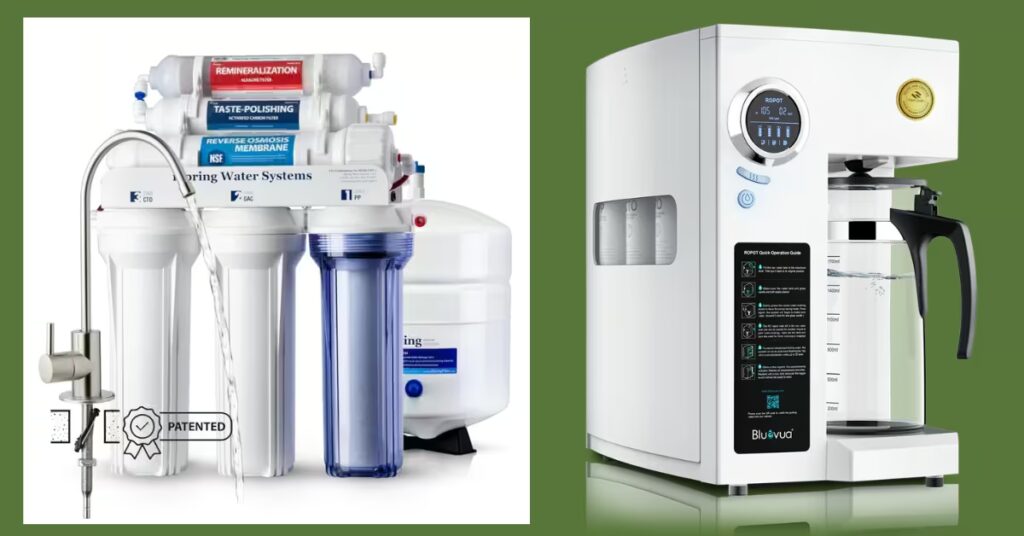
- iSpring RCC7AK – 6-Stage Alkaline RO, 75 GPD
- Waterdrop 15UA – Under-Sink Direct Connect, 2 Years
- APEC ROES-50 – 5-Stage Tank RO, 50 GPD
- iSpring RCC7 – 5-Stage RO, 75 GPD
- DREO Countertop RO – 7-Stage, 3:1 Pure to Drain
- Waterdrop G3P800 – 10-Stage Tankless RO, 800 GPD
- Waterdrop TSU – 0.01 Micron Ultrafiltration, 3-Stage
- Full Comparison Table
- Buyer’s Guide
- FAQs
🔬 RO vs. Ultrafiltration vs. Carbon Block: What’s the Difference?
Reverse osmosis (RO) systems push water through a semi-permeable 0.0001-micron membrane that blocks nearly everything, including fluoride, arsenic, heavy metals, PFAS, and dissolved salts. They also waste some water (the drain ratio) and require electricity for tankless models. Ultrafiltration (UF) systems use a slightly larger 0.01-micron membrane — they remove bacteria, cysts, and many contaminants but don’t lower TDS or remove fluoride. Carbon block direct-connect filters sit between your cold water line and existing faucet, reducing chlorine, PFAS, lead, and taste issues without reducing TDS or requiring new hardware. Each category serves a different problem — so understanding which contaminants are actually in your water is the most important first step.
Waterdrop G3P600 Reverse Osmosis System – 8-Stage Tankless, 600 GPD
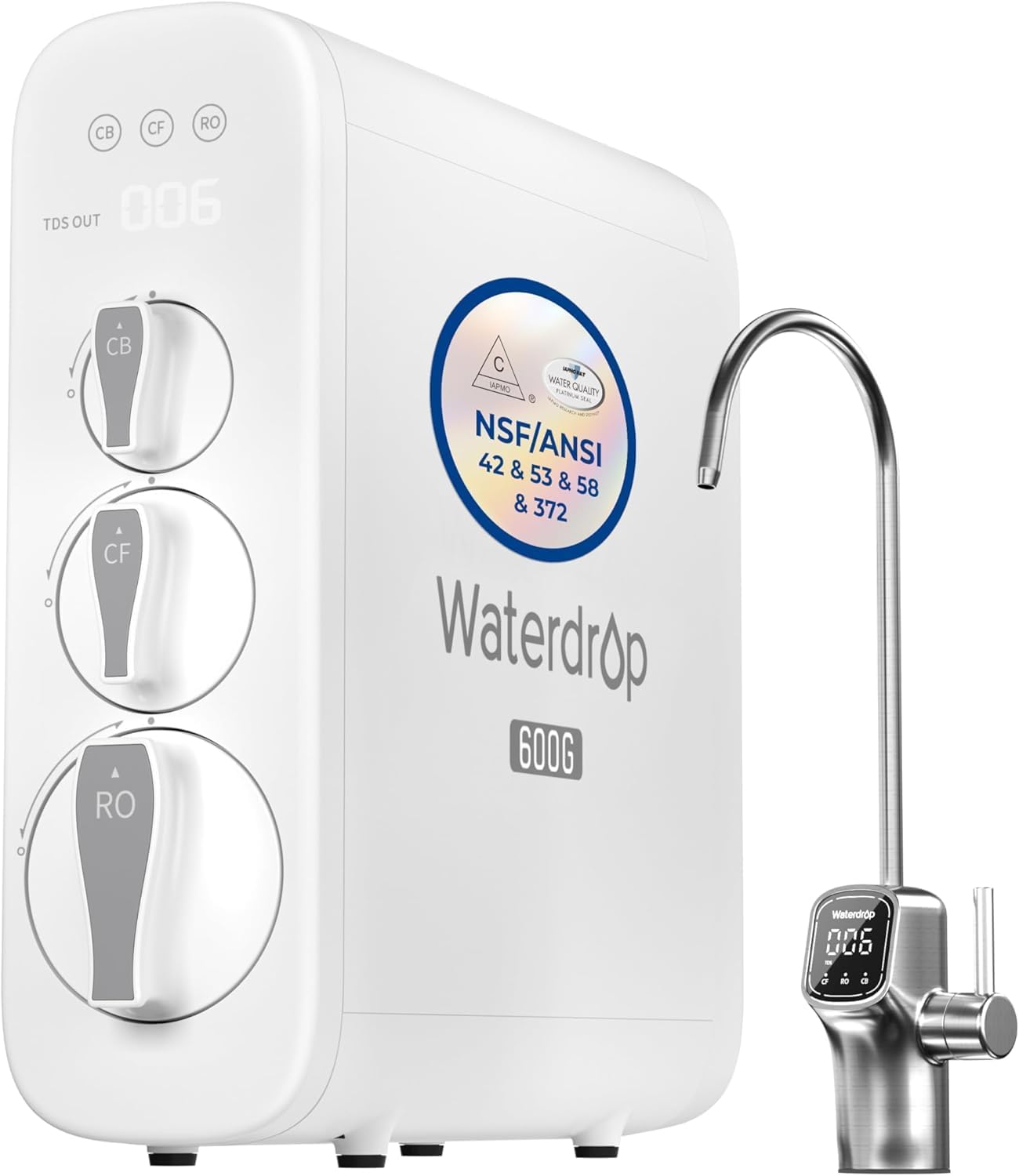
Waterdrop G3P600 Reverse Osmosis System, 8 Stage Tankless RO Water Filter, NSF/ANSI 42 & 53 & 58 & 372 Certified, Under Sink RO System, 2:1 Pure to Drain, Smart LED Faucet
View on AmazonThe Waterdrop G3P600 represents the modern evolution of under-sink filtration: no storage tank, no waiting, and a slim profile that takes up roughly 70% less under-sink space than traditional RO setups. At 600 gallons per day, it delivers a cup of purified water in about 8 seconds — meaningful speed for a gravity-free, on-demand system. Its 8-stage filtration process has been SGS third-party tested to reduce TDS, PFAS (including PFOA and PFOS), fluoride, arsenic, heavy metals like lead and chromium, radioactive substances, and more than 1,000 trace contaminants.
The certification stack includes NSF/ANSI 42, 53, 58, and 372 — one of the more comprehensive packages in its class — certified by IAPMO R&T. The 2:1 pure-to-drain ratio is meaningfully more efficient than conventional RO systems, which often waste three or four gallons for every gallon produced. Filter replacement is a highlight: the twist-off design takes roughly three seconds without moving the unit or using any tools, and filter lifespans are longer than most traditional systems, reducing the annual maintenance burden.
The smart LED faucet is a standout feature — it displays real-time TDS readings and filter life status at a glance, removing the guesswork from system monitoring. Reviewers at TechGearLab scored it a perfect mark on critical contaminant removal, calling it “top-tier” for filtration performance. Installation requires electricity under the sink (for the internal pump) and a countertop faucet hole, so it’s not renter-friendly, but for homeowners it’s a compact, intelligent system that genuinely delivers.
What We Like
- Tankless design saves ~70% of under-sink space
- NSF 42, 53, 58, 372 certified — full stack
- 600 GPD — fills a cup in 8 seconds
- 2:1 drain ratio — more efficient than conventional RO
- 3-second tool-free filter replacement
- Smart LED faucet with real-time TDS display
- SGS third-party tested for PFAS, fluoride, heavy metals
Worth Noting
- Requires under-sink electricity — not for all cabinets
- Higher upfront investment than traditional RO
- Replacement filters more expensive than standard-sized alternatives
- Some users report pump noise; furniture pads help significantly
- Requires drilling two holes (faucet + drain connection)
Bluevua RO100ROPOT Countertop Reverse Osmosis System – 5-Stage with Remineralization
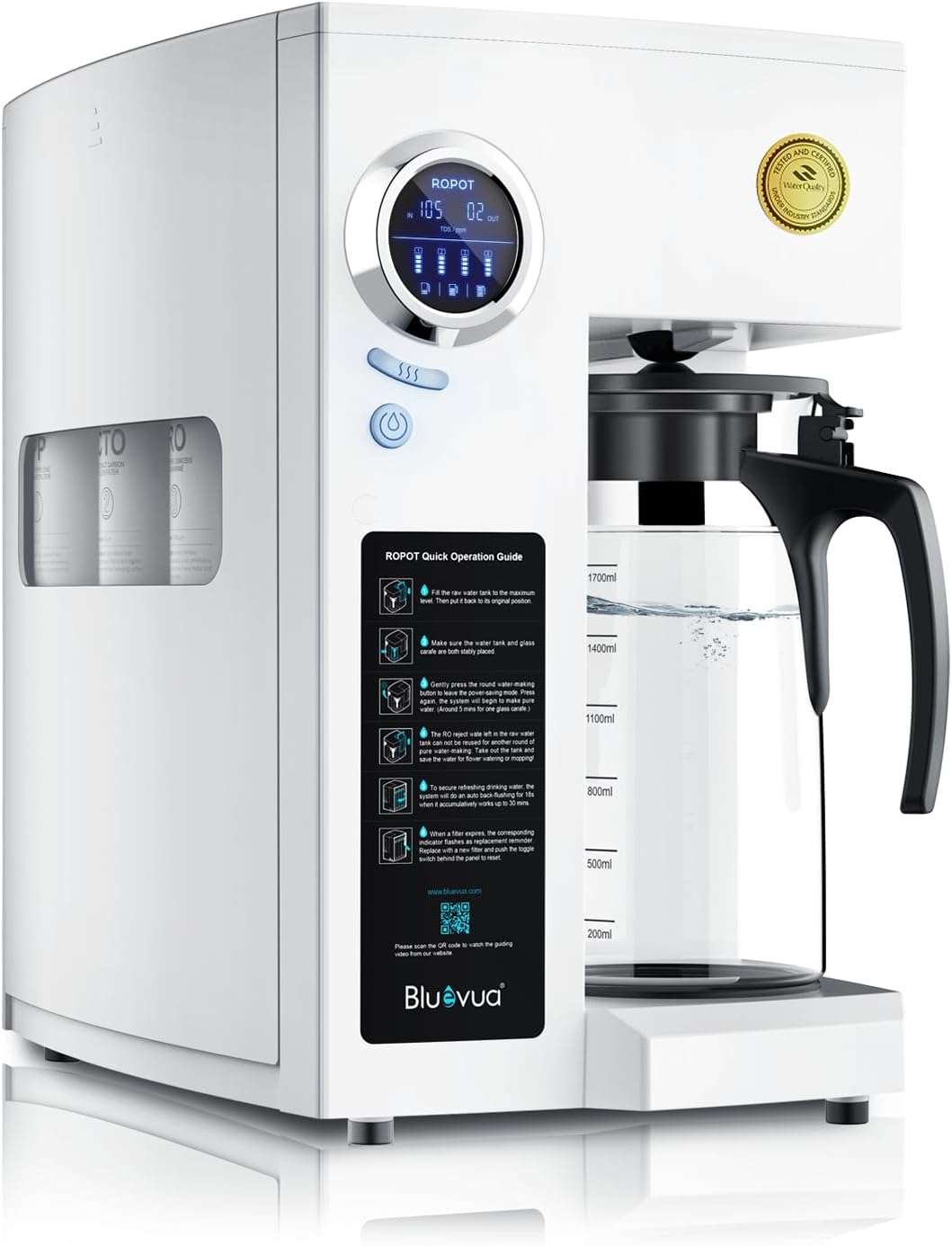
Bluevua RO100ROPOT Countertop Reverse Osmosis Water Filter System, Portable RO Filtration with Remineralization, No Installation, WQA Certified – 5-Stage RO
View on AmazonThe Bluevua RO100ROPOT solves the single biggest barrier to reverse osmosis filtration for renters, apartment dwellers, and anyone unwilling to commit to under-sink plumbing: it requires zero installation. Plug it in, fill the water reservoir, press a button, and the system handles the rest. Independent lab testing by TechGearLab and BOS Water achieved perfect filtration scores, with 100% removal of chlorine, fluoride, lead, copper, and iron in their tests — results that rival full under-sink RO systems.
The 5-stage process includes a 5-micron PP sediment pre-filter, a 0.5-micron coconut shell carbon block, a 0.0001-micron RO membrane, a post-carbon filter, and a remineralization stage that restores healthy minerals like calcium and magnesium after the RO membrane strips them out. That remineralization step is a meaningful quality-of-life addition — standard RO water has a flat, slightly acidic character, and the mineral cartridge brings back the natural balance that makes water actually pleasant to drink.
The digital LED display tracks TDS (before and after filtration), filter life status, and water quantity selection. Fill the reservoir, choose your volume, and the system dispenses into the included glass carafe — no waiting at the tap. One operational note: a 2:1 drain ratio means for every cup of purified water, a cup of wastewater goes into the unit’s waste container, which requires periodic manual emptying. This is a fair trade for no-plumbing convenience, but worth factoring into daily workflows.
What We Like
- Zero installation — ideal for renters and apartments
- Perfect filtration scores in independent lab testing
- Remineralization filter restores mineral balance post-RO
- LED display tracks TDS, filter life, and water volume
- Glass carafe (not plastic) for superior taste and safety
- Removes chlorine, fluoride, lead, arsenic, PFAS, copper
Worth Noting
- Takes countertop space — larger footprint than pitcher filters
- Waste container requires manual emptying
- NSF/ANSI 58 performance certification pending (not yet certified)
- Glass carafe reported as thin by some users — handle carefully
- Higher annual filter cost than budget under-sink systems
iSpring RCC7AK – NSF Certified 6-Stage Alkaline Reverse Osmosis System, 75 GPD

iSpring RCC7AK, NSF Certified, 75 GPD, Alkaline 6-Stage Reverse Osmosis System, pH+ Remineralization RO Water Filter System Under Sink, Patented Top-Mounted Faucet Design
View on AmazonThe iSpring RCC7AK takes the proven 5-stage RO foundation of the RCC7 and adds a sixth stage: an alkaline remineralization filter that restores calcium, magnesium, and other beneficial minerals back into the water after the RO membrane removes them. The result is water that has the purity of reverse osmosis but the natural mineral balance and pleasant taste of spring water — without the flat, slightly acidic character that standard RO systems produce.
The NSF/ANSI 58 certification covers the entire system — not just individual components — which iSpring correctly highlights as a meaningful distinction. Certified reduction rates include lead (98.9%), fluoride (97.4%), TDS (97.9%), asbestos (99.7%), barium (98.4%), cadmium (98.8%), chromium (99.2%), copper (97.8%), and selenium (99%), plus PFAS (96–99%). At 75 GPD, it fills a standard storage tank (included) steadily, keeping purified water available on demand from the dedicated faucet without waiting for on-demand filtration.
iSpring backs this system with lifetime US-based technical support from Atlanta, GA — one of the best warranty and support packages in the category. The patented top-mounted faucet design simplifies installation, and thousands of long-term owners consistently praise both the water quality and the responsiveness of iSpring’s support team when issues arise. Standard filter sizes keep replacement costs moderate, with multiple convenient multi-year filter pack options available.
What We Like
- Full-system NSF 58 certification — not just components
- 6th-stage alkaline remineralization adds back beneficial minerals
- Certified for 1,000+ contaminants including PFAS, fluoride, lead
- Lifetime technical support from US-based team
- Standard-size filters — affordable, widely available replacements
- Excellent long-term user satisfaction across thousands of reviews
Worth Noting
- Requires a storage tank — takes more under-sink space
- No power required, but traditional tank means some wait time
- Slower flow than tankless systems (tank refills over time)
- Requires countertop drilling for dedicated faucet
Waterdrop 15UA Under Sink Water Filter System – 2 Years, NSF/ANSI 42 Certified
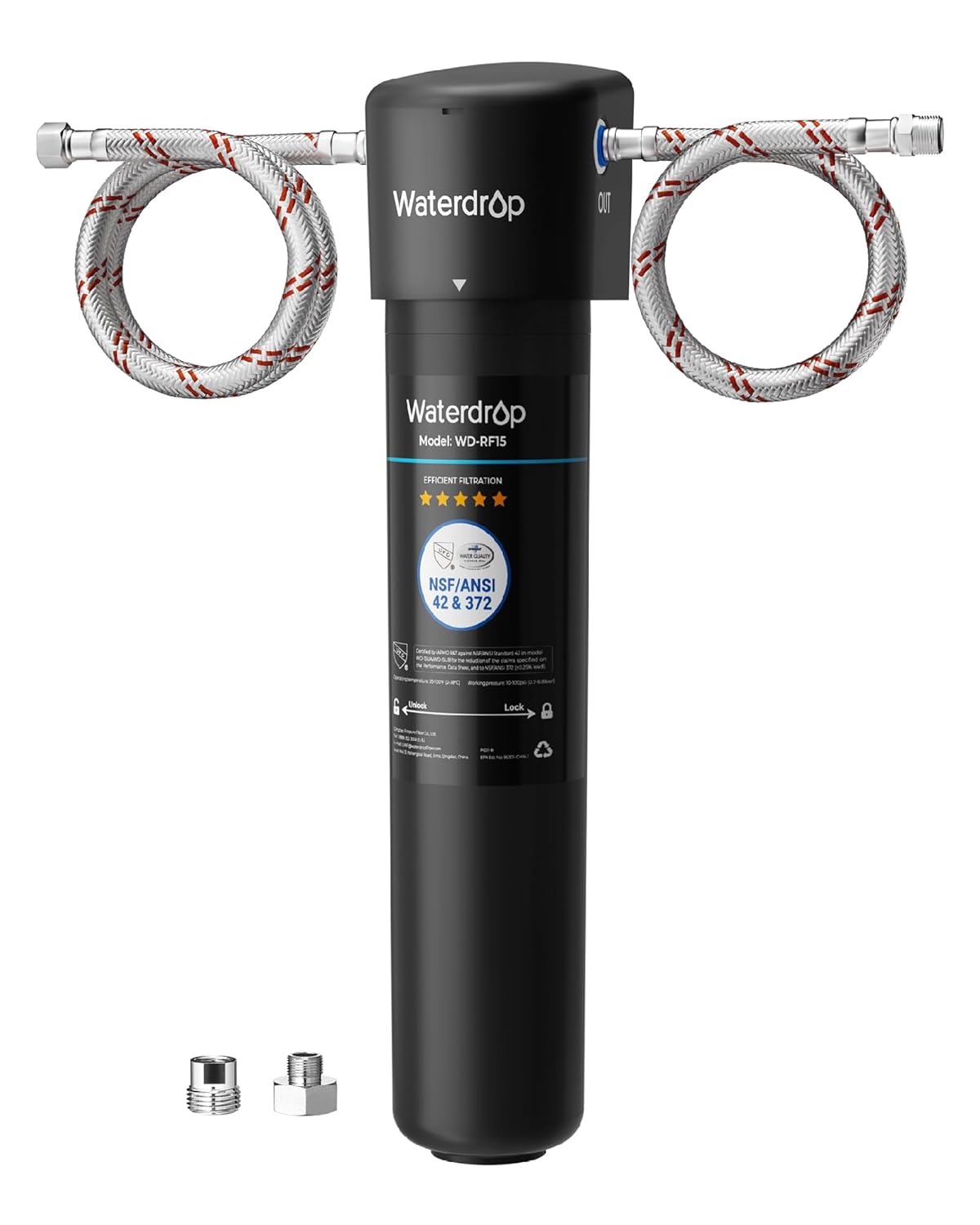
Waterdrop 15UA Under Sink Water Filter System, 2 Years, Reduces Lead, Chlorine, Bad Taste & Odor, Under Counter Water Filter Connects Directly to Your Faucet, NSF/ANSI 42 Certified
View on AmazonThe Waterdrop 15UA is not an RO system — it’s a direct-connect under-sink carbon block filter that intercepts contaminants between your cold water line and your existing kitchen faucet. No separate faucet needed, no storage tank, no electricity, and installation takes under three minutes with push-to-connect fittings. The filter slots out in three seconds with a twist-and-lock mechanism for equally fast replacements.
What sets the 15UA apart from most under-sink carbon filters is its extraordinary filter lifespan: up to 24 months or 16,000 gallons per filter — significantly longer than most competitors in this category. The multistage filtration uses an upgraded carbon block with 20x the dirt adhesion area of previous versions, reducing clogging and maintaining consistent flow over its long service life. Certified by IAPMO against NSF/ANSI 42 (chlorine, taste, odor) and 372 (lead-free materials), with third-party testing against NSF 53 confirming lead reduction. It also reduces PFAS, PFOA/PFOS, heavy metals, VOCs, sediment, and chemical impurities.
Critically, the 15UA does not reduce TDS — it retains beneficial minerals like calcium, magnesium, potassium, and sodium while removing the harmful substances. For households on good municipal water who want a significant step up from pitcher filters without committing to an RO system, this is the most cost-effective and convenient upgrade available. Flow rate is a tested 0.75 GPM at standard household pressure — fast enough for all drinking and cooking needs.
What We Like
- Remarkable 2-year / 16,000-gallon filter lifespan
- Installs in under 3 minutes — no plumber or drilling
- Connects to your existing faucet — no new hardware
- Reduces PFAS, lead, chlorine, VOCs, heavy metals
- No electricity required; no wastewater produced
- Replacement filters under $36 — exceptional value
Worth Noting
- Does not reduce TDS, fluoride, or arsenic (not an RO system)
- For municipal water only — not suitable for well water
- NSF 53 tested by third-party, not direct IAPMO certification
- Faucet compatibility: 3/8″ and 1/2″ cold water lines only
APEC ROES-50 Essence Series 5-Stage Reverse Osmosis System – WQA Certified, 50 GPD

APEC Water 5-Stage Under Sink Reverse Osmosis Water Filter System, ROES-50 Essence Series, WQA Certified, 50 GPD, Reduces 99.99% of Contaminants, Home Water Filtration, DIY Install
View on AmazonAPEC Water Systems has been engineering water filtration in California for over 20 years, and the ROES-50 Essence Series is the product of that experience distilled into the most straightforward form possible. A five-stage RO system built around a FILMTEC high-rejection RO membrane, color-coded tubing for DIY-friendly installation, industry-standard-sized filter housings, and a WQA Gold Seal certification — all at an entry-level price point that makes it one of the most accessible quality RO systems available.
The five stages run water through a sediment filter, two carbon block pre-filters, the RO membrane (removing contaminants down to 0.00000004 inches), and a final coconut shell carbon polishing filter. The manufacturer claims removal of up to 99.99% of impurities including arsenic, chlorine, lead, fluoride, heavy metals, PFAS, and microplastics. The WQA Gold Seal is certified to NSF/ANSI Standard 58 for TDS reduction. The included filter set covers the full 5 stages, and replacement filters use standard industry sizing — widely available from multiple suppliers at competitive costs.
At 50 GPD, it’s slower than tankless competitors but fills a standard pressure tank steadily over the course of a day. The installation is genuinely DIY-accessible with most household tools, typically completed in about an hour. One honest caveat: at 50 GPD, waste water production runs approximately 3:1 (three gallons wasted per gallon purified) — less efficient than newer tankless systems, but manageable for typical household consumption.
What We Like
- Entry-level tier pricing for genuine RO performance
- WQA Gold Seal certified — rigorous independent verification
- Standard-size filters — broad compatibility, lower replacement costs
- Designed, engineered, and assembled in the USA
- FILMTEC high-rejection RO membrane
- 20+ years of brand track record in water filtration
Worth Noting
- 50 GPD is slower than newer systems — tank refill takes time
- ~3:1 waste ratio — less water-efficient than tankless options
- WQA certification specifies TDS reduction; broader contaminant claims are manufacturer-stated
- Filter housing replacement is slightly messier than modular twist designs
- No smart monitoring or TDS display
iSpring RCC7 – NSF Certified 5-Stage Reverse Osmosis System, 75 GPD

iSpring RCC7, NSF Certified, High Capacity Under Sink 5-Stage Reverse Osmosis Water Filter, RO Drinking System, 75 GPD, Brushed Nickel Faucet, Patented Top-Mounted Faucet Design
View on AmazonThe iSpring RCC7 has earned its reputation as one of America’s most consistently recommended under-sink RO systems over more than 15 years of production. It’s the foundation model of iSpring’s RCC7 line — a 5-stage, 75 GPD reverse osmosis system built around the same NSF/ANSI 58 full-system certification and lifetime US-based support that makes the RCC7AK such a compelling value, without the alkaline remineralization stage.
The five-stage filtration runs water through a polypropylene sediment filter, a GAC granular activated carbon filter, a CTO carbon block filter, a high-rejection 0.0001-micron RO membrane, and a final GAC polishing filter. The dual pre-carbon approach — both GAC and CTO — is a thoughtful design choice: the loose granular carbon traps larger contaminants first, protecting the CTO block and RO membrane from premature exhaustion. Certified reductions include lead (98%), fluoride (97.4%), asbestos (99.7%), PFAS (96–99%), TDS (97.9%), barium, cadmium, chromium, copper, and selenium.
The European-designed brushed nickel faucet and transparent first-stage housing (for easy visual filter inspection) give it a more premium feel than similarly priced competitors. The patented top-mounted faucet design simplifies installation — one of the most common friction points in traditional RO setup — and the color-coded tubing system makes connections intuitive. Replacement filters use standard sizing, making long-term sourcing flexible and affordable.
What We Like
- Full-system NSF 58 certified — 15+ years of consistent performance
- 75 GPD — faster tank refill than many competitors
- Dual pre-carbon design extends membrane life
- Transparent 1st-stage housing for easy visual inspection
- Premium brushed nickel faucet included
- Standard filter sizes — affordable long-term replacements
- Lifetime technical support from US-based team
Worth Noting
- No alkaline remineralization stage — upgrade to RCC7AK for that
- Traditional tank system — more under-sink space needed
- Some long-term users report faucet leak issues; iSpring replaces free
- No smart monitoring display
DREO Reverse Osmosis Water Filter Countertop – 7-Stage, 3:1 Pure to Drain

DREO Reverse Osmosis Water Filter Countertop, RO Filtration System, 3:1 Pure to Drain, TDS & Filter Life & Autofill Pitcher, Installation-Free, Self-Cleaning Water Purifier
View on AmazonDREO — better known for smart fans and air purifiers — has applied the same emphasis on smart UX to water filtration with this countertop RO system. The WF511 runs a 7-stage process including activated carbon pre-filtration, a 0.0001-micron RO membrane, and a post-carbon polishing stage, achieving SGS-certified removal of 99.99% of over 1,000 contaminants including PFAS, PFOS, lead, nitrates, arsenic, fluoride, and chlorine. The 3:1 pure-to-drain ratio is more efficient than the Bluevua’s 2:1, meaning less wastewater per gallon produced.
The standout operational feature is the dual-pitcher autofill system. Two BPA-free pitchers come with the unit; when you place a pitcher in the collection area, the system automatically begins filling it with purified water. You can have one in the fridge chilling while the other autofills — a genuinely clever workflow that removes the repetitive manual steps of other countertop systems. The large LED display shows real-time TDS of both incoming raw water and filtered output, tracks filter life, and triggers auto-flush cycles to keep the membrane clean.
In a three-week kitchen test by Bob Vila reviewers, the filtered water performed exceptionally on taste and had no residual odors, and the system integrated smoothly into daily routines. The 5-liter raw water tank plus two 1.1-liter pitchers suits 3–4 person households without constant refilling. Installation is truly plug-and-play — no tools, no plumbing, no setup complexity. Dimensions of approximately 15.7″ × 6.7″ × 13.4″ make it countertop-sized without being overwhelming.
What We Like
- Dual-pitcher autofill system — one chilling, one filling automatically
- 3:1 drain ratio — more water-efficient than many countertop RO systems
- SGS-certified 99.99% contaminant removal including PFAS
- Real-time TDS display shows raw vs. filtered water quality
- Self-cleaning auto-flush extends membrane life
- Zero installation — true plug-and-pour operation
Worth Noting
- SGS tested but not NSF/ANSI 58 certified for contaminant reduction
- Produces a moderate hum during filtration cycles
- Takes 2–3 minutes to fill a pitcher — not instant on demand
- BPA-free plastic pitchers (vs. Bluevua’s glass carafe)
- Waste container requires periodic manual draining
Waterdrop G3P800 Reverse Osmosis System – 10-Stage, 800 GPD, UV Sterilization

Waterdrop G3P800 Reverse Osmosis System, 800 GPD Fast Flow, NSF/ANSI 42 & 53 & 58 & 372 Certified, 3:1 Pure to Drain, Tankless Under Sink RO Water Filter System, LED Purifier, Smart Faucet
View on AmazonThe Waterdrop G3P800 is the flagship of Waterdrop’s under-sink RO lineup and one of the highest-output residential systems available. At 800 gallons per day, it fills a 6-ounce cup in approximately 5 seconds — fast enough that it genuinely feels like filtered tap water rather than a waiting system. The 10-stage filtration process has been SGS third-party tested to reduce PFAS, fluoride, heavy metals including lead and chromium, arsenic, salts, large particles, and radioactive substances. Like the G3P600, it carries NSF/ANSI 42, 53, 58, and 372 certifications.
Where the G3P800 distinguishes itself from the G3P600 is in two key areas: the improved 3:1 pure-to-drain ratio (versus 2:1 on the G3P600, meaning even less wastewater per gallon produced) and the addition of a built-in UV LED sterilizing light. The UV LED activates automatically when water flows through, providing up to 99.9% sterilization against bacteria and viruses — a meaningful additional layer of protection for households on municipal water with aging pipes, or anywhere microbial quality is a concern. The LED is engineered for a lifespan of up to 50 years and requires no maintenance or replacement.
The smart faucet display is identical to the G3P600’s — real-time TDS and filter status at a glance — and the filter replacement design is the same 3-second twist system. The front-pull filter design (versus the G3P600’s side-pull) makes swaps even more convenient without repositioning the unit. Installation requires electricity and two countertop holes, consistent with the G3P600.
What We Like
- 800 GPD — fastest output in this roundup
- 3:1 drain ratio — most water-efficient under-sink RO here
- Built-in UV LED sterilization for bacteria and viruses
- NSF 42, 53, 58, 372 certified (IAPMO)
- Front-pull filter design for easiest replacement
- Smart faucet with real-time TDS display
- 10-stage filtration — most comprehensive in the lineup
Worth Noting
- Premium positioning — highest upfront investment in this roundup
- Requires under-sink electricity and two installation holes
- Proprietary filter sizes — replacement costs higher than standard-size systems
- UV sterilization adds value for microbial concerns, not everyone needs it
Waterdrop TSU 0.01 Micron Ultra Filtration Under Sink Water Filter System – 3-Stage

Waterdrop TSU 0.01 Micron Ultra Filtration Under Sink Water Filter System, 3-Stage Tankless Under Sink Water Filtration System with Faucet, Smart Panel, Not Lower TDS, Drilling Required
View on AmazonThe Waterdrop TSU occupies a distinct middle ground between simple carbon block filters and full reverse osmosis systems: it uses a 0.01-micron ultrafiltration (UF) membrane that removes bacteria, cysts, and contaminants larger than 0.01 microns while retaining all beneficial minerals — a meaningful distinction for households who want pure water without the flat, mineral-stripped taste that standard RO produces.
The three-stage filtration runs water through a polypropylene sediment pre-filter, a carbon block filter for taste and chemical reduction, and the 0.01-micron UF membrane. Reductions include 99.99% chlorine, along with PFAS, heavy metals, VOCs, fluoride, lead, chloramines, and more. Importantly, the system produces zero wastewater and requires no electricity — a significant operational advantage over RO systems in both running cost and environmental impact. No drain line is required, keeping installation cleaner.
The smart panel is a well-designed quality-of-life feature: four LED indicator lights on the sleek black front panel notify you when each filter stage needs replacement, eliminating calendar-based guesswork. Filter lifespans are long — the UF membrane lasts 24 months, the carbon block 12 months, and the sediment pre-filter 6 months. Installation requires drilling a hole for the dedicated stainless steel faucet, typically completed in about 30 minutes by most DIYers. The integrated waterway design prevents leaks and allows filter replacement without shutting off the water supply.
What We Like
- 0.01 micron UF membrane removes bacteria, cysts, heavy metals
- Retains beneficial minerals — no flat RO taste
- Zero wastewater — eco-friendly operation
- No electricity required
- Smart LED panel tracks all three filter stages individually
- UF filter lasts 24 months — excellent longevity
- Replace filters without shutting off water supply
Worth Noting
- Does not reduce TDS, fluoride completely, or dissolved salts
- Requires countertop drilling for dedicated faucet
- Not an RO system — contaminant removal is less comprehensive than RO
- Some users note water can taste slightly bitter without optional alkaline filter
| Product | Type | Capacity / Output | Key Certifications | PFAS Reduction | Minerals Retained | Installation |
|---|---|---|---|---|---|---|
| Waterdrop G3P600 | Tankless Under-Sink RO | 600 GPD | NSF 42, 53, 58, 372 | Yes (SGS tested) | No (RO strips minerals) | Under-sink + electricity |
| Bluevua RO100ROPOT | Countertop RO | ~8 cups per fill | WQA 372; NSF 58 (pending) | Yes (SGS tested) | Yes (remineralization stage) | Plug-in only |
| iSpring RCC7AK | Under-Sink RO (tank) | 75 GPD | NSF/ANSI 58 (full system) | Yes (96–99%) | Yes (alkaline AK stage) | Under-sink + faucet hole |
| Waterdrop 15UA | Under-Sink Carbon Block | 0.75 GPM flow | NSF 42, 372; 53 (3rd party) | Yes (3rd-party tested) | Yes (no TDS reduction) | 3-min push-connect, no drill |
| APEC ROES-50 | Under-Sink RO (tank) | 50 GPD | WQA Gold Seal (NSF 58) | Yes (manufacturer claimed) | No (RO strips minerals) | Under-sink + faucet hole |
| iSpring RCC7 | Under-Sink RO (tank) | 75 GPD | NSF/ANSI 58 (full system) | Yes (96–99%) | No (RO strips minerals) | Under-sink + faucet hole |
| DREO Countertop RO | Countertop RO | 5L tank / dual pitchers | SGS tested (no NSF 58 cert) | Yes (SGS tested) | No (standard RO) | Plug-in only |
| Waterdrop G3P800 | Tankless Under-Sink RO | 800 GPD + UV | NSF 42, 53, 58, 372 | Yes (SGS tested) | No (RO strips minerals) | Under-sink + electricity |
| Waterdrop TSU | Under-Sink Ultrafiltration | 0.75+ GPM flow | Not independently certified | Yes (manufacturer stated) | Yes (no TDS reduction) | Under-sink + faucet hole |
🔬 Start with Your Water Quality Report
Request your municipality’s annual Consumer Confidence Report (CCR) — it’s free and legally required. It tells you exactly what’s in your water and at what concentrations. Lead concerns from old pipes require NSF 53–certified reduction; PFAS concerns require RO or tested carbon block systems; taste and chlorine alone just need a good carbon filter. Choosing a system without knowing your water is guessing.
🏠 Understand Your Installation Constraints
Renters who can’t drill: countertop RO (Bluevua, DREO) or direct-connect under-sink (Waterdrop 15UA — no drilling needed). Homeowners willing to install: under-sink RO gives the best performance per gallon. Tankless under-sink (G3P600, G3P800) requires electricity access under the sink in addition to plumbing. Traditional tank RO (iSpring, APEC) doesn’t need power but takes more cabinet space.
💧 RO vs. Ultrafiltration vs. Carbon Block
RO removes virtually everything including TDS, fluoride, arsenic, and dissolved salts — but also strips beneficial minerals and produces wastewater. Ultrafiltration (like the Waterdrop TSU) removes bacteria, heavy metals, and many contaminants while keeping minerals. Carbon block direct-connect filters (Waterdrop 15UA) handle chlorine, PFAS, lead, and taste without touching TDS. Match the technology to your actual water problem.
💰 Calculate Total Cost of Ownership
The upfront system cost is only part of the equation. Factor in annual filter replacement costs: standard-sized filters (iSpring, APEC) are significantly cheaper to replace than proprietary modular filters (Waterdrop G-series). Long-life filters like the Waterdrop 15UA’s 2-year cartridge minimize replacement frequency. Countertop systems eliminate installation costs but typically cost more per gallon over time.
💦 Water Efficiency and Drain Ratios
Traditional RO systems waste 3–4 gallons for every gallon purified. Modern tankless systems have reduced this: the Waterdrop G3P600 runs 2:1; the G3P800 and DREO achieve 3:1. Ultrafiltration and carbon block systems produce zero wastewater. If you’re in a drought-prone area or pay per gallon, drain ratio matters meaningfully to your long-term water bill.
🌱 Mineral Retention and Water Taste
Standard RO water is technically the purest but has a flat, slightly acidic taste — the RO membrane removes beneficial minerals alongside contaminants. If this matters to you, look for systems with a remineralization stage (iSpring RCC7AK, Bluevua ROPOT) or choose an ultrafiltration system (Waterdrop TSU) that doesn’t reduce TDS at all. The mineral-balanced water from remineralization stages is noticeably more pleasant to drink.
💡 Pro Tip
Before installing any under-sink system, check your current water pressure with an inexpensive pressure gauge (available at hardware stores for under $15). Most RO systems require 40–80 PSI for optimal performance. Low-pressure homes (under 40 PSI) — common in older buildings or homes on well water — may need a booster pump. iSpring’s RCC7P-AK includes a built-in pump for exactly this reason. Running an RO system at insufficient pressure significantly reduces its contaminant rejection rate, even if the system is technically installed correctly.