A water heater rarely fails without warning. The signs are usually there for weeks or even months before the unit gives out completely.
Catching those signs early means you get to choose your next step calmly. Missing them means waking up to a cold shower or, worse, a flooded utility room.
Here are the seven most reliable indicators that your water heater is heading toward failure, and what each one tells you about the unit’s condition.
Sign 1: You Are Running Out of Hot Water Faster Than Usual
If your hot water used to last through two showers and now struggles through one, the unit is losing capacity.
In older tank heaters, sediment builds up at the bottom of the tank over time. This layer of mineral deposits reduces the amount of water the tank can heat effectively.
It can also mean a failing heating element in electric units, or a deteriorating burner in gas models. Either way, reduced hot water output is one of the earliest and clearest signs of decline.
| Quick check |
|---|
| Note the time between your shower starting with hot water and when it turns lukewarm. If that window is noticeably shorter than before, the heater is worth inspecting. |
Sign 2: Strange Noises Coming From the Tank
A water heater should operate quietly. Popping, rumbling, banging, or cracking sounds indicate that something is wrong inside the tank.
The most common cause is sediment. As mineral deposits accumulate at the bottom of the tank, water trapped beneath them boils and forces its way through. This creates the popping and rumbling sounds many homeowners describe.
Heavy sediment buildup accelerates corrosion on the tank interior and forces the heater to work harder to maintain temperature. If the noise started recently and is getting louder, the unit is under increasing strain.

| RELATED: How to Flush a Water Heater |
|---|
| Flushing your water heater annually removes sediment before it clogs. Read our step-by-step guide to doing it yourself in under an hour. |
Sign 3: Rusty or Discolored Hot Water
When hot water from your taps runs brown, orange, or red-tinged, the source is almost always rust. The question is where that rust is coming from.
If only the hot water is discolored and the cold runs clear, the problem is almost certainly inside the water heater. The tank’s interior lining is corroding.
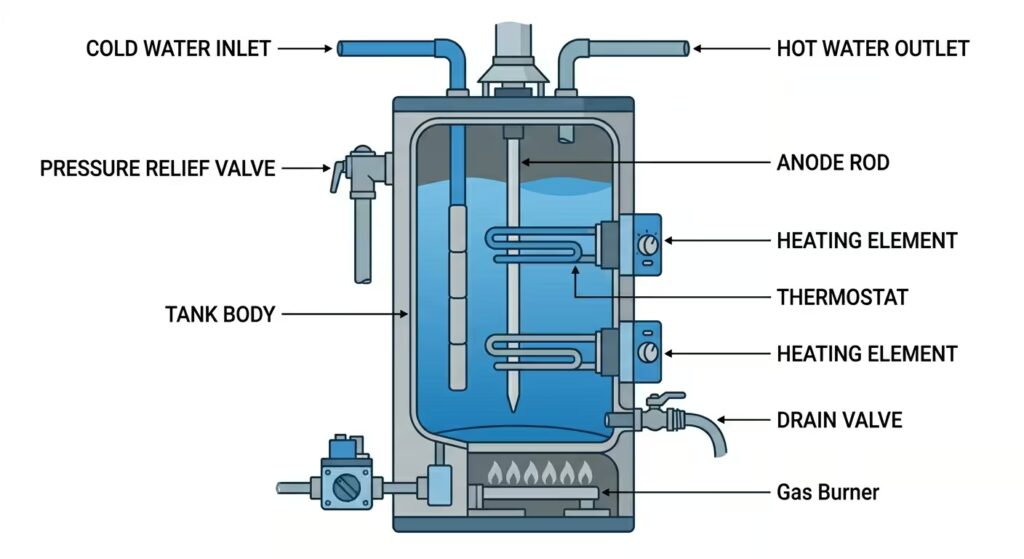
A failing anode rod is usually responsible. The anode rod is a sacrificial metal rod designed to corrode in place of the tank itself. When the rod is depleted, the tank begins to rust from the inside.
| How to test it |
|---|
| Fill three full buckets from your hot water tap. If the discoloration is still present by the third bucket, the rust is coming from the heater itself, not from pipes. This is a strong signal that the tank is nearing the end of its life. |
Sign 4: Water Pooling Around the Base of the Unit
Any moisture around the base of your water heater deserves immediate attention. Small leaks have a way of becoming large ones quickly.
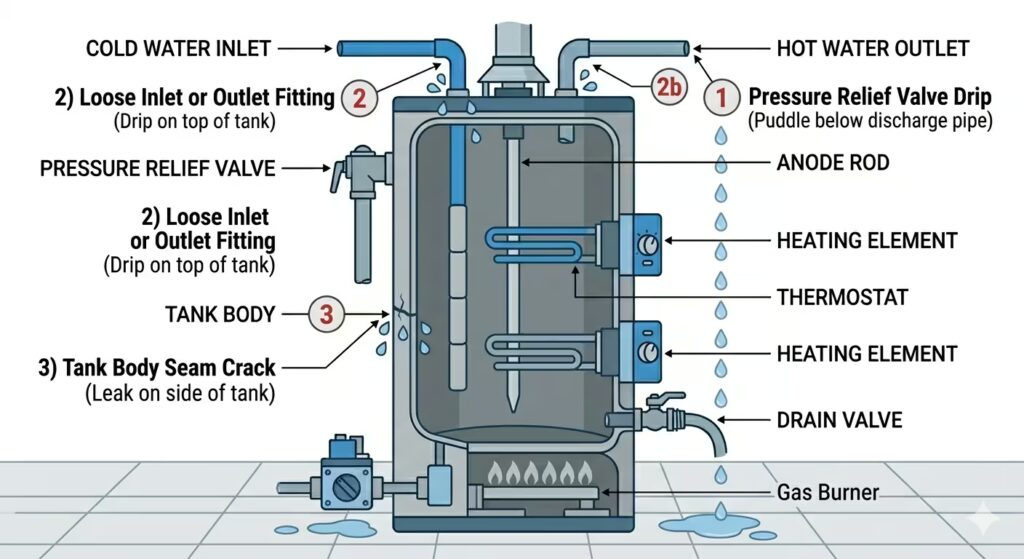
As metal tanks age, they expand and contract with each heating cycle. Over many years, this stress creates tiny fractures in the tank body. These cracks may be invisible, but allow water to seep through when the metal expands under heat.
Before assuming the tank itself is leaking, check the fittings and connections. Loose inlet and outlet connections, a dripping pressure relief valve, or a faulty drain valve can all cause pooling without compromising the tank itself.
| IMPORTANT: A cracked tank cannot be repaired |
|---|
| If the leak is traced to the tank body itself and not to a fitting or valve, the unit must be replaced. There is no reliable repair for a cracked water heater tank. Attempting to seal it is at best a temporary measure. |
Sign 5: Inconsistent Water Temperature
Water that fluctuates between hot, warm, and cold during use, without you adjusting anything, points to a failing thermostat or heating element.
In electric water heaters, most units have two heating elements. If one fails, the remaining element struggles to keep up with demand, producing inconsistent temperatures.
In gas units, a faulty thermocouple or a partially blocked burner can cause irregular heating. Both are repairable by a licensed plumber or HVAC technician, but if the unit is already old, the repair cost may not justify keeping it.
Sign 6: The Unit Is Over 10 Years Old
Age alone is not a failure, but it is a significant risk factor. Most conventional tank water heaters have a reliable lifespan of 8 to 12 years.
After the 10-year mark, components deteriorate faster. The anode rod is likely depleted, internal corrosion is more advanced, and efficiency has dropped noticeably from the unit’s original rating.
You can find the manufacture date on the serial number label, usually on a sticker near the top of the unit. The format varies by brand, but most encode the year and month in the first few characters.
| Unit Age | Risk Level | Recommended Action |
| Under 6 years | Low | Annual flush, monitor normally |
| 6 to 10 years | Moderate | Inspect the anode rod, check for signs |
| 10 to 12 years | High | Plan for replacement, watch closely |
| Over 12 years | Very high | Replace proactively if possible |
| RELATED: How Long Does a Water Heater Last — and When Should You Replace It? |
|---|
| Age is just one piece of the replacement decision. Read our full guide on what other factors are involved and how to plan the timing of a replacement on your own terms. |
Sign 7: Rising Energy Bills With No Other Explanation
A water heater that is struggling to maintain temperature runs longer and more frequently than a healthy unit. This shows up as a steady increase in your gas or electricity bill.
If your energy usage has crept upward and you have not changed your habits or added appliances, the water heater is one of the first things to investigate.
Sediment insulates the heating element from the water, forcing the unit to consume more energy to reach the set temperature. This inefficiency compounds over time as sediment accumulates.
Repair or Replace: How to Make the Decision
Not every warning sign means the unit needs to be replaced immediately. Some issues are worth repairing. Others make more financial sense to replace.
Use this general framework to guide your decision:
| Situation | Likely Best Action |
| Unit under 6 years old, single issue | Repair |
| Faulty thermostat or one heating element | Repair |
| Unit 8 to 10 years old with one issue | Evaluate repair cost vs replacement |
| Multiple signs are present at the same time | Replace |
| Unit over 10 years old with any sign | Replace |
| Leaking tank body | Replace immediately |
A useful rule of thumb is the 50 percent rule. If a repair costs more than 50 percent of the price of a new unit, replacement is almost always the better investment.
| RELATED: Tankless vs. Tank Water Heaters — Which Is Right for Your Home? |
|---|
| If replacement is on the table, it is worth considering whether a tankless unit makes sense for your household. Read our comparison guide before committing to another tank. |
How to Extend Your Water Heater’s Life
Most water heater problems are preventable with basic annual maintenance. These tasks take less than an hour and cost almost nothing.
- Flush the tank once a year to remove sediment before it accumulates
- Inspect and replace the anode rod every 3 to 5 years
- Check the pressure relief valve annually to confirm it opens and closes correctly
- Keep the area around the unit clear and dry
- Set the thermostat to 120 degrees Fahrenheit to reduce strain and energy use
- Insulate older tanks with a water heater blanket to improve efficiency
| TOOL: Water Heater Replacement Cost Calculator |
|---|
| Wondering what a new unit will cost before you call a plumber? Use our free calculator to get an instant estimate based on your heater type, fuel source, and location. |
Frequently Asked Questions
Can I still use my water heater if it is making noise?
Yes, in most cases. Noise alone does not mean the unit is unsafe. It does mean sediment is present, and the unit should be flushed soon.
If the noise is accompanied by leaks, fluctuating temperatures, or discolored water, have the unit inspected before continuing to use it.
How do I find the age of my water heater?
Look for the serial number label on the unit, usually near the top. Most manufacturers encode the manufacture date in the first four characters of the serial number.
Brand-specific decoder guides are available online. Search for your brand name and “serial number date decoder” to find the right format.
Is discolored water dangerous?
Rusty water from a corroding tank is not ideal for drinking or cooking. It is unlikely to cause acute illness, but should be addressed promptly.
Run the hot tap until the water clears before using it. If discoloration persists, stop using the hot water for consumption and arrange an inspection.
What is the pressure relief valve, and should I be worried if it drips?
The pressure relief valve is a safety device that releases pressure if the tank overheats or over-pressurizes. An occasional drip under high demand can be normal.
A valve that drips constantly or discharges repeatedly is malfunctioning. This needs attention from a plumber, as a stuck-open valve can indicate dangerously high pressure inside the tank.
Should I repair or just replace a 9-year-old water heater?
At 9 years old, a single minor repair, like a thermostat or element replacement, is reasonable if the rest of the unit is in good condition.
If the repair is significant or multiple signs are present, replacing now avoids the cost of a second repair in two or three years on an aging unit.
Do Not Wait for the Cold Shower
A water heater rarely fails dramatically without giving you advance notice. The seven signs above are your warning window.
Acting on one or two signs early keeps you in control of the timing and the cost. Waiting until the unit fails completely takes that control away entirely.
If you are seeing multiple signs at once, or if your unit is over 10 years old and showing any of these symptoms, start planning your replacement now. The difference between proactive and reactive in this case can be hundreds of dollars and a very unpleasant few days.