When a water heater needs replacing, most homeowners face this question for the first time: Should I stick with a tank or switch to a tankless model?
Both types have genuine advantages. The right answer depends on your household size, budget, how much hot water you use, and how long you plan to stay in the home.
This guide walks through every meaningful difference between the two so you can make a confident decision before calling a plumber.
How Each Type Works
Tank water heaters
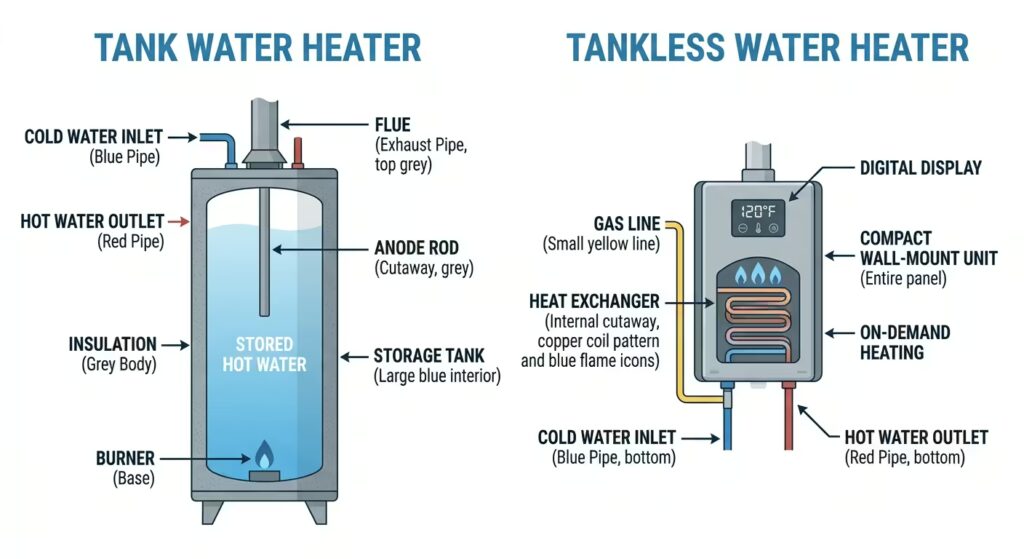
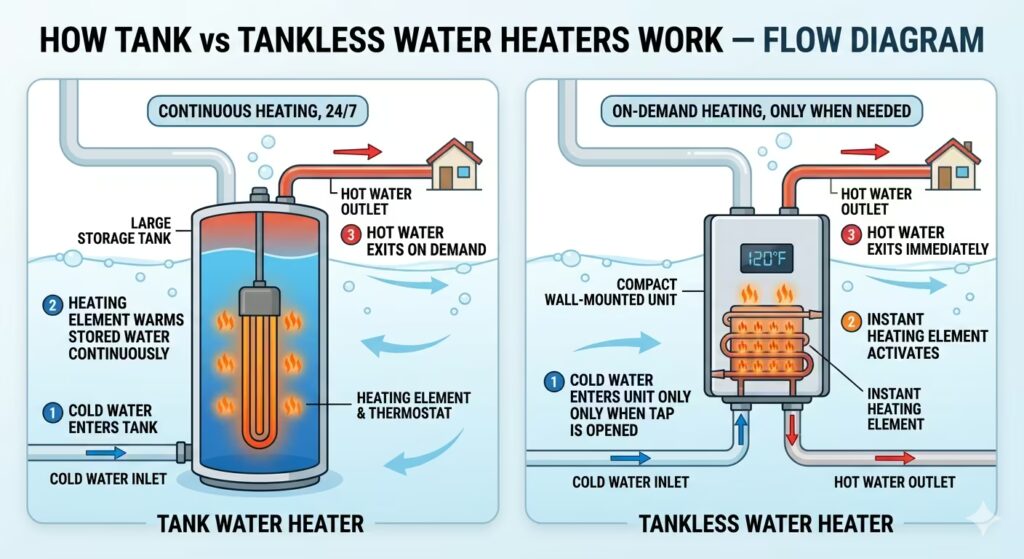
A tank water heater stores a fixed volume of water, typically 40 to 80 gallons, and maintains a constant temperature. When you turn on a hot tap, preheated water flows out, and cold water enters the tank to be heated for the next use.
The standby heating required to keep that stored water hot at all times is the tank’s biggest inefficiency. The unit is consuming energy even when no hot water is being used.
Tankless water heaters
A tankless unit heats water on demand. When a hot tap is opened, cold water flows through the unit and is heated instantly by a gas burner or electric element.
There is no stored water and no standby heat loss. The unit only consumes energy when hot water is actively being drawn. This is where the efficiency advantage comes from.
Upfront Cost: Tank Wins
This is the clearest difference between the two types. A traditional tank water heater costs significantly less to purchase and install.
A standard tank unit typically costs between $400 and $900. Installation by a licensed plumber adds another $200 to $600, bringing the total to roughly $600 to $1,500, depending on your location and the unit size.
A tankless unit costs considerably more upfront. The unit itself ranges from $700 to $1,500 for a gas model and from $400 to $900 for an electric model. Installation, however, is where costs climb sharply.
Tankless installation often requires new gas lines, upgraded electrical panels, or additional venting. Total installed cost typically runs from $1,500 to $3,500 or more, depending on what upgrades your home needs.
| Cost Factor | Tank Heater | Tankless Heater |
| Unit cost | $400 to $900 | $700 to $1,500 (gas) |
| Installation | $200 to $600 | $800 to $2,000+ |
| Total installed | $600 to $1,500 | $1,500 to $3,500+ |
| Lifespan | 8 to 12 years | 20 years or more |
| Annual energy cost | Higher | Lower by 24 to 34% |
| TOOL: Water Heater Replacement Cost Calculator |
|---|
| Get a personalised cost estimate for your specific situation before calling a contractor. Our free calculator covers both tank and tankless options across all fuel types. |
Energy Efficiency: Tankless Wins
The US Department of Energy estimates that tankless water heaters are 24 to 34 percent more energy efficient than tank heaters for homes that use 41 gallons or less of hot water per day.
For higher-usage households, the efficiency gain is somewhat lower but still meaningful. Over the unit’s lifetime, those savings add up significantly.
The payback period — the point at which energy savings offset the higher upfront cost — is typically 6 to 12 years, depending on your energy rates, usage habits, and what type of tankless unit you install.
| Worth noting for renters |
|---|
| If you are renting and the landlord is replacing the water heater, the efficiency benefit of a tankless unit matters less to you directly, since you are not paying for the unit. What matters more is the availability and reliability of hot water. |
Hot Water Supply: It Depends on Your Household
Where tank heaters have the edge
A tank heater delivers a ready supply of hot water immediately. When multiple taps or appliances run simultaneously, a large tank handles the demand without hesitation.
For households that regularly run a shower, dishwasher, and washing machine at the same time, a well-sized tank handles that load reliably.
Where tankless heaters have the edge
A tankless unit never truly runs out of hot water. As long as demand does not exceed the unit’s flow rate, it will continue to produce.
This makes tankless ideal for households where hot water is used in sequence rather than simultaneously, such as a family that showers one after another rather than all at once.
The flow rate limitation
Every tankless unit has a maximum flow rate measured in gallons per minute (GPM). If simultaneous demand exceeds that rate, the water temperature drops.
A whole-house gas tankless unit typically delivers 5 to 10 GPM, which is sufficient for most households. Electric tankless units often have lower flow rates and are better suited for point-of-use applications than for whole-house supply.
| Household Scenario | Better Fit |
| Large family, simultaneous hot water use | Tank (large capacity) |
| Sequential use, one at a time | Tankless |
| Small household, 1 to 2 people | Either — tankless is more efficient |
| Vacation home or low-use property | Tankless |
| Tight budget, straightforward replacement | Tank |
Lifespan: Tankless Wins by a Wide Margin
A traditional tank water heater lasts 8 to 12 years with regular maintenance. After that, replacement is typically necessary regardless of how well the unit was cared for.
A tankless unit, properly maintained, routinely lasts 20 years or more. The components are modular and replaceable, meaning individual parts can be swapped out rather than replacing the entire unit.
This longevity significantly changes the financial calculation. Over a 20-year period, you would likely replace a tank unit at least once, while a tankless unit installed today could still be running.
| RELATED: How to Tell If Your Water Heater Is Failing |
|---|
| If your current tank is already showing warning signs, read our guide on the seven symptoms that indicate a unit is nearing the end of its useful life. |
Space Requirements: Tankless Wins
A 50-gallon tank water heater is a large appliance. It takes up a dedicated corner of a utility room, basement, or closet and cannot be installed in confined spaces without adequate clearance.
A tankless unit is typically the size of a large wall-mounted cabinet. It can be installed in tight spaces, on exterior walls, or even outdoors in mild climates.
For apartments, condos, and smaller homes where space is at a premium, this size difference is genuinely significant.
Maintenance Requirements
Tank heaters
Annual flushing to remove sediment is the primary maintenance task. The anode rod should be inspected every 3 to 5 years and replaced when depleted.
These tasks can be handled by a confident homeowner and take less than an hour each. Skipping them noticeably shortens the unit’s lifespan.
| RELATED: How to Flush a Water Heater |
|---|
| Annual flushing is the single most important maintenance task for a tank heater. Read our step-by-step guide to doing it yourself safely and correctly. |
Tankless heaters
Tankless units require annual descaling, particularly in areas with hard water. Mineral buildup inside the heat exchanger reduces efficiency and can damage the unit if ignored.
This process involves running a descaling solution through the unit using a small pump. It takes about an hour and is manageable for a DIY-comfortable homeowner.
Gas tankless units should also be inspected by a technician every few years to check the burner, venting, and gas connections.
Fuel Type Considerations
Both tank and tankless water heaters are available in gas and electric models. The fuel type affects both operating cost and installation requirements.
Gas
Gas heaters heat water faster and typically cost less to operate than electric heaters in most US regions. Gas tankless units deliver higher flow rates than electric models, making them better suited for whole-house use.
Gas installation requires proper venting. Tankless gas units require either a dedicated direct-vent system or a condensing unit that handles venting differently. Both add to the installation cost.
Electric
Electric tank heaters are simpler to install and widely available. Electric tankless units are best suited for point-of-use applications, such as a single bathroom or kitchen sink, rather than supplying an entire home.
In regions with high electricity rates, an electric tankless unit may offer less savings than expected. Check your local rates before making a fuel-type decision.
Heat pump water heaters
A heat pump water heater is a third option worth knowing about. It uses electricity to move heat from the surrounding air into the water rather than generating heat directly.
Heat pump units are the most energy-efficient option available, using roughly 60 percent less electricity than a conventional electric tank. They work best in climates where the surrounding air stays above 40 degrees Fahrenheit year-round.
Upfront cost is higher than a standard electric tank but lower than most gas tankless installations. They qualify for federal energy efficiency tax credits, which reduces the effective cost.
Which Type Is Right for You?
There is no universal answer. The right choice depends on your specific circumstances.
Choose a tank water heater if:
- You need a straightforward, lower-cost replacement
- Your household has a high simultaneous hot water demand
- Your home does not have the gas line or electrical infrastructure for a tankless system
- You plan to sell the home within a few years
- You are renting, and the landlord is covering the cost
Choose a tankless water heater if:
- You plan to stay in the home long enough to recoup the higher upfront cost
- Energy efficiency and lower monthly bills are a priority
- You have limited installation space
- Your household uses hot water sequentially rather than simultaneously
- You want a unit that will last 20 years without full replacement
Frequently Asked Questions
Can a tankless water heater supply a whole house?
Yes, a properly sized gas tankless unit can supply an entire home. The key is matching the unit’s GPM flow rate to your peak household demand.
A plumber can calculate the right size based on the number of fixtures and appliances that may run simultaneously in your home.
Does tankless water actually arrive at the tap faster?
Not necessarily. A tankless unit still takes time for hot water to travel from the heater to the tap. In larger homes, this wait can actually be longer than with a nearby tank.
Point-of-use tankless units installed near a specific fixture effectively solve this problem in that location.
What happens to a tankless heater during a power outage?
Both gas and electric tankless units require electricity to operate their controls and ignition systems. During a power outage, neither type will produce hot water.
A tank heater, by contrast, holds already-heated water that remains usable for several hours after power is lost.
Are there rebates or tax credits for tankless water heaters?
Yes. Energy-efficient water heaters, including gas condensing tankless units and heat pump water heaters, often qualify for federal tax credits and utility rebates.
Check the current Database of State Incentives for Renewables and Efficiency (DSIRE) at dsireusa.org for what is available in your state.
How do I know what size tank I need?
Tank size is measured by first-hour rating (FHR), which indicates how much hot water the unit delivers in the first hour of use. Match the FHR to your household’s peak hour demand.
A general guide: 1 to 2 people need a 30 to 40-gallon tank; 3 to 4 people need a 50 to 60-gallon tank; 5 or more people need a 60 to 80-gallon tank.
The Best Water Heater Is the One That Fits Your Life
Tankless wins on efficiency, lifespan, and space. Tank wins on upfront cost, installation simplicity, and simultaneous demand.
If you are replacing a failing unit on a budget and need something installed quickly, a good-quality tank heater is a perfectly sound choice.
If you are planning ahead, have the budget for a higher upfront investment, and want a unit that outlasts the next two tank replacements, tankless is worth the cost.
Either way, getting the sizing right and having it installed properly by a licensed plumber makes more difference than the type you choose.