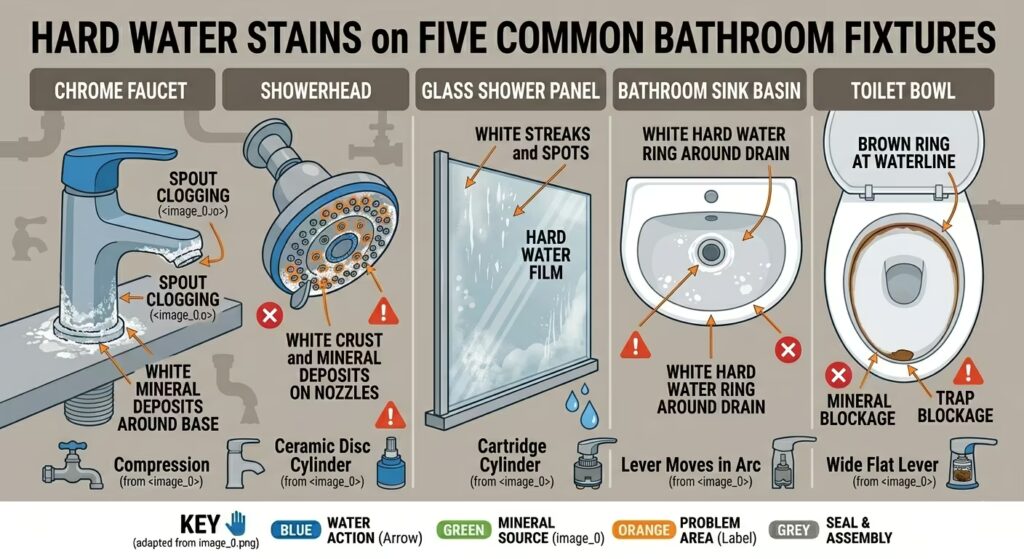
Hard water stains are one of the most persistent cleaning problems in the bathroom. They appear as white, chalky deposits on faucets, a crusty buildup around showerhead nozzles, and cloudy film on glass surfaces.
The good news is that these stains are mineral deposits, not permanent damage. They respond reliably to acid-based cleaning, whether from white vinegar or a commercial descaler. The key is matching the right method to the right surface.
This guide covers removal methods for every common bathroom fixture and finish, including what not to use on surfaces that acid can damage.
What Hard Water Stains Actually Are
Hard water contains elevated levels of dissolved calcium and magnesium. When water evaporates from a surface, these minerals are left behind as white or off-white deposits. Over time, layers build up into the visible crusty staining that is so common in bathrooms.
The harder your water, the faster these deposits accumulate. Areas with limestone-rich soil typically have the hardest water, which is why hard-water staining is more severe in some regions than in others.
Because the deposits are alkaline mineral compounds, they dissolve readily in mild acids. This is why vinegar and citric acid work so well on them.
| Stain Appearance | Cause | How Hard to Remove |
| White or off-white chalky film | Calcium deposits from evaporated water | Easy to moderate |
| Thick white or grey crust | Heavy mineral buildup over months | Moderate to difficult |
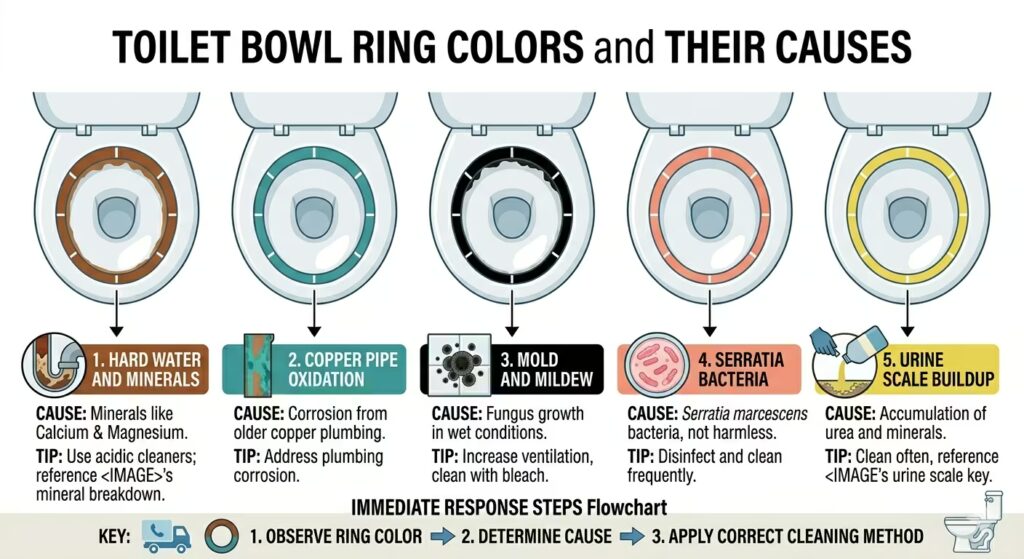
| Orange or rust-coloured stains | Iron in the water supply | Requires an iron-specific remover |
| Green or blue-green staining | Copper pipe oxidation in water | Acid cleaner, similar to mineral deposits |
What Cleaners Are Safe on Each Surface
Using the wrong cleaner on the wrong finish causes permanent damage. Acid-based cleaners work brilliantly on most mineral deposits but can strip protective coatings on certain finishes.
| Surface or Finish | Safe Methods | Avoid |
| Chrome | Vinegar, citric acid, CLR | Abrasive scrubbers |
| Brushed nickel | Diluted vinegar, gentle acid cleaners | Undiluted strong acid, bleach |
| Oil-rubbed bronze | Mild soap and water only | All acid cleaners strip the finish |
| Matte black fixtures | Mild soap and water, diluted vinegar briefly | Prolonged acid exposure, abrasives |
| Porcelain and ceramic | Vinegar, baking soda, CLR | Steel wool, abrasive pads |
| Glass shower panels | Vinegar, citric acid, and commercial glass cleaner | Steel wool, razor blades on tempered glass |
| Natural stone (marble, granite) | Stone-specific pH-neutral cleaner only | Vinegar and all acid cleaners etch stone |
| Acrylic and fiberglass | Diluted vinegar, citric acid spray | Abrasive scrubbers, acetone |
| Natural stone is the exception to every rule |
|---|
| Marble, travertine, and granite are made of calcium carbonate, the same compound in hard water deposits. Acid dissolves them both. Never use vinegar, citric acid, or any commercial descaler on natural stone surfaces. Use only a pH-neutral stone cleaner. |
Removing Hard Water Stains by Fixture
Faucets and taps
Hard water deposits on faucets typically form around the base, around the aerator, and on the spout tip. White vinegar is the most effective everyday remover.
- Soak paper towels or a cloth in undiluted white vinegar.
- Wrap the cloth around the affected areas and leave it on for 30 minutes to 2 hours, depending on the severity of the buildup.
- Scrub with an old toothbrush to work the loosened deposits out of crevices.
- Rinse thoroughly and dry. Drying immediately after cleaning prevents new deposits from forming.
For the aerator at the tip of the spout, unscrew it by hand and drop it into a small bowl of undiluted white vinegar. Leave for an hour. The mineral deposits in the screen will dissolve completely.
Showerhead
Clogged showerhead nozzles are among the most common complaints about hard water. Mineral deposits block the spray holes, weakening the flow and creating uneven spray patterns.
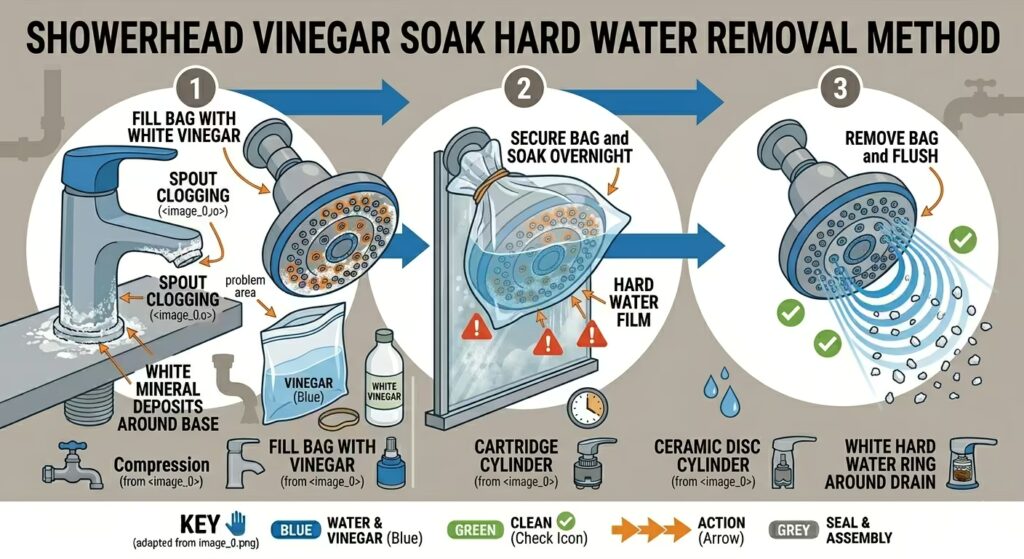
- Fill a plastic bag with undiluted white vinegar. Enough to submerge the showerhead nozzles.
- Secure the bag around the showerhead with a rubber band so the nozzle face is fully submerged in the vinegar.
- Leave for at least 2 hours. For a heavily clogged showerhead, leave it overnight.
- Remove the bag and run the shower on hot for a minute to flush the loosened deposits through.
- Use an old toothbrush to scrub any remaining deposits from the nozzle holes.
| For a showerhead, you can remove |
|---|
| If the showerhead unscrews easily, remove it and soak it in a bowl of white vinegar for 2 hours rather than using the bag method. This gives better access for scrubbing the nozzle face and the internal screen. |
Glass shower panels and shower doors
Glass shower panels develop a milky film from mineral deposits over the entire surface. Daily splashing leaves a thin layer that gradually builds into an opaque haze.
- Mix equal parts white vinegar and warm water in a spray bottle.
- Spray the entire glass surface generously and leave for 15 to 30 minutes.
- For heavy buildup, apply undiluted vinegar directly and leave for up to an hour.
- Scrub with a non-scratch sponge in circular motions.
- Rinse with clean water, then immediately dry with a squeegee or a lint-free cloth. This step is critical. Leaving water on the glass after cleaning causes new deposits to form immediately.
For particularly stubborn glass haze, make a paste from cream of tartar and white vinegar. Apply it to the glass, leave it on for 15 minutes, then scrub it off. Cream of tartar is mildly acidic and adds a gentle abrasive action without scratching.
Bathroom sink and basin
Hard water rings form around the drain opening and at the waterline in sinks that hold standing water. Porcelain and ceramic sinks tolerate vinegar well.
- Plug the drain and fill the basin with equal parts hot water and white vinegar.
- Leave to soak for 30 minutes to an hour.
- Drain and scrub with a non-scratch cloth, focusing on the ring line around the drain.
- For the tap base area, use the paper towel soaking method described in the faucet section above.
Toilet bowl hard water ring
A brown or rust-colored ring at the toilet waterline is almost always a hard-water mineral deposit. Standard toilet cleaners have a limited effect on these. Acid-based approaches work far better.
- White vinegar: Pour two cups into the bowl and let it soak for 30 minutes to overnight. Scrub and flush.
- Baking soda and vinegar: Add 1 cup of baking soda, then 1 cup of vinegar. Let it fizz for 20 minutes, scrub, and flush.
- Pumice stone: A wet pumice stone rubbed gently over the ring removes mineral deposits that liquids cannot dissolve. Keep both the stone and the surface wet throughout. Never use a dry pumice stone on porcelain.
| RELATED: How to Get Rid of Toilet Bowl Ring |
|---|
| For a complete guide to every ring type, including brown, blue-green, black, and pink rings with specific treatments for each, read our dedicated toilet bowl ring article. |
Chrome fixtures and handles
Chrome is the most forgiving finish for hard water cleaning. White vinegar, citric acid sprays, and commercial descalers all work well without damaging the surface.
The one thing to avoid on Chrome is abrasive scrubbers. Steel wool and rough sponge pads scratch the chrome plating, leaving permanent dull marks that no cleaning will restore.
Natural Cleaning Methods That Work
Several household ingredients remove hard water stains effectively without harsh chemicals. They are safe for most surfaces, inexpensive, and do not produce fumes.
White vinegar
The most versatile hard water remover. The acetic acid in white vinegar dissolves calcium and magnesium deposits reliably on chrome, porcelain, ceramic, glass, and acrylic.
For light deposits, a spray and 15-minute soak is enough. For heavy buildup, overnight soaking with undiluted results in the best results.
Citric acid
Citric acid powder dissolved in warm water makes a powerful descaling solution that is gentler on sensitive finishes than vinegar. Mix one tablespoon per cup of warm water for a general cleaning spray.
Citric acid is particularly effective for removing buildup on showerheads and faucet aerators. It is also the active ingredient in many commercial descaling products sold at hardware stores.
Baking soda paste
A paste of baking soda and a small amount of water provides mild abrasive action combined with light alkaline cleaning. On its own, it does not dissolve mineral deposits, but combined with vinegar, the fizzing reaction helps loosen stubborn buildup.
Baking soda paste is safe on all bathroom surfaces, including those that cannot tolerate acid, making it a gentle scrub for matte black and oil-rubbed bronze fixtures where other cleaners could cause damage.
Lemon juice
Fresh lemon juice has similar acidity to diluted vinegar and works on light to moderate mineral deposits. It leaves a fresher scent than vinegar, though it is less economical for large-scale cleaning.
Cut a lemon in half and rub it directly over the affected surface. Leave the juice on for 10 to 15 minutes, then scrub and rinse.
When Natural Methods Are Not Enough
For thick, long-standing mineral deposits that have built up over months or years, commercial descalers work faster than natural methods.
CLR (Calcium, Lime, and Rust Remover)
CLR is one of the most widely available and effective commercial descalers. It dissolves calcium, lime, and rust deposits on contact and works well on chrome, porcelain, and glass.
Apply according to label directions, rinse thoroughly, and do not leave it on surfaces longer than recommended. CLR is too strong for natural stone, oil-rubbed bronze, and certain specialty finishes.
Bar Keepers Friend
Bar Keepers Friend is a powder or liquid cleaner containing oxalic acid. It works well on porcelain, ceramic, stainless steel, and glass.
It is slightly abrasive, so use a soft cloth rather than a scrubbing pad. It excels at removing the orange rust-coloured staining that standard vinegar does not fully address.
Lime Away
Similar in formulation to CLR, Lime Away is particularly effective on thick limescale buildup on faucets and showerheads. Safe for most plumbing finishes, but check the label before using on specialty surfaces.
How to Prevent Hard Water Stains From Returning
Once the fixtures are clean, preventing redepositing is far easier than repeated deep cleaning.
Dry after every use
The single most effective prevention habit is wiping fixtures and glass dry after each use. Mineral deposits only form when water evaporates on the surface. No evaporation means no deposits.
Keep a small squeegee in the shower for the glass panel and a microfibre cloth near each sink and tap. The habit takes 20 seconds and eliminates most hard-water staining.
Weekly vinegar spray
Once a week, spray fixtures and glass with diluted white vinegar and wipe them down. This dissolves fresh mineral deposits before they form thick stains, making cleaning effortless.
Water softener
If hard water staining is severe and returning within days of cleaning, treating the root cause is more effective than repeated cleaning. A whole-house water softener removes the calcium and magnesium ions from the water supply before they reach your fixtures.
Water softeners require installation by a plumber and a salt supply for ongoing operation. For homes in very hard-water areas, the savings in cleaning time, product costs, and reduced wear on fixtures and appliances make them worth considering.
Inline showerhead filter
An inline filter installed between the water supply and the showerhead specifically reduces mineral content in the shower water. Less expensive than a whole-house softener, it targets the areas where hard-water staining is most visible and most annoying.
Frequently Asked Questions
Will hard water stains eventually permanently damage my fixtures?
Surface mineral deposits do not damage the fixture finish itself, but a very thick buildup left for years can be difficult to remove without abrasion that risks scratching the surface.
Inside fixtures like showerheads and faucet aerators, heavy mineral buildup can permanently clog the small holes and screens if left unchecked for long enough. Regular cleaning prevents this from reaching the point of no return.
Why do hard water stains come back so quickly after I clean them?
If deposits reform within days, your water has very high mineral content, or you are not drying the surfaces after use. In very hard water areas, even a few hours of standing water on a surface can leave visible deposits.
Drying fixtures after use and a weekly vinegar spray keep surfaces clean with minimal effort in most hard water situations.
Can I use vinegar on all my bathroom fixtures?
No. Vinegar is safe on chrome, porcelain, ceramic, glass, acrylic, and most standard finishes. It should not be used on natural stone such as marble or granite, as it etches them. It should also be used with caution on oil-rubbed bronze and matte black specialty finishes, where prolonged exposure dulls the surface.
When in doubt about a specialty finish, test a small hidden area first and rinse quickly.
The mineral buildup on my showerhead is so thick that it barely sprays. Is it too far gone?
Very rarely. Even severely blocked showerheads almost always respond to an overnight vinegar soak followed by scrubbing. If a single soak does not clear it completely, repeat the process.
If the showerhead has not been cleaned for several years and the metal itself is corroding around the blocked nozzles, replacement is more practical than continued cleaning. A basic showerhead is inexpensive, and an upgrade is an easy DIY job.
| RELATED: How to Replace a Showerhead Yourself |
|---|
| If the buildup is beyond cleaning or you simply want a new showerhead, read our step-by-step replacement guide. It takes under 20 minutes with no special tools. |
Is hard water dangerous to drink?
Hard water is safe to drink. The calcium and magnesium it contains are natural minerals and are not harmful in the concentrations found in household water supplies.
The effects of hard water are cosmetic and mechanical. It stains fixtures, leaves deposits on appliances, and reduces the effectiveness of soap. It has no adverse health effects for the vast majority of people.
Clean Fixtures With What You Already Have
Hard water stains are one of the most satisfying cleaning problems to solve because the solution is almost always already in the kitchen. White vinegar reliably and safely removes most bathroom mineral deposits.
Match the method to the surface, soak long enough for the acid to work, and rinse and dry thoroughly. Add a weekly maintenance spray, and the deep cleaning sessions become rare.
For the surfaces that vinegar cannot touch, such as natural stone, stick to pH-neutral cleaners. Everything else in the bathroom responds to the simple, inexpensive approach.