Most households own a plunger. Far fewer own a drain snake. When a drain blocks, most people reach for the plunger first — which is right about half the time and completely wrong the other half.
The plunger and the drain snake work in fundamentally different ways and excel at different types of clogs. Using the wrong tool wastes time and sometimes makes the blockage harder to clear.
This guide explains exactly how each tool works, which situations call for which, and when using both together is the fastest path to a clear drain.
Quick Answer: Which Tool for Which Clog?
| Clog Type | Best Tool | Why |
| Toilet — soft waste and paper | Plunger first | Pressure dislodges soft blockages fast |
| Toilet — foreign object | Toilet auger | Hook and retrieve — plunger pushes it deeper |
| Shower or tub — hair clog | Drain snake | Hook and pull — plunger cannot grab hair |
| Kitchen sink — grease buildup | Plunger then snake | Plunger loosens, snake clears residue |
| Bathroom sink — soap and hair | Drain snake | Pull out the physical clog directly |
| Deep pipe clog (past the trap) | Drain snake | Plunger cannot reach that far |
| Multiple drains blocked at once | Neither — call a plumber | Main sewer line issue |
How a Plunger Works
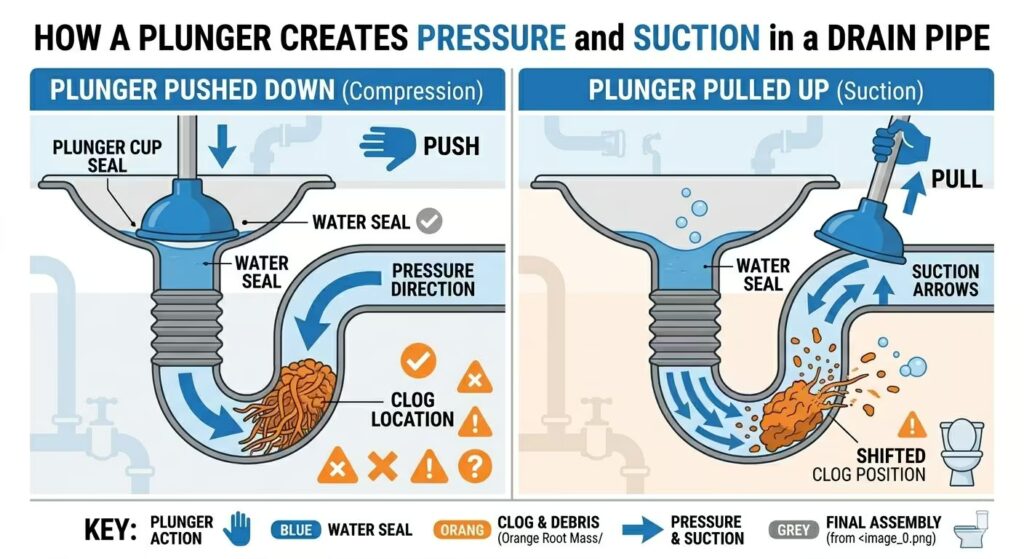
A plunger does not grab or break up a clog. It creates alternating pressure and suction through the water in the pipe, generating a hydraulic force that pushes and pulls the blockage until it dislodges and moves through the pipe.
This makes a plunger highly effective on soft, compressible clogs — built-up waste, toilet paper, and loose grease accumulations that can be forced through the pipe. It is far less effective against physical obstructions such as tangled hair, solid foreign objects, or hard mineral scale that cannot be compressed or moved by pressure alone.
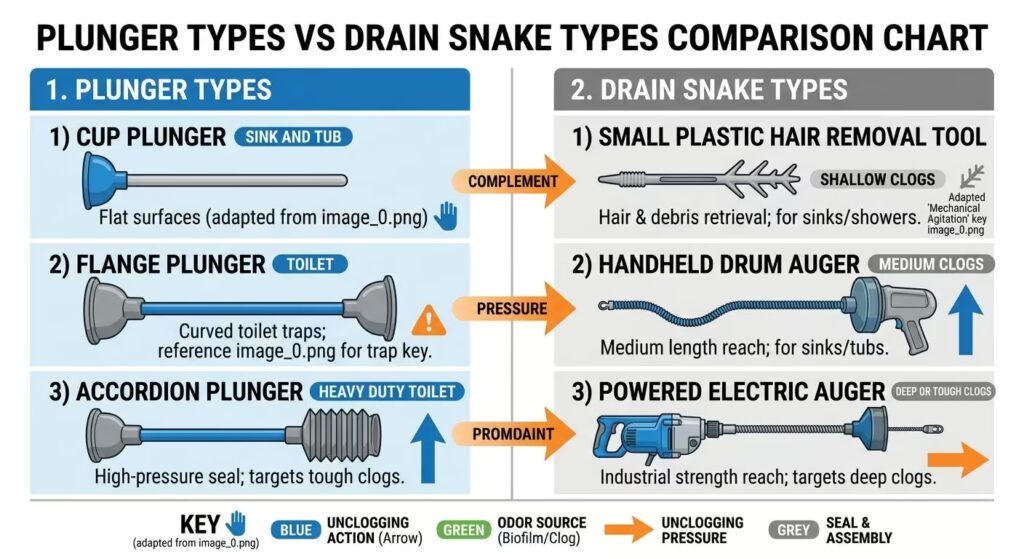
The three plunger types and when to use each
| Plunger Type | What It Looks Like | Use It For |
| Cup plunger | Flat rubber cup on a stick | Sinks, tubs, and shower drains — flat surfaces only |
| Flange plunger | Cup with a rubber fold extending from the bottom | Toilets — the flange fits into the drain opening for a proper seal |
| Accordion plunger | Hard plastic accordion bellows | Toilets — generates higher pressure than a flange plunger |
| The most common plunger mistake |
|---|
| Using a cup plunger on a toilet. A cup plunger cannot create a proper seal against the curved toilet drain opening. It looks like it is working but generates almost no actual pressure. Always use a flange or accordion plunger on a toilet. |
What a plunger does well
- Toilet clogs caused by waste and toilet paper are the most common type
- Kitchen sink clogs from loose grease and food debris sitting near the drain
- Partial blockages in any fixture drain that can be dislodged by pressure
- Fast first response — no setup, no mess beyond what is already there
What a plunger cannot do
- Remove a tangled hair clog — the hair catches on the drain walls and does not move under pressure
- Reach a clog sitting further than a foot or two past the trap
- Clear a clog caused by a foreign object that needs to be hooked and retrieved
- Fix a slow drain caused by mineral scale or pipe buildup — it has nothing to push
How a Drain Snake Works
A drain snake — also called a drain auger — is a flexible metal cable that is fed physically into the pipe. It either breaks up the blockage by rotating through it or hooks into it and retrieves it when pulled back.
Unlike a plunger, a drain snake engages the blockage directly. It can reach much further into the pipe and physically removes what it encounters rather than relying on pressure to move it.
The four drain snake types
| Snake Type | Reach | Best Use |
| Plastic hair removal tool | 6 to 12 inches | Shower and tub hair clogs just below the drain |
| Handheld drum auger | 15 to 25 feet | Sink, tub, and shower clogs into the pipe |
| Toilet auger (closet auger) | 3 to 6 feet | Toilet clogs — protected sleeve prevents bowl damage |
| Powered electric auger | 50 to 100 feet | Main line clogs and deep pipe blockages |
What a drain snake does well
- Hair clogs in showers, tubs, and bathroom sinks — hooks and pulls them out completely
- Clogs sitting further into the pipe that a plunger cannot reach
- Foreign objects that need to be hooked and retrieved rather than pushed
- Physical removal of the blockage material rather than just relocating it
What a drain snake cannot do
- Create pressure to dislodge compacted toilet paper and waste as quickly as a plunger
- Clean grease from the pipe walls — it passes through the coating without removing it
- Reach a main sewer line blockage without a long powered auger
- Navigate tight bends in some older pipe configurations without a flexible cable
Plunger vs Drain Snake: Head-to-Head by Situation
Blocked toilet
Start with a flange plunger. The vast majority of toilet clogs are soft blockages of waste and toilet paper sitting in or just past the trap. A plunger clears these in under two minutes with no mess beyond what is already there.
If the plunger fails after ten to fifteen strokes, switch to a toilet auger. A clog that does not respond to pressure is either a foreign object that needs to be hooked, or a compacted mass that needs to be physically broken up or retrieved.
Never use a standard drain snake in a toilet. A snake without the protective rubber sleeve of a toilet auger will permanently scratch the porcelain bowl.
| RELATED: How to Unclog a Toilet Without a Plunger |
|---|
| No plunger available? Read our five-method guide for clearing a toilet clog using dish soap, baking soda, a wire hanger, a plastic bottle, or a toilet auger. |
Blocked shower or bathtub drain
Go straight to the drain snake — specifically a plastic hair removal tool first, then a drum auger if needed. Shower and tub clogs are almost always hair tangles combined with soap scum, and a plunger simply cannot grab and remove tangled hair.
A plunger applied to a hair clog pushes the tangle further into the pipe rather than clearing it. You may get a temporary improvement as the loosened hair moves slightly, but the clog reassembles within hours.
Pull the drain cover, insert the hair removal tool, rotate it, then pull. The entire clog usually comes out in one or two passes.
Blocked kitchen sink
Try the plunger first for a completely blocked kitchen sink — a double-plunge technique works well here. Cover the second drain in a double sink with a wet cloth, place the cup plunger over the blocked drain, and pump firmly.
For a slow kitchen sink rather than a fully blocked one, a plunger is less effective because there is no standing water to create a proper seal. Use a drain snake to physically break up and retrieve the grease and food debris accumulation inside the pipe.
For recurring kitchen sink clogs, the most effective long-term approach is a monthly baking soda-and-vinegar flush, combined with running hot water for 30 seconds after every use, to keep grease moving through the pipe.
| RELATED: How to Unclog a Drain Without Chemicals. |
|---|
| Kitchen drain clogs respond well to several chemical-free methods before you reach for a snake. Read our five-method guide, including the baking soda flush and the wet-dry vacuum technique. |
Blocked bathroom sink
A bathroom sink drain snake — specifically pulling the stopper and using a small drum auger — clears bathroom sink clogs more reliably than a plunger in almost every case.
Bathroom sinks clog primarily from soap scum and hair accumulation on the stopper and just inside the drain pipe. This physical material needs to be removed, not pressured through. A plunger may temporarily clear the water standing in the basin, but the clog remains in the pipe.
Remove the stopper first and clean it — the underside is often the primary source of both the clog and any smell. Then use a small drain snake if the drain still flows slowly.
| RELATED: Why Does My Drain Smell? |
|---|
| A bathroom sink that clogs repeatedly is also likely to smell. Read our guide to identifying the specific cause of drain odors by location and the quick fix for each. |
When to Use Both Tools Together
The plunger and drain snake are not competitors — they address different parts of the same problem and are often most effective when used in sequence.
The most productive approach for a stubborn sink or tub clog is to plunge first, then snake. The plunger loosens the blockage and moves it from the pipe wall. The snake then hooks and retrieves what the plunger has dislodged. This one-two approach clears clogs faster than either tool alone in many cases.
| Situation | Step 1 | Step 2 |
| Stubborn sink clog | Plunge to loosen | Snake to retrieve |
| Toilet clog — plunger failed | Plunge to compress | Toilet auger to hook or break up |
| Kitchen sink after grease clog | Kitchen sink after a grease clog | Hot water flush to clean pipe walls |
| Shower drain hair clog | Snake to pull hair out | Plunge to flush remaining debris |
What Every Household Should Own
You do not need a full set of drain tools. You need the right ones for the problems that actually happen in your home.
The minimum toolkit for any home
- One cup plunger — for sinks, tubs, and shower drains
- One flange plunger — for toilets
- A pack of plastic hair removal tools — for shower and tub drains- costs under two dollars
These three items handle the majority of household drain problems. The plastic hair removal tool, in particular, is one of the most cost-effective tools in the house — a two-dollar piece of plastic with barbs on it clears the most common drain clog in under a minute.
Worth adding if you have recurring clogs
- A handheld drum auger (15 to 25 feet) — reaches clogs past the trap that a hair tool cannot get to
- A toilet auger — for toilet clogs that consistently resist the plunger
Rent, not buy
- A powered electric drain auger — needed only for main line clogs, available at hardware stores for around $50 per day
Common Mistakes That Make Clogs Worse
Both tools are straightforward to use, but can be misused in ways that push the clog deeper or damage the pipe.
Plunger mistakes
- Using a cup plunger on a toilet — wrong seal, almost no pressure generated
- Not covering the overflow hole in a sink — pressure escapes, and the plunge is ineffective
- Plunging with the drain dry — you need enough water in the basin to cover the plunger cup
- Short, shallow strokes — use full, deliberate push-and-pull cycles to generate real hydraulic force
Drain snake mistakes
- Using a standard snake in a toilet without a protective sleeve — scratches porcelain permanently
- Forcing the cable when it meets firm resistance — rotate gently first to feel whether it is a clog or a pipe bend
- Pulling the cable back too fast — the clog may drop back into the pipe before you retrieve it
- Not cleaning the cable after use — hair and debris left on the cable corrode it and transfer bacteria next time
Frequently Asked Questions
Can I use a drain snake on a toilet?
Only if it is a toilet auger — a drain snake specifically designed for toilets with a rubber protective sleeve over the cable where it contacts the bowl. A standard drum auger or handheld snake inserted into a toilet will scratch the porcelain.
The toilet auger’s short reach of 3 to 6 feet is intentional — toilet clogs almost always sit in the trap, which is within that range.
My plunger is not doing anything. When should I switch to a snake?
If 10 to 15 full pump-and-pull strokes produce no improvement and the water is not moving at all, switch tools. A clog that does not respond to sustained pressure is either a physical obstruction that needs to be hooked or a hair tangle that needs to be removed rather than pushed.
The exception is a toilet clog — give it more attempts with a flange plunger before switching, as toilet clogs often take longer to dislodge than sink clogs.
Do I need an electric drain snake, or will a manual one do?
For household drains — sinks, showers, tubs, and toilets — a manual handheld drum auger with a 15- to 25-foot cable handles the vast majority of clogs. These cost between $20 and $60 and are sufficient for everything up to and including stubborn branch line blockages.
An electric auger is only necessary for main sewer line work, where you need 75 to 100 feet of cable with enough torque to cut through compacted debris or roots. Rent one if you need it rather than buying.
Is it safe to use a drain snake on old pipes?
Yes, with care. Feed the cable gently and rotate slowly when you feel resistance to distinguish between a clog and a pipe bend. Aggressive rotation against a pipe wall can score older pipes, particularly those made of clay or cast iron.
If you have very old clay or Orangeburg pipes — common in homes built before the 1960s — and a clog that will not clear with a manual snake, call a plumber rather than escalating to powered equipment. Fragile pipes can be damaged by powered augering.
Why does my drain clog again soon after I clear it?
A clog that returns within days usually means the blockage was moved rather than removed. Plunging often pushes debris further into the pipe rather than clearing it entirely. Using a snake to physically retrieve the material after plunging produces a more lasting result.
A recurring kitchen drain clog is almost always a grease coating on the pipe walls that catches new debris each time it passes. A monthly baking soda and vinegar flush, combined with running hot water after cooking, helps prevent grease buildup.
Right Tool, Right Clog, Done in Minutes
The plunger and drain snake are both essential household tools. Neither one is universally better — they solve different problems and work best when matched to the right situation.
Keep both a cup plunger and a flange plunger in the house. Add a plastic hair removal tool and a small drum auger, and you are equipped to handle everything a typical home throws at you without calling a plumber.
When neither tool works and multiple drains are affected simultaneously, that is the signal to stop and call a professional. That situation is not a drain clog — it is a main sewer line problem that requires entirely different equipment.