Most homeowners do not think about their water heater until it stops working. By then, a replacement is urgent rather than planned, and urgent replacements are almost always more expensive.
Knowing how long your water heater should last and recognising when it is approaching the end of that window puts you back in control of the timing and cost.
This guide covers expected lifespans by heater type, the factors that shorten or extend them, and the clearest signals that replacement is the right call.
How Long Does Each Type of Water Heater Last?
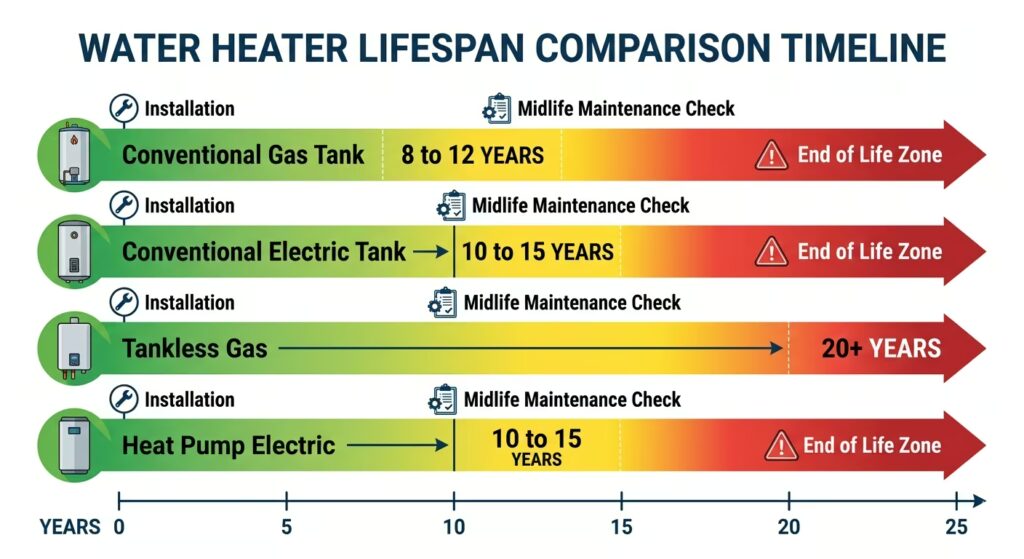
Lifespan varies significantly depending on the type of unit, the fuel source, and the level of maintenance. Here is what to expect from each.
| Water Heater Type | Average Lifespan | Well Maintained | Neglected |
| Conventional gas tank | 8 to 12 years | Up to 15 years | 6 to 8 years |
| Conventional electric tank | 10 to 15 years | Up to 18 years | 8 to 10 years |
| Tankless gas | 20 or more years | 25 or more years | 12 to 15 years |
| Tankless electric | 15 to 20 years | 20 or more years | 10 to 12 years |
| Heat pump water heater | 10 to 15 years | Up to 18 years | 8 to 10 years |
| Solar water heater | 20 or more years | 25 or more years | Varies widely |
Electric tank heaters tend to outlast gas tank units. The gas burner and its components are subject to more mechanical wear than electric heating elements.
Tankless units last the longest of all types, primarily because their modular design allows individual components to be replaced without scrapping the entire unit.
What Shortens a Water Heater’s Lifespan
The gap between a heater that lasts 8 years and one that lasts 15 is almost always explained by maintenance habits and installation quality, not luck.
Skipping annual flushing
Sediment buildup is the single biggest lifespan reducer for tank heaters. It forces the unit to work harder, raises operating temperatures, and accelerates corrosion of the tank lining.
A tank that is never flushed can lose several years of useful life compared to one that is flushed annually. It is also the primary cause of the popping and rumbling noises that signal a stressed heater.
| RELATED: How to Flush a Water Heater |
|---|
| Annual flushing is the most impactful maintenance task you can do for a tank water heater. Read our step-by-step guide to doing it yourself in under an hour. |
A depleted anode rod
The anode rod is a sacrificial metal rod inside the tank designed to corrode in place of the tank walls. When it is fully depleted, the tank itself begins to rust from the inside.
Most anode rods last 3 to 5 years. Replacing a depleted rod is a low-cost task that can add years to the tank’s life. Ignoring it is one of the fastest ways to shorten a heater’s useful life.
Water quality
Hard water accelerates mineral buildup on heating elements and tank interiors. Homes with very hard water should flush more frequently and may benefit from a water softener upstream of the heater.
Highly acidic water, common in some well-water systems, corrodes metal components faster than neutral municipal water. A water test can identify whether your supply is contributing to faster wear.
Oversized or undersized unit
A water heater that is too small for the household runs almost continuously, trying to keep up with demand. That constant cycling shortens the life of every component.
A unit that is too large for the household heats and reheats water that sits unused, wasting energy and subjecting the tank to more thermal cycles than necessary.
Installation quality
A poorly installed unit — with incorrect pressure settings, inadequate venting, or mismatched pipe connections — operates under more stress than one installed correctly.
Always use a licensed plumber for water heater installation. The savings from a cut-price job rarely outweigh the long-term cost of a unit running outside its design parameters.
How to Find Out How Old Your Water Heater Is
If you moved into a home without knowing the heater’s history, the age is encoded in the serial number on the unit’s label.
Most manufacturers embed the manufacture date in the first few characters of the serial number. The format varies by brand but typically encodes the year and month.
| Brand | Serial Number Format | Example |
| Rheem / Ruud | First digit = year, next two = week | F1234 = 2015, week 12 |
| A.O. Smith | First four digits = year and month | 2103 = March 2021 |
| Bradford White | Second letter = year code | Letter cycles A to Z |
| State / American | First four digits = year and week | 1612 = 2016, week 12 |
When in doubt, search your brand name and model number along with the phrase “serial number date decoder.” Most manufacturers publish a guide online.
Signs Your Water Heater Is Ready to Be Replaced
Age is only one factor. A unit approaching the end of its life usually gives clear signals well before it fails completely.
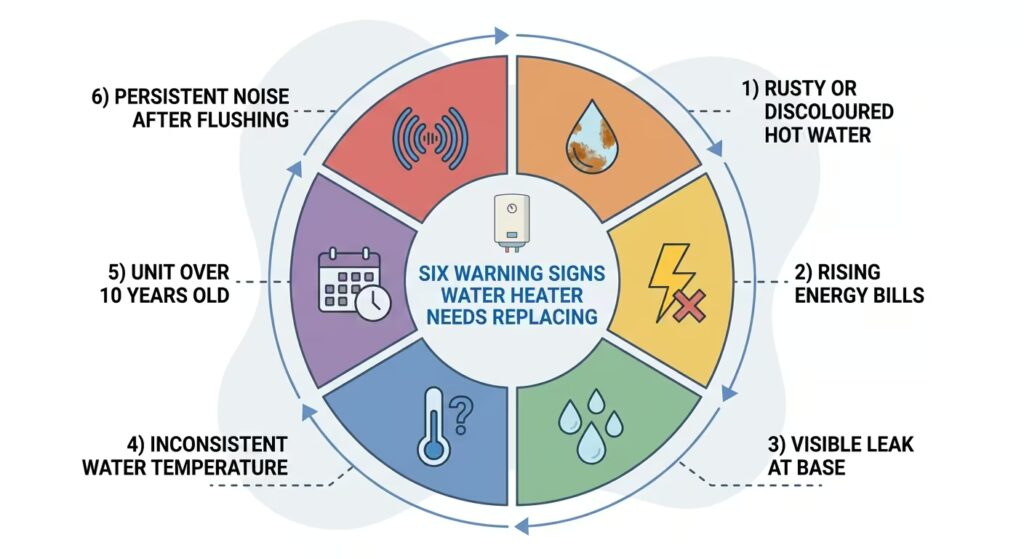
- Rusty or brown-tinted hot water that does not clear after running the tap for several minutes
- Persistent popping or rumbling that continues after a thorough flush
- Visible water pooling at the base of the unit that is not traced to a fitting or valve
- Hot water that runs out noticeably faster than it used to
- The unit is over 10 years old and is showing any of the above signs
- Energy bills are creeping upward with no other obvious cause
- Repair costs approaching or exceeding half the cost of a new unit
| RELATED: How to Tell If Your Water Heater Is Failing |
|---|
| Each of these warning signs has a specific cause and a specific action. Read our full diagnostic guide for a detailed breakdown of what each symptom means and how to address it. |
The Repair vs Replace Decision
Not every problem with an ageing water heater automatically means replacement. The right answer depends on the unit’s age, the nature of the fault, and the cost of repair.
A helpful framework is the 50 percent rule: if a repair costs more than half the price of a comparable new unit, replacement is usually the better financial decision.
| Situation | Unit Age | Recommended Action |
| Single failed heating element | Under 8 years | Repair |
| Faulty thermostat | Under 8 years | Repair |
| Leaking pressure relief valve | Under 8 years | Replace valve only |
| Sediment buildup, no other issues | Any age | Flush and monitor |
| Any repair on the ageing unit | 8 to 12 years | Weigh repair cost vs replacement |
| Leaking tank body | Any age | Replace immediately |
| Multiple issues at the same time | Over 10 years | Replace |
| Persistent rusty water | Over 10 years | Replace |
When Is the Best Time to Replace a Water Heater?
The best time to replace a water heater is before it fails, not after. An emergency replacement removes every advantage: you have no time to compare units, no choice about timing, and no ability to plan for the disruption.
If your unit is between 8 and 12 years old and showing one or more warning signs, start researching replacement options now. You do not need to act immediately, but having a clear preference before the unit fails saves significant stress and money.
Winter is often when a water heater is most likely to fail. Scheduling a proactive replacement in spring or autumn gives you more flexibility and sometimes better pricing from plumbers.
| RELATED: Tankless vs. Tank Water Heaters — Which Is Right for Your Home? |
|---|
| If replacement is on the horizon, it is worth considering whether to stick with a tank or upgrade to a tankless system. Read our full comparison before making the decision. |
How to Get the Most Years Out of Your Water Heater
The maintenance habits that extend a water heater’s life are consistent, low-effort, and inexpensive compared to replacing it early.
- Flush the tank once a year to remove sediment buildup
- Inspect and replace the anode rod every 3 to 5 years
- Set the thermostat to 120 degrees Fahrenheit — higher temperatures accelerate wear
- Test the pressure relief valve annually to confirm it opens and closes cleanly
- Insulate the first two feet of hot and cold water pipes connected to the unit
- Fix dripping taps and running toilets promptly — excess water use stresses the heater
- Schedule a professional inspection every 5 years for units over a decade old
| TOOL: Smart Home Plumbing Checklist |
|---|
| Track your annual water heater maintenance tasks alongside the rest of your home plumbing health in one place. Our interactive checklist keeps a running score and lets you print a record. |
Frequently Asked Questions
Does brand make a significant difference to lifespan?
Brand matters less than installation quality, water quality, and maintenance habits. A mid-range unit from any reputable manufacturer, properly installed and regularly maintained, will outlast a premium unit that is poorly maintained.
That said, units with longer warranty periods — 10 to 12 years versus 6 years — tend to use higher-quality components that support a longer service life.
Should I replace both hot and cold water pipes when replacing the heater?
Not always, but it is worth inspecting them together. If the pipes show signs of corrosion, scale buildup, or deterioration, replacing them during the same job saves a second call-out later.
Can a water heater last 20 years?
A conventional tank heater reaching 20 years is unusual but not impossible in areas with soft water and with consistent maintenance. Electric tank units are more likely to reach this than gas units.
Tankless units typically last 20 years or longer with proper annual descaling and component maintenance.
Is it worth getting a home warranty that covers water heaters?
It depends on your unit’s age. A home warranty covering a unit that is already 8 or more years old can offer good value, as the likelihood of a claim is meaningfully higher.
Read the terms carefully. Many home warranties cap the payout for replacements below the actual installation cost, leaving you to cover the difference.
What should I do with my old water heater?
Most plumbers will remove and dispose of the old unit as part of the installation job. Confirm this is included before booking.
If you are disposing of it yourself, check with your local municipality. Many areas have appliance recycling programmes or scheduled bulk pickup days that handle water heaters at no charge.
Know Your Unit’s Clock — Stay Ahead of It
A water heater does not last forever, but it does not have to catch you off guard either.
Know how old yours is, watch for the warning signs as it ages, and keep up with the basic annual maintenance that extends its useful life. Those three habits give you the information and the time to replace on your own schedule.
A planned replacement is cheaper and calmer, and it opens the door to choosing the right unit for your home rather than grabbing whatever is available on short notice.
| TOOL: Water Heater Replacement Cost Calculator |
|---|
| Before you call a plumber, get a ballpark figure for the cost of a replacement based on your heater type, fuel source, and location. Use our free calculator to go into the conversation prepared. |