A water heater that pops, rumbles, bangs, or hisses is telling you something. Most homeowners hear these sounds and either ignore them or assume the unit is about to fail.
The truth is usually less dramatic — but still worth addressing. Different sounds point to different causes, and understanding which is which tells you exactly what action to take.
This guide breaks down every common water heater noise, explains what is causing it, and tells you whether it is a DIY fix, a call to a plumber, or a sign that the unit needs replacing.
Quick Reference: Water Heater Noises at a Glance
| Sound | Most Likely Cause | Action Needed |
| Popping | Sediment at the bottom of the tank | Flush the tank |
| Rumbling | Heavy sediment buildup | Flush; consider replacement if old |
| Sediment at the bottom of tank | Water hammer in pipes | Leak at the valve or fitting |
| Hissing | Ticking/tapping | Inspect all connections and valves |
| Banging/knocking | Pipe expansion from heat | Usually normal, monitor only |
| Screeching | Partially closed valve | Fully open the inlet valve |
| Crackling (electric) | Scale on the heating element | Descale or replace the element |
Popping and Rumbling: The Most Common Culprit
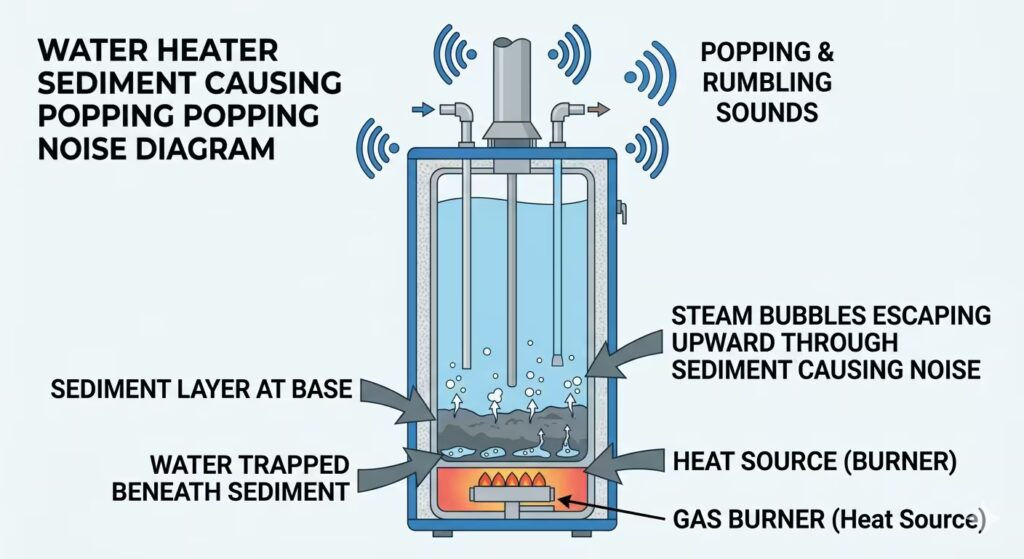
A popping or rumbling sound from your water heater is almost always caused by sediment buildup at the bottom of the tank. This is by far the most common complaint about water heater noise.
Over time, minerals such as calcium and magnesium dissolved in your water supply settle at the bottom of the tank each time the water is heated. These deposits form a dense sedimentary layer.
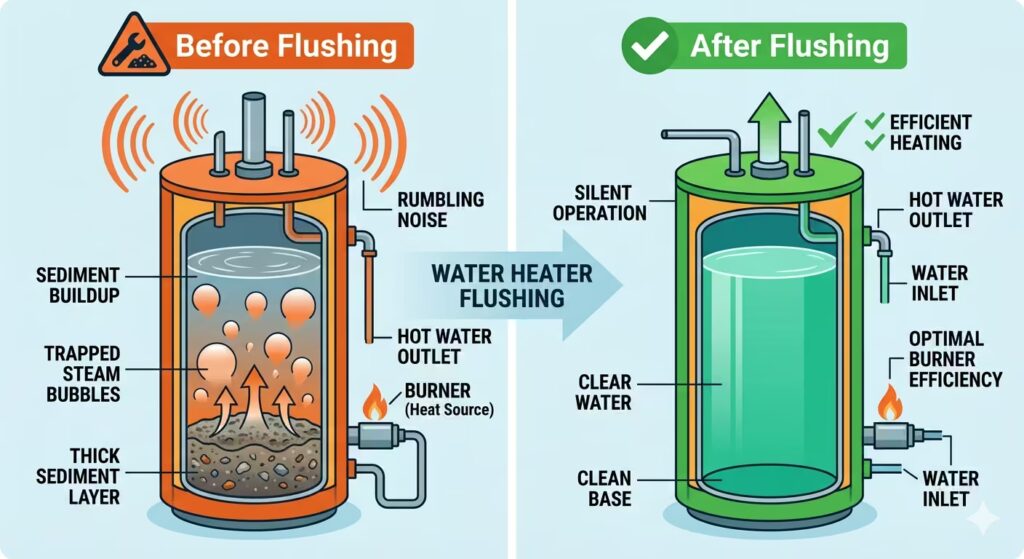
When the heating element or gas burner heats the tank, water trapped beneath the sediment layer turns to steam. As those steam bubbles push their way through the sediment, they create the popping and rumbling sounds you hear.
How serious is it?
Popping and rumbling do not mean the unit is about to fail. However, the sediment causing the noise is also reducing efficiency and accelerating internal corrosion.
Left unaddressed, heavy sediment buildup shortens the tank’s life and increases your energy bills. The noise is a useful early warning that the tank is overdue for maintenance.
What to do
Flush the tank. Draining and flushing removes the sediment layer and should eliminate the noise entirely if the buildup is not too severe.
If the noise returns quickly after flushing, or if flushing produces very little sediment despite the noise, the issue may be internal corrosion rather than loose sediment. That warrants a closer inspection.
| RELATED: How to Flush a Water Heater |
|---|
| Flushing is the direct fix for popping and rumbling caused by sediment. Read our complete step-by-step guide to doing it yourself safely in under an hour. |
Banging or Knocking: Water Hammer
A loud bang or knock that occurs when a tap is turned off sharply is called water hammer. It is not a problem with the water heater itself, but with the plumbing system connected to it.
Water hammer happens when fast-moving water is stopped abruptly. The sudden pressure surge sends a shockwave through the pipes, producing the banging sound.
Over time, repeated water hammer can stress pipe joints and fittings. It is worth fixing even if the sound is not currently causing visible damage.
What to do
The most effective solution is installing water hammer arrestors on the supply lines near the water heater or at the fixtures causing the problem. These devices absorb the pressure surge before it reaches the pipes.
Water hammer arrestors are inexpensive and available at any hardware store. A confident DIY homeowner can install them without calling a plumber.
Hissing: Check for a Leak
A hissing sound coming from a water heater almost always indicates water escaping under pressure somewhere. This needs immediate attention.
The most common sources of hissing on a water heater are a partially open pressure relief valve, a leaking inlet or outlet fitting, or a weeping drain valve.
How to locate the source
- Run your hand carefully near the pressure relief valve — feel for moisture or hear whether the hiss is loudest there
- Check the inlet and outlet pipe connections at the top of the unit for drips or moisture
- Inspect the drain valve at the base for any seeping water
- Check the floor around the base of the unit for pooling water
| IMPORTANT: A hissing pressure relief valve needs prompt attention |
|---|
| The pressure relief valve is a safety device. If it hisses or discharges repeatedly, the tank may be over-pressurised or overheating. Do not ignore this. Call a plumber the same day. |
Ticking or Tapping: Usually Nothing to Worry About
A gentle ticking or tapping sound is one of the most common and least serious water heater noises. It is typically caused by the pipes expanding and contracting as hot water flows through them.
Metal pipes expand slightly when heated and contract as they cool. Where a pipe passes through a wall bracket or sits against a surface, that movement creates a ticking sound.
This is completely normal behavior and does not require any action. If the ticking is very loud or rhythmic in a way that concerns you, check that all pipe clips and brackets are secure.
Screeching or Whining: Check Your Valves
A high-pitched screeching or whining sound from a water heater is usually caused by water being forced through a partially closed valve.
Check the cold water inlet valve at the top of the unit first. If it is not fully open, water rushing through the narrow opening produces a whistling or screeching noise.
Open the valve fully by turning it counterclockwise until it stops. The noise should stop immediately if the valve is the cause.
If the screeching continues after the inlet valve is fully open, check any other shut-off valves on the supply lines. A partially closed valve anywhere in the line can produce this sound.
Crackling or Sizzling: Electric Heater Specific
A crackling or sizzling sound from an electric water heater usually points to scale buildup on one of the heating elements.
Hard water minerals accumulate on the surface of electric heating elements over time. When the element heats up, the moisture trapped in the scale layer boils and crackles.
This is similar in nature to the sediment problem in gas heaters, but affects the element directly rather than the tank floor.
What to do
Descaling the heating element can resolve the crackling in mild cases. This involves removing the element and soaking it in a descaling solution.
If the element is heavily scaled or the crackling is accompanied by reduced hot water output, replacing the element is the more reliable fix. It is a relatively straightforward plumbing task that costs between $20 and $80 for the part.
When to Call a Plumber
Many water heater noises are DIY-manageable. A few are not.
| Situation | Recommended Action |
| Popping or rumbling, unit under 8 years old | DIY flush the tank |
| Popping persists after flushing | Call a plumber for inspection |
| Any noise plus water pooling at the base | Hissing from the pressure relief valve |
| Any noise plus water pooling at base | Call a plumber immediately |
| Any noise plus rusty or discoloured water | Call a plumber for assessment |
| Unit over 10 years old with any new noise | Assess for replacement |
| RELATED: How to Tell If Your Water Heater Is Failing |
|---|
| Noises are one of seven warning signs that a unit may be heading toward failure. Read our guide to see what else to watch for and when replacement becomes the smarter choice. |
Frequently Asked Questions
Is it safe to keep using a water heater that is making noise?
For popping, rumbling, ticking, and crackling sounds, continued use is generally safe in the short term. These noises indicate maintenance is needed, not immediate danger.
Hissing is the exception. If the noise is coming from the pressure relief valve or a fitting under pressure, stop using the unit and call a plumber before continuing.
My heater just started making noise after years of silence. Why now?
Sediment accumulates gradually. The noise often appears suddenly when the buildup reaches a threshold at which it begins to trap significant amounts of water under the heat source.
It also commonly appears after a period of higher-than-usual water use, or after a change in your water supply that increases mineral content.
Will flushing definitely stop the popping noise?
In most cases, yes. If sediment is the cause, a thorough flush removes the material creating the noise, and the sound stops.
If the popping returns within a few months of flushing, your water has very high mineral content. Consider installing a water softener or setting a more frequent flushing schedule.
My gas water heater rumbles only when heating. Is that different?
No — this is the classic sediment symptom. The rumbling occurs specifically when the burner is active, because that is when water is forced through the sediment layer.
Flush the tank. If the unit is old and the rumbling is loud, have a plumber assess the extent of sediment buildup and the condition of the tank lining simultaneously.
Can a noisy water heater cause higher energy bills?
Yes. The sediment causing the noise also acts as insulation between the heat source and the water. The unit runs longer cycles to reach temperature, which shows up as higher gas or electricity usage.
Flushing the tank removes this inefficiency. Most homeowners notice a modest but measurable improvement in energy bills after a first flush on a long-neglected heater.
Your Water Heater Is Talking — Listen to What It Is Saying
A noisy water heater is rarely a cause for immediate panic, but it is always worth paying attention to.
Popping and rumbling are the most common sounds, and the fix — flushing the tank — is something most homeowners can handle in an afternoon. Hissing and persistent banging deserve faster action.
Catch these sounds early, respond with the right fix, and your water heater will run quietly and efficiently for years longer than one that gets ignored.