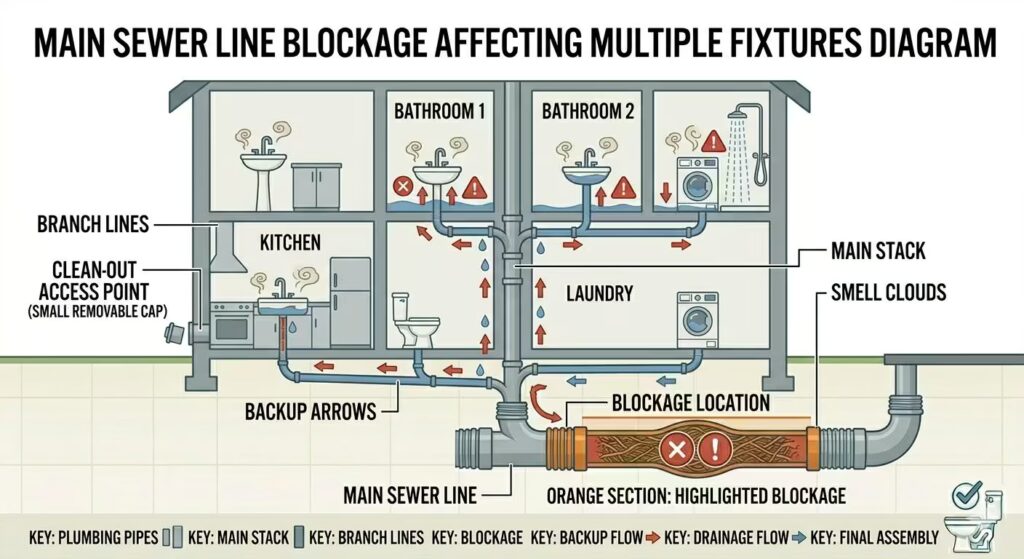
Most drain problems affect one fixture at a time. A slow kitchen sink is a sign of a kitchen drain problem. A blocked toilet is a toilet problem. When multiple drains in your home slow down or back up at the same time, the problem is somewhere else entirely.
A main sewer line clog sits in the single pipe that all your home’s drains feed into. When that pipe is blocked, every fixture connected to it is affected — and no amount of plunging individual drains will fix it.
This guide explains how to identify a main line clog with certainty, what typically causes it, what you can and cannot do yourself, and how to get it resolved before it turns into a sewage emergency.
Is It Really a Main Sewer Line Clog?
Before calling a plumber for a main line job, confirm that the symptoms you are seeing are not a coincidence of two separate clogs. The distinction matters because the solution and cost are very different.
| What You Are Seeing | Main Line Clog? | Alternative Explanation |
| Multiple drains slow at the same time | Likely | Coincidence of separate clogs — possible but unlikely |
| Localized clog in that drain only | Very likely | Shared vent pipe issue |
| Water backs up into the tub when the toilet is flushed | Almost certain | Nothing else causes this |
| Sewage smell from multiple drains | Likely | Multiple dry P-traps — check first |
| Raw sewage is backing up into the lowest fixture | Confirmed emergency | Nothing else |
| Only one drain is slow | No | Localised clog in that drain only |
The bathtub test
If you are unsure whether you have a main line problem or multiple separate clogs, this simple test confirms it. Flush the toilet and immediately watch the bathtub or shower drain.
If water rises in the tub or shower drain when the toilet is flushed, the main sewer line is blocked. Water from the toilet flush has nowhere to go but back up through the next lowest opening, which is the tub drain.
This is the clearest single indicator of a main sewer line blockage. If you see this, stop using water and call a plumber.
| Stop using water immediately if sewage is backing up |
|---|
| Every flush, tap, and appliance you run sends more water into a system that has nowhere to drain. Stop all water use in the house the moment sewage starts entering your living space. Call a licensed plumber for same-day service. |
The Warning Signs of a Main Sewer Line Clog
A mainline blockage rarely progresses from normal to emergency without warning. Most develop over days or weeks with progressive symptoms.
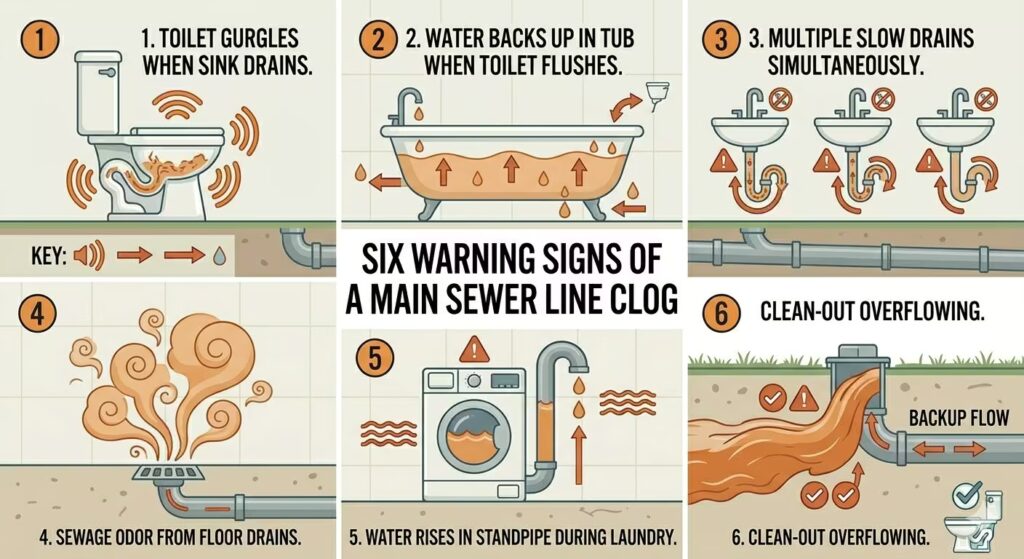
Gurgling sounds from fixtures you are not using
When water drains through a partial blockage, it displaces air in the pipe. That air finds the nearest escape route — which is usually another fixture’s drain. A toilet that gurgles when you run the kitchen sink is sharing a drain line that is struggling to move water past a restriction.
Water is backing up in unexpected places
The lowest fixture in the house — usually a ground-floor or basement toilet, bathtub, or floor drain — will be the first to receive backed-up water. If flushing an upstairs toilet causes the downstairs tub to fill, the blockage is in the main line between those fixtures and the street.
Multiple slow drains on the same day
Individual drains clog independently and randomly. If your kitchen sink, bathroom sink, and shower all slow down on the same day without any obvious cause, the problem is almost certainly shared, meaning the main line.
Sewage smell from floor drains or multiple drains
A single smelly drain is usually a dry P-trap or a localized clog. A sewage smell coming from multiple drains or floor drains simultaneously points to a main line problem that is pushing gases back into the house.
| RELATED: Why Does My Drain Smell? |
|---|
| Before assuming a main line problem, rule out dry P-traps as the odor source. Read our guide to identifying drain smells by location and the quick fixes for each. |
Water rises in the washing machine standpipe during a laundry cycle
The washing machine standpipe connects directly to the drain system. During a wash cycle, the machine pumps a large volume of water quickly. If the main line is partially blocked, that water backs up into the standpipe rather than draining away cleanly.
The outdoor clean-out cap is overflowing or wet
Your home has a sewer clean-out — a capped pipe usually located outside the house or in the basement that provides direct access to the main sewer line. If the cap is wet, has sewage around it, or is popped off, the main line is either full or actively overflowing.
What Causes a Main Sewer Line Clog?
Understanding the cause helps you know what to expect from the repair and how to prevent a recurrence.
Accumulated grease, wipes, and debris
The most common cause of a main sewer line clog is a gradual accumulation of grease, flushed wipes, paper towels, and other non-biodegradable materials that have built up over months or years.
Grease coats the inside of the pipe and catches other debris. Over time, this layer thickens until it restricts and eventually blocks flow. This type of clog is very common in homes where cooking grease is regularly poured down the kitchen drain.
| RELATED: How to Unclog a Drain Without Chemicals |
|---|
| Individual drain clogs from grease and debris are the starting point before they reach the main line. Read our guide on clearing them early before they contribute to a larger blockage. |
Tree root intrusion
Tree roots enter sewer pipes through cracks, loose joints, and the small gaps around pipe connections. Once inside, they grow rapidly and can fill a pipe completely within a season.
Root intrusion is particularly common in older homes where the sewer line is made of clay or concrete, which can develop cracks as they age and settle. Homes with large trees near the sewer line path are at higher risk.
Pipe collapse or offset
Older pipes made of clay, cast iron, or Orangeburg — a fiber composite used from the 1940s to the 1970s — deteriorate over time. They can collapse, crack, or shift out of alignment, creating a physical restriction that no amount of cleaning will permanently fix.
A collapsed or significantly offset pipe requires pipe replacement, not just clearing. A camera inspection is the only reliable way to identify this as the cause.
Flushed items that should not be flushed
Wet wipes, paper towels, dental floss, feminine hygiene products, and cotton items do not break down in water. They travel through individual drain pipes but accumulate at bends and restrictions in the main line, forming dense clogs that grow over time.
Scale and mineral buildup in older pipes
In homes with hard water and cast-iron sewer pipes, mineral scale accumulates on the inside of the pipes over decades. This buildup gradually reduces the effective diameter of the pipe and creates rough surfaces that catch debris. A pipe that was four inches in diameter can effectively function as two inches after years of scale buildup.
What You Can Try Before the Plumber Arrives
A full blockage in the main sewer line requires professional equipment to clear. There is, however, one legitimate DIY step that can sometimes relieve pressure while you wait for a plumber.
Locate and open the sewer clean-out
The sewer clean-out is a capped pipe that gives direct access to the main line. Opening it relieves the blockage and gives the plumber immediate access without having to work through individual fixtures.
- Find the clean-out — it is usually a white or black-capped pipe, roughly four inches in diameter, located outside near the foundation, in the basement, or under a ground-floor toilet.
- Place old towels or a bucket around the base before opening it. If the line is backed up, some sewage may discharge when the cap is removed.
- Use a pipe wrench to slowly unscrew the cap counterclockwise. Stand back and to the side as you open it.
- Once open, do not run any water or flush any toilets. The open clean-out is not a fix — it simply releases the pressure.
- Leave the cap off until the plumber arrives. This gives them direct access to the line.
| Do not attempt to snake the main line yourself without the right equipment |
|---|
| A main sewer line typically requires a powered drain auger with a cable of at least 75 to 100 feet. Standard hand-held drain snakes are too short and too light to reach or clear a main line blockage. Using the wrong equipment can push the clog deeper or damage older pipes. |
What a Plumber Does to Clear a Main Sewer Line
Knowing what to expect helps you ask the right questions and understand the service you are being charged for.
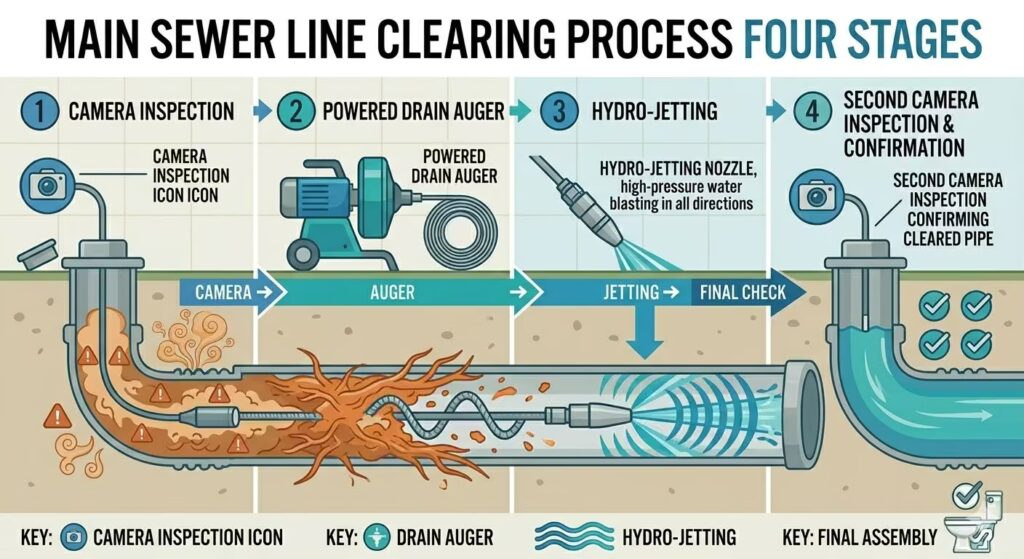
Camera inspection
Most plumbers begin with a camera inspection — a flexible cable with a small camera is fed into the clean-out to identify the exact location, nature, and severity of the blockage. This tells them whether it is a soft clog, root intrusion, or a structural pipe problem.
A camera inspection is worth paying for. It prevents guesswork and ensures the right treatment is applied. Ask for one if it is not offered automatically.
Mechanical augering
A powered drain auger feeds a heavy-duty rotating cable into the main line. The cutting head at the end breaks up soft clogs and cuts through root masses. The debris is either pulled back out or broken into small pieces that flush through the system.
Augering clears the immediate blockage but does not clean the pipe walls. Grease coating and soft buildup remain after augering and will accumulate again over time.
Hydro-jetting
Hydro-jetting uses a high-pressure water stream — typically 3,000 to 4,000 PSI — to scour the inside of the pipe in all directions simultaneously. It removes grease coating, mineral scale, and root stubs that augering leaves behind.
Hydro-jetting is more thorough than augering, and the results last significantly longer. It is the better choice for pipes with a history of recurring clogs or significant grease buildup. It is also more expensive.
Note: Hydro-jetting should not be used on severely deteriorated or fragile pipes — the pressure can cause further damage. This is why camera inspection should always come first.
Pipe repair or replacement
If the camera inspection reveals a collapsed section, severe offset, or deteriorated pipe, clearing the blockage is only a temporary fix. The damaged section needs to be repaired or replaced.
Modern pipe relining technology allows some damaged sections to be repaired without excavation by inserting a resin-coated liner that hardens into a smooth new pipe surface inside the old one. This is called cured-in-place pipe (CIPP) lining and is significantly less disruptive than traditional dig-and-replace methods.
What Does Main Sewer Line Clearing Cost?
Costs vary by location, access difficulty, and the job’s requirements. These are general US ranges to help you understand what you are being quoted.
| Service | Typical Cost Range |
| Camera inspection only | $150 to $350 |
| Mechanical augering | $150 to $500 |
| Hydro-jetting | $350 to $900 |
| Camera plus augering (combined) | $250 to $650 |
| Emergency same-day service premium | Add $100 to $300 to above |
| Pipe section relining (CIPP) | $75 to $250 per foot |
| Full sewer line replacement | $3,000 to $25,000+ |
Get at least two quotes for any job over $500. Sewer line work pricing varies significantly between plumbers, and the first quote is not always the most accurate.
Is the Blockage on Your Property or the City’s?
This is one of the first questions a plumber will try to answer — and it determines who pays for the repair.
The sewer line running from your house to the street is typically divided into two sections. The lateral — the section from your house to the property line or the main sewer — is usually the homeowner’s responsibility. The main municipal sewer line in the street is the city’s responsibility.
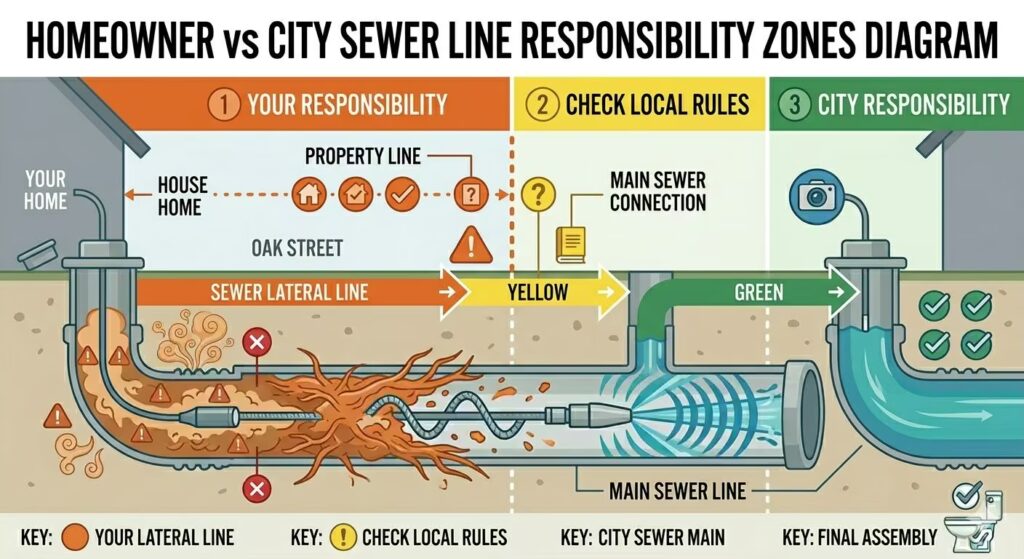
Before calling a plumber, contact your local municipality. If your neighbors are also experiencing drain problems at the same time, the blockage may be in the municipal main line — in which case, the city is responsible for clearing it at no cost to you.
If only your home is affected, the blockage is almost certainly on your lateral and is your responsibility.
How to Prevent Main Sewer Line Clogs
Most clogs in the main sewer line are preventable with consistent habits and occasional professional maintenance.
- Never pour grease, oil, or fat down any kitchen drain — pour into a sealed container and throw it in the bin
- Flush only human waste and toilet paper — wipes, paper towels, and hygiene products belong in the bin
- Have the sewer line camera-inspected every 5 to 7 years, especially in homes over 30 years old
- Schedule a hydro-jet cleaning every 3 to 5 years if you have a history of recurring clogs or heavy tree cover
- Know where your sewer clean-out is located before a problem happens
- If large trees are near your sewer line path, apply a foaming root killer annually as a preventive measure
| RELATED: How to Unclog a Toilet Without a Plunger |
|---|
| Individual toilet clogs are often the first sign that debris is accumulating in the drain system. Clearing them promptly prevents buildup from reaching the main line. Read our five-method guide. |
Frequently Asked Questions
Can I use chemical drain cleaners to clear a main sewer line?
No. Chemical drain cleaners are designed for individual fixture clogs near the drain opening. They cannot travel 50 to 100 feet to reach a main line blockage and will not dissolve tree roots or break up compacted debris at that scale.
Pouring large amounts of chemical cleaner into a blocked system can also damage older pipes and harm municipal water treatment systems. Use a plumber with the right equipment.
How long does it take to clear a main sewer line?
A straightforward clog cleared by augering typically takes one to two hours from arrival to completion. A job requiring camera inspection, hydro-jetting, and a post-treatment camera check can take three to four hours.
Jobs involving pipe repair or replacement are scheduled separately and can take a full day or multiple days, depending on the extent of the damage.
My main line clogs every year. Is that normal?
Recurring annual clogs are not normal — they indicate an underlying problem that clearing alone cannot fix. The most common causes of recurring main line clogs are tree roots that keep regrowing after cutting, a deteriorating pipe with rough interior surfaces that trap debris, or a persistent grease coating that never fully comes off.
A camera inspection during or after the next clearing will identify which of these is the cause and what the permanent fix needs to be.
Will homeowners’ insurance cover a clog in the main sewer line?
Standard homeowner’s insurance policies typically do not cover sewer line clearing as routine maintenance. Damage caused by a sewer backup — to floors, walls, or belongings — may be covered under a sewer backup endorsement if you have one.
Some insurers offer service line coverage as an add-on that covers the cost of repairing or replacing the lateral sewer line. Check your policy and ask your insurer specifically about service line and sewer backup coverage.
Can I rent a drain auger and clear the main line myself?
Powered drain augers are available for rental at most hardware stores. An experienced DIY homeowner can clear a soft main line clog with a rented machine if the clean-out is accessible.
The risks are significant: using the wrong cable size can damage older pipes, and working in sewage conditions without proper protective equipment is a genuine health hazard. If the clog is caused by roots or a structural issue, a rental auger will not solve it, and you will still need a plumber. For most homeowners, the cost of a professional service is worth the certainty.
One Pipe, One Problem — But It Affects Everything
A clog in the main sewer line is the one plumbing problem that takes the whole house down at once. The good news is that it is almost always fixable and almost always preventable.
Recognize the symptoms early, stop adding water to the system when backing up begins, open the clean-out to relieve pressure, and call a licensed plumber with camera and jetting equipment.
Once it is cleared, the habits that prevent it from recurring are simple: no grease down the drain, nothing non-biodegradable down the toilet, and a camera inspection every few years to stay ahead of root intrusion and pipe deterioration.