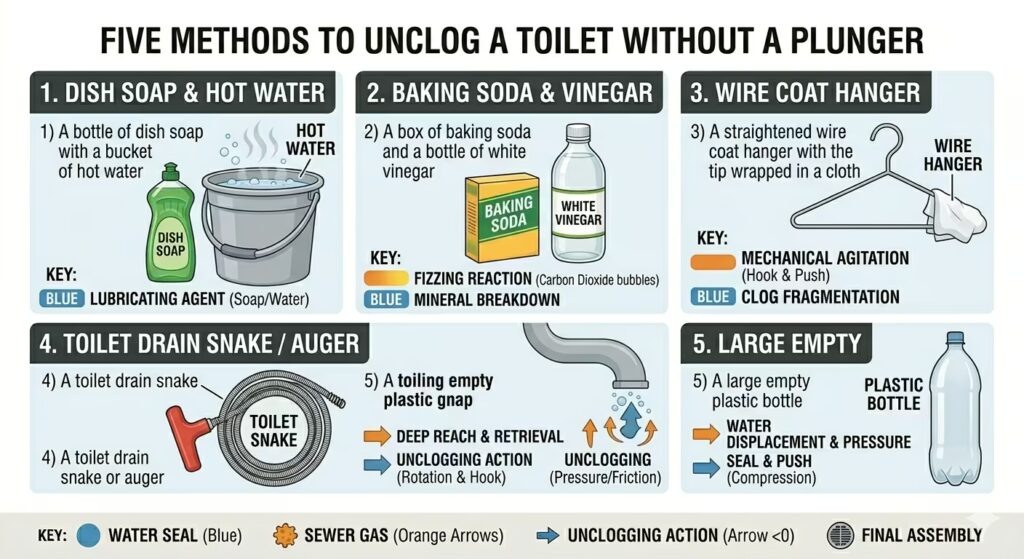
A blocked toilet and no plunger is one of those moments that demands a quick, practical solution. The good news is that most toilet clogs can be cleared with items you already have at home.
The five methods below work on the most common type of toilet clog — a soft blockage of organic waste and toilet paper sitting in or just past the trap. They are not for hard foreign objects, such as toys or sanitary products, which require a different approach.
Start with Method 1 and work through the list in order. Most clogs clear before you reach Method 4.
Before You Try Anything: Stop the Overflow Risk
The biggest risk with a blocked toilet is flushing it and causing an overflow. Before doing anything else, make sure you will not make the situation worse.
- Do not flush again if the bowl is already full or close to the rim. A second flush on a blocked toilet will overflow the bowl.
- If the bowl is very full, remove some water using a cup or small bucket before attempting any method. This gives you working room and reduces the risk of overflow.
- Keep a stack of old towels or newspapers on the floor around the toilet base as a precaution before you start.
| How to stop the toilet from refilling if you are worried about overflow |
|---|
| Lift the lid off the toilet tank and push the flapper down with your hand to stop water from flowing into the bowl. You can also turn the shut-off valve behind or beneath the toilet clockwise until it stops. This cuts the water supply to the toilet without affecting the rest of the house. |
Method 1: Dish Soap and Hot Water
This is the first method to try because it is the simplest and works for most soft toilet clogs. Dish soap lubricates the clog, and hot water softens and breaks it apart.
What you need
- Two to three tablespoons of liquid dish soap
- A bucket of hot water — hot from the tap, not boiling
How to do it
- Squirt two to three tablespoons of dish soap directly into the toilet bowl. Let it sit for five to ten minutes to work its way down toward the clog.
- While you wait, fill a bucket with the hottest water from your tap. Do not use boiling water — it can crack the porcelain of older toilets.
- Pour the hot water into the bowl from about waist height. Pouring from a height adds force and helps push the soap and water into the clog.
- Wait another few minutes. The heat softens the waste, and the soap lubricates the trap walls, helping the clog slide through.
- Flush to test. If the water drains normally, the clog has cleared. If not, repeat once more before moving to Method 2.
| Why does this work most of the time? |
|---|
| Most toilet clogs sit in the trap — the curved section of pipe at the base of the toilet. They are almost always made of toilet paper and organic waste, which softens and breaks apart quickly with heat and lubrication. |
Method 2: Baking Soda and Vinegar
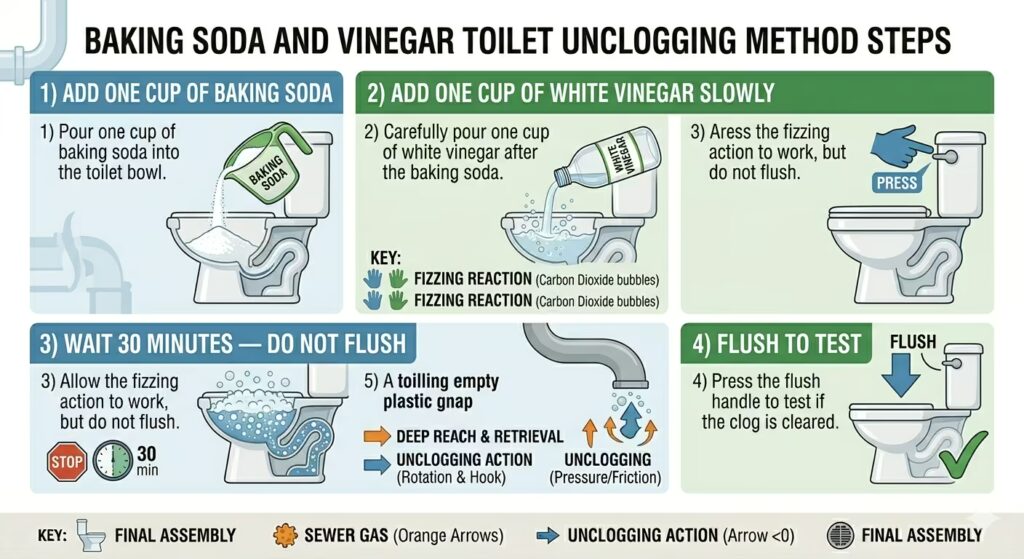
This combination creates a fizzing chemical reaction that can break up and dislodge soft organic clogs. It works more slowly than dish soap and hot water, but is effective on clogs that have not responded to Method 1.
What you need
- One cup of baking soda
- One cup of white vinegar
- Hot water from the tap
How to do it
- Pour one cup of baking soda directly into the toilet bowl.
- Slowly pour one cup of white vinegar into the bowl. Pour slowly — the reaction creates significant fizzing that can overflow a full bowl if poured too quickly.
- Let the mixture fizz and work for 20 to 30 minutes. Do not flush during this time.
- Pour a bucket of hot tap water into the bowl from waist height to add pressure.
- Flush to test. If the clog has cleared, the bowl will drain normally.
This method works best on clogs caused primarily by toilet paper. It is less effective on dense or compacted waste. If it does not work after two attempts, move to Method 3.
Method 3: A Wire Coat Hanger
When soap, water, and baking soda have not cleared the clog, it usually means the blockage is more solid or deeper in the trap. A straightened wire coat hanger acts as a makeshift drain snake and can physically break up or dislodge the clog.
What you need
- A wire coat hanger
- A small cloth or rubber glove to wrap the end
- Rubber gloves for your hands
How to do it
- Unwind the coat hanger until you have a long, mostly straight wire with a small hook at one end.
- Wrap the hook end in a small cloth or rubber glove, then secure it with tape or a rubber band. This protects the porcelain from scratching.
- Insert the wrapped end into the drain opening at the base of the bowl and push it into the trap while rotating gently.
- When you feel resistance, work the wire back and forth and in circles to break up the clog or hook into it.
- Pull the wire back slowly — if you have hooked the clog, it will come with it. Dispose of any material directly into a bin bag.
- Flush with hot water to clear any remaining debris.
| IMPORTANT: Do not scratch the porcelain |
|---|
| Always wrap the end of the wire before inserting it. A bare wire dragged against the toilet bowl leaves permanent scratches. If you do not have cloth or tape available, use a section of an old rubber glove stretched over the end instead. |
Method 4: A Plastic Bottle Pressure Flush
This method uses a large plastic bottle filled with warm water to generate a manual pressure flush directly into the drain. It mimics the action of a plunger by forcing a concentrated burst of water into the trap.
What you need
- A large plastic bottle of at least 1.5 litres — an empty drinks bottle works well
- Rubber gloves
- Warm water
How to do it
- Put on rubber gloves. Remove enough water from the bowl so it is not full to the rim.
- Fill the plastic bottle with warm water from the tap.
- Place your thumb over the bottle opening, then position it directly into the drain hole at the base of the bowl.
- Remove your thumb, then squeeze the bottle firmly and quickly, forcing the water into the drain in a concentrated burst.
- Repeat two to three times in quick succession to build pressure in the trap.
- Flush to test whether the clog has shifted.
This method is most effective on clogs sitting right at or just past the trap opening. It works by using concentrated water pressure rather than physical force or chemical action.
Method 5: A Toilet Drain Snake or Auger
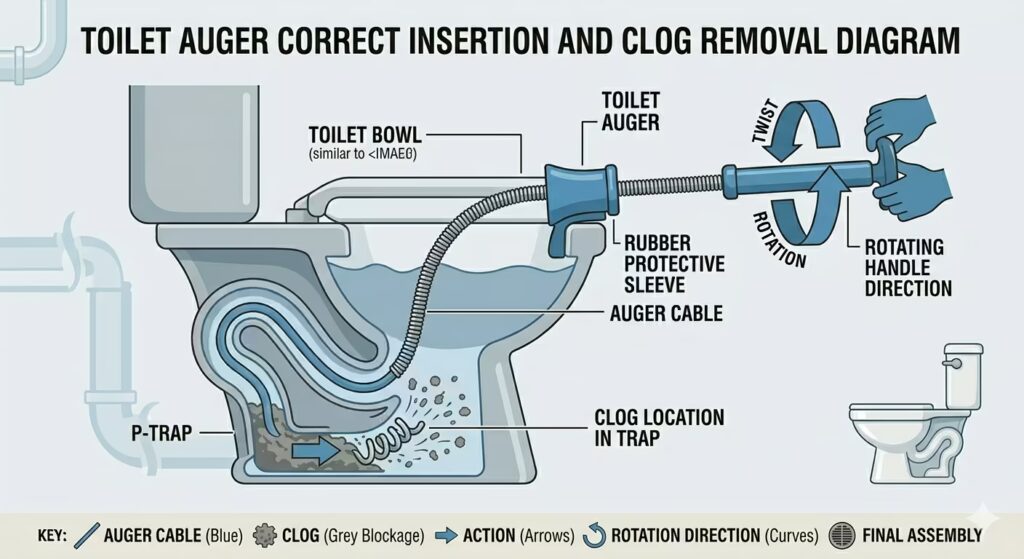
A toilet auger — also called a closet auger — is a tool specifically designed to clear toilet clogs. It is different from a standard drain snake in that it has a protective rubber sleeve that prevents damage to the porcelain bowl.
If you do not own one and the clog has resisted all previous methods, a toilet auger is inexpensive and available at any hardware store. It is the most reliable tool for clearing a stubborn toilet clog without a plunger.
What you need
- A toilet auger or closet auger
- Rubber gloves
How to do it
- Insert the rubber-sleeved end of the auger into the toilet bowl drain opening.
- Rotate the handle clockwise while pushing the cable forward through the trap.
- When you feel resistance, continue rotating to break up the clog or hook into it.
- Pull the cable back slowly. If the clog has been hooked, it will come with it.
- Run hot water into the bowl and flush to clear any remaining debris.
| RELATED: Drain Snake vs Plunger — Which Should You Use? |
|---|
| A toilet auger is a type of drain snake. Read our comparison guide on when each tool works best and which one is worth keeping at home for different types of drain and toilet clogs. |
What Not to Use on a Blocked Toilet
A few approaches are commonly suggested but should be avoided. They either cause damage, worsen the blockage, or are simply ineffective.
| What to Avoid | Why |
| Chemical drain cleaners | Not designed for toilet traps and can damage the wax ring seal and older porcelain. Ineffective on solid clogs. |
| Boiling water | Can crack older porcelain toilet bowls. Use hot tap water only. |
| Flushing repeatedly | Each flush adds water to a blocked bowl, increasing the risk of overflow. Never flush more than once when blocked. |
| Bleach | Does not break up physical clogs and introduces harsh chemicals with no benefit for blockage removal. |
| Bare wire without protection | Scratches and permanently damages the porcelain bowl. Always wrap the end. |
When to Stop and Call a Plumber
The five methods above handle the vast majority of toilet clogs caused by waste and toilet paper. There are situations where a plumber is the right call.
- A hard foreign object — a toy, a phone, a large piece of soap — has been flushed and is physically lodged in the trap. Manual methods will not shift it and may push it deeper.
- The toilet has been clogged for more than 24 hours, and nothing has worked. The blockage may be deeper in the drain line than a trap-level fix can reach.
- Multiple toilets or drains are slow or blocked simultaneously, indicating a main sewer line problem rather than a single toilet clog.
- Water is coming up in other drains when you attempt to flush. This is a clear sign of a mainline blockage.
| RELATED: Main Sewer Line Clog — Signs, Causes, and What to Do |
|---|
| When more than one fixture is affected, the problem is not in the toilet itself. Read our guide on identifying and addressing a main sewer line blockage before it becomes an emergency. |
How to Prevent Future Toilet Clogs
Most toilet clogs are caused by the same things: too much toilet paper at once, flushing non-flushable items, or a partial clog that builds up over time. A few habits eliminate the most common causes entirely.
- Use single-ply or septic-safe toilet paper that dissolves faster. Thick multi-ply paper takes significantly longer to break down and clogs more easily.
- Never flush wipes — including those labeled flushable. They do not dissolve and are one of the leading causes of toilet clogs worldwide.
- Flush in stages if using a large amount of toilet paper rather than all at once.
- Keep a bin in every bathroom for non-flushable items. Cotton balls, dental floss, cotton swabs, and hygiene products belong in the bin, not the toilet.
- If the toilet clogs frequently, the issue may be a low-flow toilet struggling with volume or a partial buildup in the trap. A plumber can assess this in a single visit.
| RELATED: How to Fix a Running Toilet |
|---|
| A toilet that runs constantly is a separate but equally common problem. Read our guide in the Toilets and Fixtures category for a step-by-step fix that takes less than 30 minutes. |
Frequently Asked Questions
Will a toilet unclog itself overnight?
Sometimes, yes. A soft clog made of toilet paper and organic waste can dissolve on its own if left for several hours. The water in the bowl softens the material, and it eventually passes through.
This only works for soft clogs. A clog involving a foreign object or compacted material will not resolve without intervention.
How do I know if the clog is in the toilet or further down the line?
If only the toilet is affected and other drains in the house are working normally, the clog is almost certainly in the toilet trap itself. The methods in this guide will reach it.
If other drains are also slow or backing up, the clog is in the main drain line, and a plumber is needed. The methods above will not reach a mainline blockage.
Is it safe to leave a blocked toilet overnight?
If the water level is stable and not rising, leaving it overnight is safe as long as no one flushes it. The standing water may help soften a soft clog naturally.
If the water is near the rim, the toilet has overflowed, or a sewage smell is present throughout the house, do not leave it unattended. Address it immediately or call an emergency plumber.
Can too much toilet paper really clog a toilet?
Yes, particularly in older toilets or low-flow models. A large amount of toilet paper flushed at once can exceed what the trap can pass in a single flush and accumulate into a blockage.
Flushing in two stages — once to clear the initial waste and again for the paper — prevents this in toilets that clog regularly from paper alone.
What is the toilet trap, and where is it?
The trap is the curved S-shaped or P-shaped section of pipe built into the base of the toilet. It holds a small amount of water at all times to block sewer gases from entering the bathroom.
Most toilet clogs occur at this curve, which is why the methods in this guide — all of which push or dissolve material at close range — are effective for most blockages.
Blocked Toilet, No Plunger, No Problem
A clogged toilet without a plunger is frustrating but rarely a crisis. Dish soap and hot water clear most soft clogs in under 15 minutes. A wire hanger or a plastic bottle handle what soap alone cannot.
Work through the methods in order, stay calm, and avoid flushing repeatedly. Most toilet clogs resolve well before you reach Method 5.
Once the toilet is clear, keep a proper plunger and a toilet auger in a place that’s easy to access in your home. They are the two tools that handle virtually every toilet blockage faster and more reliably than any improvised method.